DPP Illustration: Chen Xia/GT
During a recent provocative visit to Europe, Taiwan island's deputy regional leader Hsiao Bi-khim claimed Taiwan must "do the right thing and stand on the right side of history."
The line sounds righteous and is easy to win applause. But history is not decided by slogans, and people do not judge only by political poses. The real question is this: What choice can keep Taiwan island away from war, let people live in peace, and give compatriots on both sides of the Straits a future they can plan for? Is it to uphold the one-China principle, oppose outside interference, and promote peaceful development across the Straits, so that Taiwan region can enjoy lasting stability? Or is it to keep pushing up confrontation in the name of "democracy," "freedom," and "international participation," pushing Taiwan region to the front line of great-power rivalry and even to the brink of war?
The answer concerns the well-being of compatriots in Taiwan island. It also concerns the direction of cross-Straits relations.
Su Chi, a former leader of Taiwan's Mainland Affairs Council, first put forward the "1992 Consensus" in 2000. In a recent commentary, he made a sharp judgment: After Taiwan region's "constitutional revision" in 1997, its "competitive democratic system" has degenerated into an "elected monarchy," with a serious imbalance of power. He then links this institutional judgment to Taiwan region's "nationalism", identity politics, and the political motive of "using democracy to win outside support."
1. Beware of 'democracy' becoming 'the emperor's new clothes'
Taiwan region has elections, party rivalry, and intense political combat. Many people therefore simply conclude that "Taiwan region has a well-developed democracy."
But what democracy really needs to prove is whether different voices can be heard equally, whether major policies can be fully debated, whether people's daily needs are truly answered, and whether people can live stable and decent lives.
If the executive is deeply shaped by political stance, if public debate is cut up by identity labels, and if smear campaigns, "red-baiting," and judicial tools are used to attack opponents and create a chilling effect, then public discussion steadily loses its rational base.
In that atmosphere, parties still compete, but the playing field can become distorted. People still vote, but the issues they face may be shaped by emotional mobilization and identity anxiety, while real livelihood needs are drowned out by political fighting.
That is what is most dangerous about the "emperor's new clothes" of democracy.
2. Identity politics is eating away institutional rationality
Su criticizes the growing political mobilization of "nationalism in Taiwan." In today's Taiwan region, political identity has already overtaken livelihood issues, and ideology has overtaken any real test of institutions. This is a reality that cannot be ignored.
When an election is framed as "choosing a country," politics easily turns extreme. Voters no longer mainly judge governing ability, economic results, or social management. They are pulled instead by labels of "us versus them," "loyalty," and "identity."
When political goals are described as lofty enough, institutional limits are easily treated as obstacles. When power is packaged as a necessary means to "defend Taiwan region," those who supervise power may instead be accused of "undermining unity."
What follows? Society can no longer discuss cross-Straits policy calmly. People's sense of insecurity is constantly amplified. Poor governance can be covered up by stories of external threat and ideology. Public resources that should go to jobs, housing, education, healthcare, and industry are poured instead into identity mobilization and narratives of confrontation.
What is damaged in the end is ordinary people's trust in institutions, social cohesion inside Taiwan, and Taiwan region's own room for development.
3. If 'democracy' is traded externally, who will set Taiwan island's price?
In recent years the DPP authorities have kept tying "democracy" to "international support," presenting Taiwan island as a so-called "front line of democracy." This probably can win some statements from some overseas politicians. But it also brings deeper strategic dependence.
Yet this can only amount to strategic support filled with calculations of interest.
Su notes that the US side has more than once mentioned about Taiwan region's semiconductor industry, using talk of high tariffs and industrial reshoring as pressure. The interest logic behind this is clear: In the eyes of some US politicians, Taiwan island's chip industry is a strategic resource that can be taxed, told to move, and rearranged.
That is the reality Taiwan's authorities must face. When Taiwan region is defined as one link in the chip supply chain, one card in geopolitical competition, and one front in containing China, its interests will inevitably be subordinated to the overall plans of outside powers. External politicians will adjust their Taiwan policy at any time, based on elections, employments, finance, industrial competition, and global strategy.
Treating outside intervention as a source of security is itself pushing Taiwan island into danger.
Taiwan region needs normal economic, cultural, and social exchanges, and it needs more room to develop. But Taiwan island's industrial lifeline, social security, and future choices cannot rest on a speech by foreign politicians, still less on a "security check" that can be revalued at any moment.
4. The right side of history belongs to peace and reunification
One fact cannot be avoided: Once war breaks out, it is always ordinary people who pay the highest price.
Foreign arms sales, foreign military deployments, and political promises cannot replace stable cross-Straits relations. Any country that puts military resources abroad is constrained by its own interests, domestic politics, fiscal capacity, and strategic priorities. Taiwan regional politicians who place island's security entirely on outside forces are taking an extremely high risk.
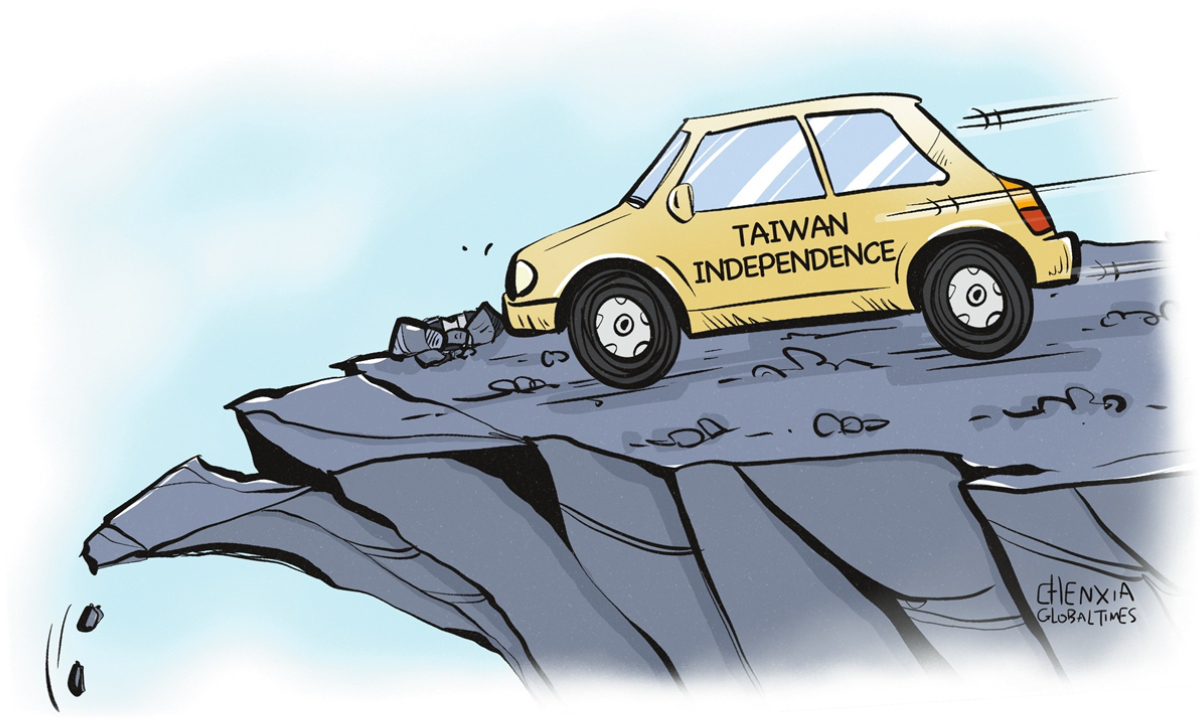
What Taiwan society should cherish most is a peaceful environment, industrial stability, family reunion, and a life in which people can plan for the future in a normal way. The more tense cross-Straits relations become, the higher the economic, social, and security costs Taiwan region must bear. The more "Taiwan independence" provocations there are, and the deeper outside interference goes, the larger the space for misjudgment and conflict.
The right side of history belongs to safeguarding national reunification, to opposing secession, to refusing to let Taiwan island become a chip in the hands of outside forces, and to making power subject to oversight, returning institutions to people's livelihoods, and making politics truly accountable to the people.
To strip away the "emperor's new clothes" of Taiwan island's democracy is to keep compatriots on the island from being manipulated by politics, used by outside forces, and pushed to the edge of war by the gamble of "Taiwan independence." Taiwan region's future lies in the great rejuvenation of the Chinese nation, and in the historical choice of Chinese people on both sides of the Straits to jointly oppose secession, jointly safeguard peace, and jointly move toward reunification.