Xi concludes India visit with five initiatives for greater BRICS co-op
Remarks provide practical substance for grouping’s next ‘golden decade’: experts
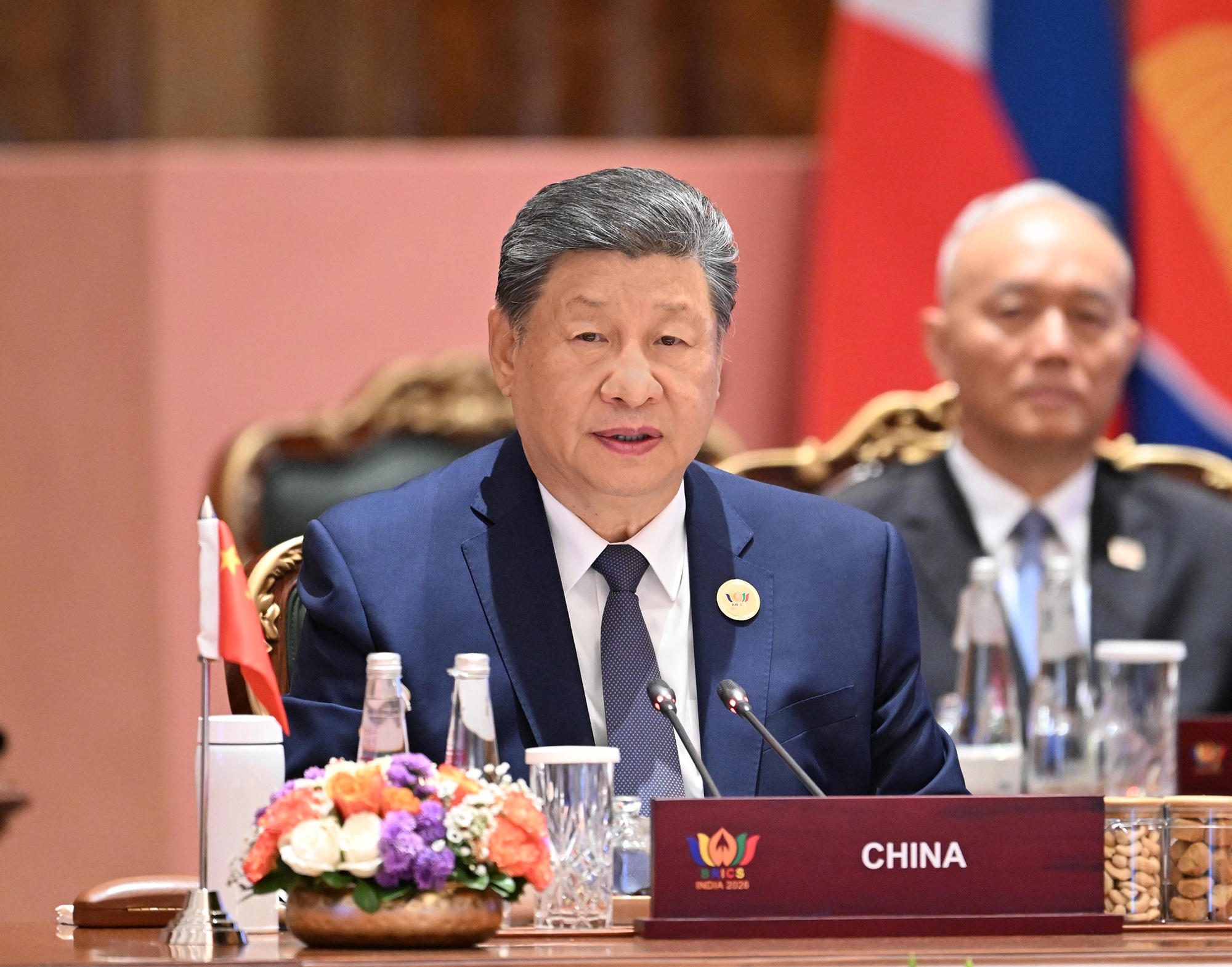
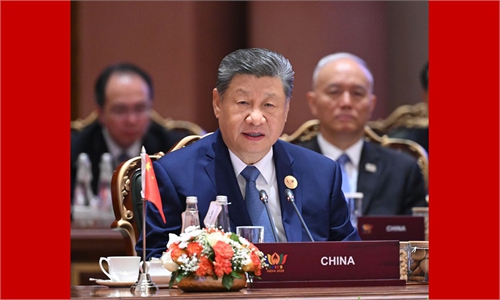
Chinese President Xi Jinping delivers a speech when attending the second day of the 18th BRICS Summit in New Delhi, India, on September 13, 2026. Photo: Xinhua
As journalists from across the Global South and beyond filled the media center some distance from the main BRICS summit venue, Bharat Mandapam, Chinese President Xi Jinping concluded his two-day visit to India on Sunday by proposing five initiatives to advance "greater BRICS" cooperation.
The initiatives, covering AI, trade and investment facilitation, digital industry, smart manufacturing and talent development, came as the 18th BRICS Summit marked the grouping's 20th anniversary and set the stage for China's chairmanship next year.
Global Times reporters visited the site where leaders had planted banyan trees - a quiet symbol that represents a shared future. In the media center, many Indian journalists showed keen interest in exchanges with their Chinese counterparts, reflecting the broader attention the summit drew to China-India relations.
"I think this BRICS summit was pretty successful, partly thanks to Xi's visit," Mohammed Saqib, founder and secretary general of the India China Economic and Cultural Council, told the Global Times. "The Chinese president's speech was inspiring... With China set to assume the [BRICS] chairmanship in 2027, there are expectations that it will bring his vision to life."
Xu Feibiao, a researcher at the China Institutes of Contemporary International Relations and director of the BRICS and G20 Research Center, told the Global Times on Sunday that the five initiatives form a tightly linked system designed to ensure Global South countries do not fall behind in emerging technologies and the new industrial revolution.
"If they fall behind in emerging technologies, AI and the new round of industrial revolution, then there is no talk of sustainable development for Global South countries," Xu said, adding that the initiatives address AI models, digital industries, talent cultivation, trade and investment in an interconnected way.
Practical cooperation
When attending the second day of BRICS summit in New Delhi, Xi stressed that "greater BRICS" must make greater impacts, achieve greater development and lay a solid foundation for practical cooperation, the Xinhua News Agency reported.
He also noted that "greater BRICS" should build innovation incubators, upgrade traditional industries, develop emerging industries and make forward-looking plans for future industries, so that emerging technologies can illuminate the path toward common prosperity, Xinhua reported.
According to Xu, the package is a comprehensive governance and mutual assistance framework. "Simply put, it takes talent as the foundation, technology as the engine, industry as the carrier, trade as the link, and inclusiveness as the underlying color," he said.
Experts noted that these five initiatives are more action-oriented, focused and in-depth, targeting the critical domain of the new industrial revolution where Global South countries most need empowerment.
Saqib told the Global Times that one of the most forward-looking aspects of the Chinese president's remarks was the focus on AI and innovation-driven development. By rallying BRICS around innovation, China aims to shift the grouping's focus to collective progress.
Foad Izadi, associate professor at the University of Tehran, welcomed the AI cooperation given China's leading position within BRICS. He also sees great value in trade and investment facilitation.
On the previous day, when addressing Session I at the BRICS summit, Xi proposed four pioneers for BRICS: striving to be a pioneer of the times, pioneer in advancing innovation-driven development, pioneer in facilitating mutual learning between civilizations, and pioneer in reforming and improving global governance.
Xu observed that the Saturday remarks provide the overarching framework for the next "golden decade," while the Sunday initiatives supply concrete, practical content. Together, they outline the direction for China's BRICS presidency in 2027.
The New Delhi summit produced more than 50 outcomes, across the four priority pillars of resilience, innovation, cooperation and sustainability. These ranged from the Strategy for BRICS Economic Partnership 2030 to practical initiatives such as the proposed BRICS Invoice Discounting Mechanism, according to the Times of India.
The gathering was successful in both carrying forward the BRICS legacy and charting its future course, Xu noted.
After 20 years of development, BRICS has become one of the most influential cooperation platforms of the Global South and stands in the front ranks as a pioneering force. This means BRICS has both the responsibility to stand up and promote world stability and development, and the strength and conditions to do so. It is also an opportunity, the expert noted.
Charting path
This year's summit marked Xi's first visit to India in seven years, drawing considerable attention. During several days of visits to think tanks, media outlets and conversations with ordinary people in New Delhi, Global Times reporters found that many Indians believe closer cooperation between the two countries better serves their development interests.
Kanika, 25, who has studied in China and is now a businesswoman, told the Global Times that she has visited China many times and regards it as "another hometown." Speaking of India hosting the summit, she said it was "a very good thing" that would improve relations and cooperation with other countries.
"I hope we stay together forever, like a family," Kanika said. "In the past we were like a family, so this is our family and we must protect it. Both of us are large countries with many businesses and many people. If our two countries cooperate more closely, both can develop better."
Shubhajit Roy, senior diplomatic editor with The Indian Express who previously covered the Shanghai Cooperation Organization summit in Tianjin, expressed interest in participating in next year's summit in China.
He noted that China possesses development experience different from the Western model and could showcase it during its upcoming BRICS presidency.
Izadi voiced similar views, pointing out that China's chairmanship next year carries significant weight, given that it is a founding member and the largest economy in the group, and that the continued growth of Chinese influence is positive for the wider international community.
When Global Times reporters walked to the green space in front of the main venue of the BRICS summit, rows of knee-high saplings had been carefully planted on the lawn. Dark-red tables stood before them, neatly displaying the flags of BRICS member states and golden water jugs. The small shovels and soil bags used by the leaders during the tree-planting ceremony remained on site. The Chinese sapling's branches and leaves still showed bright green, with traces of recent watering.
Standing before the quiet scene, Global Times reporters felt the shared vision of the BRICS countries - a commitment to continued cooperation oriented toward the future.
RELATED ARTICLES