China to remain among world’s most populous nations, rolling out measures to support childbearing during 15th Five-Year Plan period: NHC
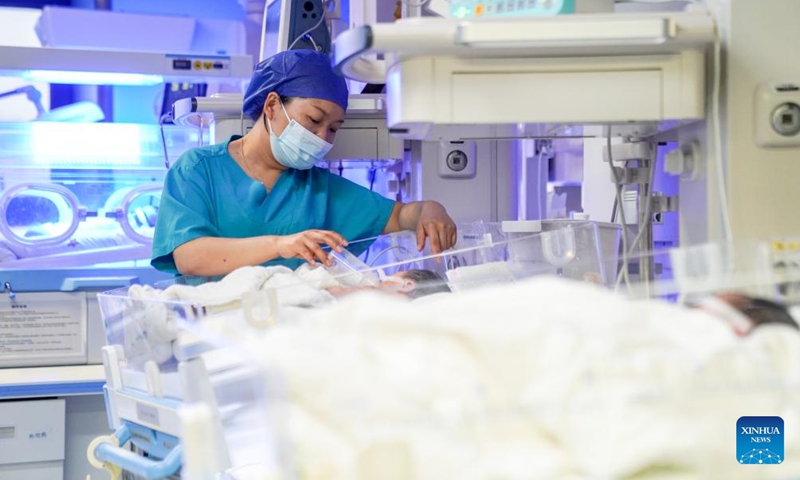
A nurse feeds a neonatal patient at the neonatology department of the First People's Hospital of Yunnan Province in Kunming, southwest China's Yunnan Province, May 10, 2026. As the neonatal nurses in the First People's Hospital of Yunnan Province, Yang Limei and her colleagues' routine work is to take care of the newborns suffering with critical illness like premature birth, asphyxia, congenital diseases or severe infections.
China will maintain its status as being among the world's most populous nations for a long time to come, health officials said Monday as the authorities roll out measures to strengthen its policy framework to support childbearing during the 15th Five-Year Plan period (2026-2030) as part of a broader strategy to foster high-quality population development.
Despite recording four consecutive years of negative population growth, Lei Haichao, director of the China's National Health Commission (NHC) emphasized at a State Council Information Office press conference on Monday that China's fundamental standing as a major populous nation remains unchanged.
With a population currently standing at 1.405 billion, China is expected to maintain its status among the world's most populous nations for a long time to come, Lei told reporters.
The health official pointed to the structural strengths of China's workforce, noting that higher education continues to expand rapidly. With more than 10 million students enrolling in colleges and universities each year, the nation maintains a robust supply of high-caliber talent to drive economic growth.
Addressing demographic shifts, Lei highlighted that while annual births have declined in recent years, new births remain steady at around 8 million annually—a figure matched by very few countries globally, ensuring a relatively abundant labor reserve for the foreseeable future.
To further ease financial pressure on young families, authorities plan to accelerate the creation of a birth-friendly social environment, which is one of priorities of China's 15th Five-Year Plan.
"The current birth support and population policies represent an active response to the new features of China's demographic development, such as negative growth and declining birth rates," Wang Peian, a former deputy director of the National Health and Family Planning Commission, told the Global Times.
Low fertility is a universal phenomenon following industrialization, urbanization, and the popularization of education - nearly two-thirds of the global population lives in countries with low fertility rates, spanning from Europe to East Asia - and is by no means unique to China, according to Wang.
"Although population size is important, it is not the sole index determining economic and social development. The structure and quality of the population, as well as the nation's capacity to effectively guide and respond to the changes, are more profound factors," Wang said.
According to Lei, building on the child care subsidies launched last year - which benefited over 30 million families by offsetting expenses for childbirth, rearing, and education - the government will focus heavily on expanding early childhood services over the next five years.
In detail, Lei mentioned that the initiative supports communities and employers in setting up child care service institutions, enabling residents to access nearby, convenient, and reasonably affordable child care services. Raising the enrollment rate for child care will effectively lower family costs related to childbirth, child-rearing, and education, the official said.
To make child-related health service more accessible, Lei said that 1,000 additional community health service centers and township health centers will offer pediatric medical services this year, building on last year's progress.
By the end of the year, over 95 percent of township health centers and community health service centers are expected to provide pediatric services. Additionally, 3,100 pediatricians have already been dispatched to primary-level healthcare institutions, the health official said at the press conference.
At the conference, Lei also noted that the health authorities is drafting the child care services Law, which has entered the deliberation process of the National People's Congress.
RELATED ARTICLES