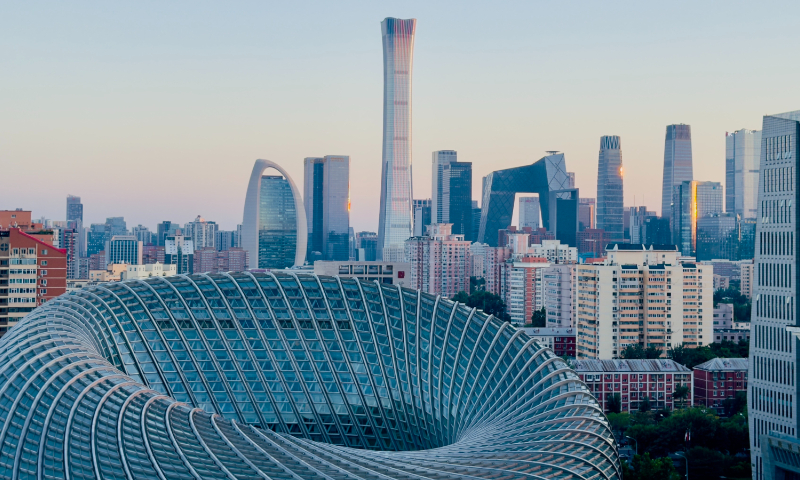
A distant view of Beijing's CBD on September 3, 2026 Photo: VCG
Reporter's Note:
A city's openness is measured not only by its skyline and industries, but by its respect and inclusiveness toward people.
For foreigners working, starting businesses, studying or living in Beijing, the city's warmth is felt most clearly through practical conveniences: simplified visa procedures that ease arrival, multilingual guides that make policies accessible, and platforms that connect international talent with Chinese partners. From daily services to innovation support, Beijing turns openness into tangible details, showing that the city offers both opportunity and genuine acceptance.
Good policies attract talent; a welcoming environment retains it. A true sense of belonging stems from shared values and cultural resonance. In incubators, co-working spaces and factories, foreigners and Chinese colleagues collaborate across design, entrepreneurship and engineering. This ancient capital becomes a space of mutual understanding that welcomes differences and supports dreams.
Beijing also serves as a window into China's broader opening-up. A growing number of overseas young people choose Beijing to chase their dreams - stories that reflect China's confident and inclusive approach.
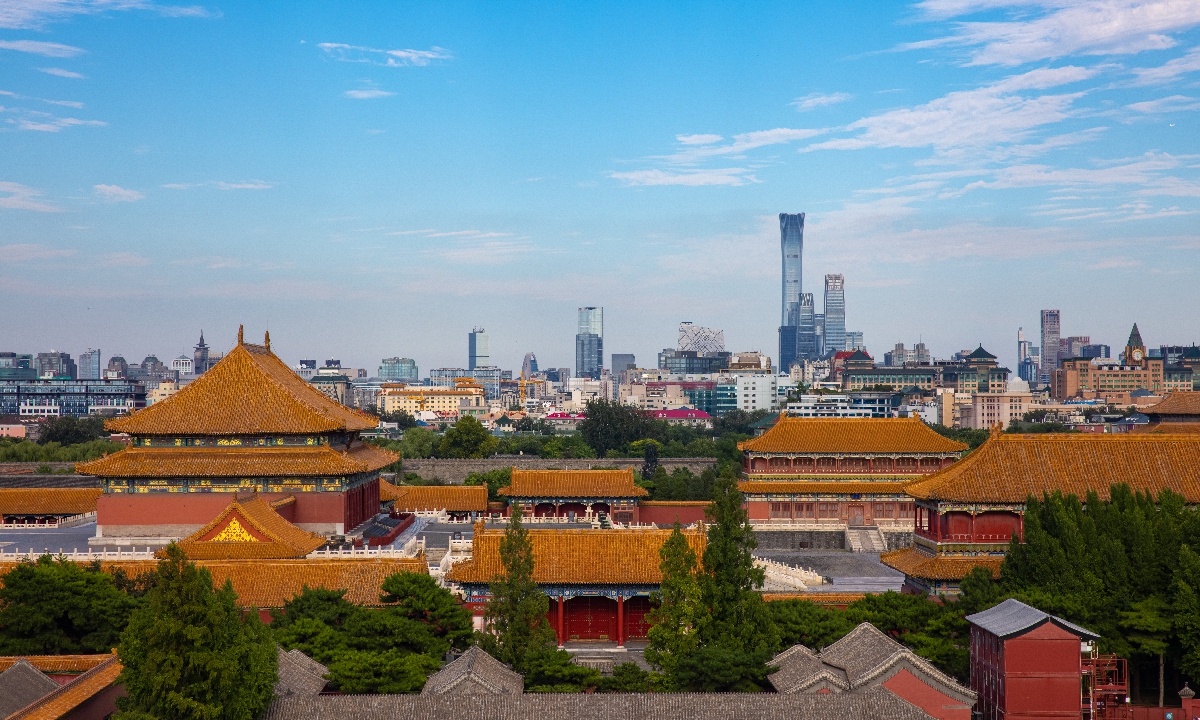
A view of the Forbidden City and the CBD area in Beijing. Photo: VCG
Autumn wraps Beijing in mild sunshine. At a Sanlitun café, a young American greets clients in fluent Putonghua. Inside a CBD office, an Afghan entrepreneur juggles a dozen WeChat groups across two mobile phones. In a coffee shop in Shunyi district, a South Korean creator maps out shooting routes for a Belt and Road-themed documentary.
These young people travelled thousands of miles away from home to launch businesses in China. What drew them here?
Thanks to China's expanding opening‑up drive and maturing innovation ecosystem, the country offers invaluable certainty and fresh opportunities for entrepreneurs across the globe. In interviews, seven young innovators from different nations shared their real‑life journeys of building ventures in Beijing.
Drawn by curiosity
Gavin Cooley came to China out of pure curiosity and now the 24‑year‑old American boasts more than three million followers on China's social‑media platforms.
Cooley first set foot in China at a summer language camp in 2016, and his curiosity about the country took hold. Every summer throughout high school, he travelled across the Pacific to study Chinese. When graduation arrived, he chose Peking University over top US universities for further education.
While studying in Beijing, a business idea began to form. "Things local Chinese take for granted often amaze foreigners," Cooley reflected. Lightning‑fast food delivery, ubiquitous mobile payments, high‑speed trains racing above 300 kilometers per hour - he realized these everyday stories would resonate with global audiences when told through foreign eyes.
That led him to start sharing real Chinese daily life from a foreign perspective. The unique positioning won him millions of followers. After graduation, he founded a cultural company, acting as a two-way bridge: helping Chinese brands expand overseas and guiding foreign brands to adapt to the Chinese market.
If curiosity brought Cooley to China, a timely phone call changed the course of Biman Najika Liyanage's life. Looking back, the Sri Lankan entrepreneur calls it his stroke of good fortune.
He enrolled at Beihang University in Beijing in 2009. Struggling to adapt to his new surroundings, he fell seriously ill shortly after arrival. Alone in hospital, he barely had enough money left for a flight home.
Timely encouragement from his professor changed his path. The professor encouraged Biman to join a university tech competition with the promise of a full tuition waiver for winners. Motivated by this support, Liyanage threw himself into research and coding. He developed sensor gloves to support communication for people with hearing and visual impairments and walked away with first prize.
He stayed in Beijing to launch his tech ventures, focusing on AI, healthcare and IoT technologies. His team's AI emotion detection project, which identifies anxiety and depression through voice features, has secured over $1.2 million in clinical research funding.
"In China, as long as you have a good idea and are willing to put in the effort, you can achieve success," Liyanage said from years of entrepreneurial experience.
Greater possibilities
German entrepreneur Jelte, who has lived in China for nearly two decades, has witnessed the continuous optimization of Beijing's business policies.
"Some Western media paint China as a hard‑to‑access market, but reality tells a different story," Jelte said. "Policies covering company registration, visa procedures and talent incentives keep improving, opening ever‑greater possibilities for overseas entrepreneurs," he said.
In 2019, he co-founded a tech company to build connections between global innovation projects and Chinese markets. His team helps overseas startups understand China's market rules and assists local institutions in recognizing the value of international projects.
Close to 30 foreign enterprises have established operations in China through their work, with 90 percent of recommended projects successfully taking root, ranging from Norwegian medical firms to Italian sensor developers.
Also in 2019, Brazilian entrepreneur Daniel registered his Beijing startup with just 6,000 yuan ($894.3) in seed capital. Riding on policies for expanded opening‑up in the service sector, the business grew rapidly.
"China and Brazil sit at different stages of technological development - and that gap creates plenty of room for collaboration," Daniel noted.
Daniel's company took off with educational robots - sourcing hardware from South China's Guangdong Province and localizing software to create cost-effective, technologically competitive solutions for Brazilian public schools, earning over $2 million a year.
The company has since expanded into smart agriculture and VR. Last year's revenue topped 50 million yuan, most of which was reinvested in R&D. Today Daniel advises Chinese firms and guides Brazilian clients through Chinese factories.
Feeling welcome
South Korean entrepreneur Kim Junbum has built his business in Beijing over the past 15 years and runs a tech company.
"A more practical policy framework is emerging for entrepreneurs, and foreign talent feels increasingly welcome," he observed.
The business later expanded into new-media production. Kim initially worried his foreign national status might hinder content creation and partnerships, but found that as long as operations stay compliant, Beijing actively encourages creative entrepreneurship.
"China's policies deliver tangible support rather than empty promises," he said. He is currently planning a documentary series themed around the Belt and Road Initiative to capture stories of connectivity between China and partner countries.
For Belgian Antoine Bruneel, China means speed. Arriving in Beijing in 2006, he's worked across media, motorsports and now the new energy industry, witnessing rapid transformation. Simplified visa procedures, more sectors opened to foreign investment and online business registration have made things easier for foreign founders.
"Twenty years on, I feel more and more of a bridge between markets, and I have seen priorities shift: two decades ago, European companies were coming to China; today, Chinese firms are looking toward Europe," he said.
In new-energy vehicles and related tech, Chinese firms have accumulated extensive expertise, while European businesses still have room to grow in China. The priority is now to find areas for complementary, long-term collaboration, he added.
Opening wider
At 6 am each day, Wahed Ahmadzai, an Afghan entrepreneur, heads out by taxi, munching a sandwich while managing multiple projects simultaneously across two phones.
After 12 years in Beijing, his core mission is straightforward: to guide international entrepreneurs on how to build companies in China from scratch.
Language barriers often prevent foreign founders from fully grasping local policies, even when support mechanisms exist. Fluent in seven languages, Ahmadzai translates official documents and offers policy interpretations.
Since 2021, his team has held hundreds of exchange activities, connected more than 5,000 international professionals, and helped over 50 foreign enterprises and projects establish themselves in Beijing. For Ahmadzai, Beijing is a global innovation platform where international talent can translate ideas into practical cross-border cooperation.
"China keeps opening wider to the world, and every corner holds potential," he noted.
These global innovators navigate Beijing's skyscraper-lined avenues and lively neighborhood streets. They are no mere visitors or onlookers, but core participants in China's innovation wave.
Their entrepreneurial experiences tell a simple truth: Choosing China means choosing future opportunities. Across Beijing and beyond, their stories continue to unfold, promising even more inspiring chapters ahead.
This was compiled and translated by the Global Times based on an article published by the People's Daily on September 8, 2026.
RELATED ARTICLES