Beijing Galeries Lafayette enters closure countdown, drawing surging shoppers; localization key for long-term growth in Chinese market: expert
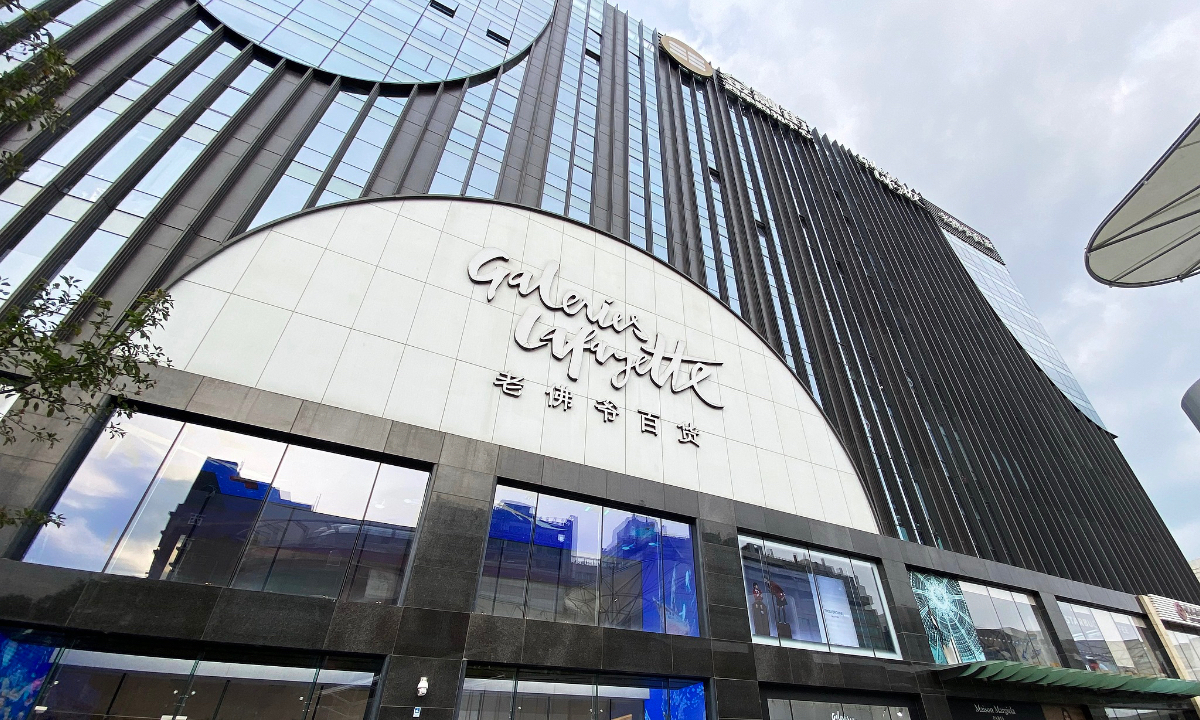
A view of Galeries Lafayette in Beijing's Xidan commercial district on May 21, 2026. The Paris-originated department store recently announced that its Beijing outlet will officially cease operations on May 27. Photo: VCG
With just days remaining before its scheduled closure on Wednesday, Beijing's Galeries Lafayette store has seen a surge of shoppers hunting for discounted goods, while many Chinese netizens have taken to social media to express nostalgia over the departure of what was once regarded as a landmark of the Chinese capital's luxury retail scene.
A Chinese expert said on Sunday that the closure reflects broader shifts in China's retail landscape rather than any so-called "withdrawal of foreign businesses from China," stressing that there is still vast growth potential in the Chinese market for foreign businesses that have successfully adapted to new market trends, as shown by many foreign brands that are expanding in the country.
Following the closure of its Beijing store, Galeries Lafayette will have only two remaining outlets in the Chinese mainland. However, Galeries Lafayette has clearly stated that it intends to retain a presence in the Chinese market, and is in talks with its local partners. It indicated that for the time being, there are no plans to close the much smaller Shanghai store covering 10,000 square meters and the Shenzhen store, extending over 3,500 square meters. These formats are better suited to the group's changing retail approach in China, according to the Fashion network.
Ye Yufei, a 26-year-old finance professional in Beijing, told the Global Times that she visited Galeries Lafayette on Friday mainly to "say goodbye" to a mall she regarded as iconic during her middle and high school years.
She said that there were not many luxury brands left in the store and discounts were not as steep as expected. The sunglasses section, however, remained relatively crowded, with more styles still available compared with other areas of the mall, Ye said.
Li, a Beijing white-collar worker in her 30s, told the Global Times that her last visit to Galeries Lafayette was around 2015, when the Xidan area was one of Beijing's most popular shopping destinations for young consumers. She recalled being particularly drawn to foreign designer brands such as Maje and Sandro, which were still relatively new and less accessible in China at the time.
"But later, many of these brands opened standalone stores and became easily available online, so the mall gradually lost some of its uniqueness," Li said. After seeing online posts about clearance discounts ahead of the store's closure, she said that she may visit once more before it shuts down. "What I remember most is actually the atmosphere. It was quieter and more relaxed than many other malls in Xidan, and the service felt comfortable without being overly attentive," she added.
Following news of the closure, many Chinese netizens took to social media to share nostalgic memories tied to the store. "Seeing the announcement was both surprising and emotional," one commenter wrote. "When I was interning in Beijing, I used nearly half of my internship salary to reward myself with something from Galeries Lafayette. I may not wear it often anymore, but it remains a cherished memory."
Another netizen described the store as "a place filled with memories of youth," while others recalled enjoying its quieter atmosphere and carefully curated multi-brand boutiques amid the bustle of Beijing's Xidan shopping district.
Some foreign retailers have struggled by copying overseas operating models too directly, with conservative strategies and slow decision-making that failed to keep pace with China's evolving consumer habits, growing guochao trends and highly digital retail ecosystem, experts said.
At the same time, luxury brands have gained greater bargaining power and increasingly shifted toward closing underperforming stores while focusing on flagship locations in core commercial districts, reducing their reliance on traditional foreign department stores, Liu Dingding, a veteran Chinese industry observer, told the Global Times.
Liu noted that localization has become essential for foreign companies seeking long-term success in China, citing KFC, Tesla and Sam's Club as examples of brands that have deeply adapted to Chinese consumer habits. "Many consumers today hardly even see them as foreign brands anymore," he said.
Using Sam's Club as an example, Liu noted that its success lies in combining global supply-chain advantages with operations tailored to Chinese family consumption habits. By contrast, Galeries Lafayette failed to sufficiently adapt its product selection, retail strategy and online presence to the Chinese market. "Localization is not a compromise, but a core competitiveness," Liu said.
Highlighting the vast growth potential in China for foreign brands, Sam's Club, the membership warehouse chain owned by Walmart, has continued expanding in China. In May, construction officially began on a new Sam's Club store in Tianjin, which is expected to become the company's largest outlet in North China and further strengthen its presence in the Beijing-Tianjin-Hebei region.
Liu noted that China has consistently remained open to foreign investment and maintained a fair and transparent business environment. Foreign brands that are able to deeply adapt to Chinese consumer habits, the country's digital retail ecosystem and local supply chains can still find significant room for growth in the Chinese market.
RELATED ARTICLES