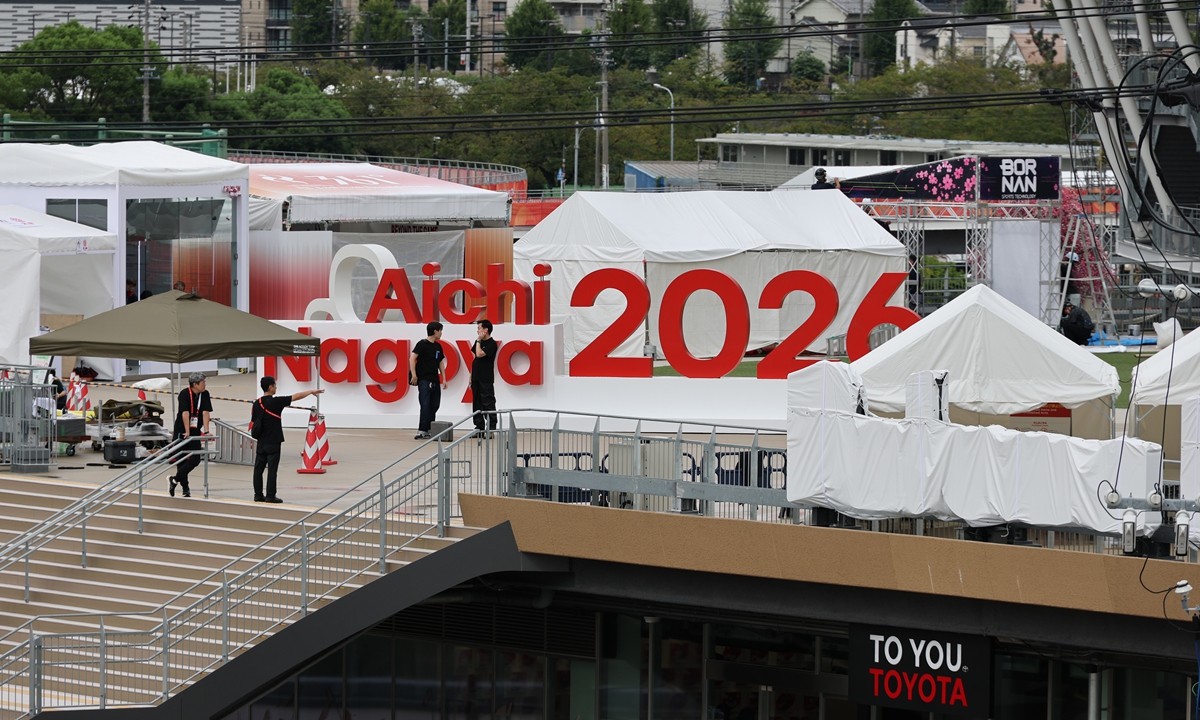
Staff members prepare for the opening ceremony of the 2026 Aichi-Nagoya Asian Games at Paloma Mizuho Stadium on September 14, 2026. Photo: VCG
The 20th Asian Games are just around the corner, but host city Nagoya, Japan, has come under fire over accommodation conditions, venue preparations and budget cuts. South Korean sports official described the accommodation at this year's Games as "worst ever," while some athletes have taken to social media to plead, "Please help us." The Olympic Committees of several countries criticized the organizing committee for failing to deliver the number of rooms it had promised, leaving some delegations scrambling to find hotels at the last minute. There is nothing inherently wrong with hosting the Games economically, but frugality should not mean shabbiness. When athletes cannot even find a bed long enough to stretch out their legs, Japan has fallen short of basic decency.
To cut costs, the Aichi-Nagoya Asian Games abandoned the traditional athletes' village and opted for scattered accommodation, including 200 container-style temporary housing units. Each 35-square-meter unit has four beds, with corridors so narrow that people can barely pass through sideways. After staying there, members of the South Korean men's basketball team posted videos showing leaking sinks and waterlogged floors. The beds are also undersized, making it impossible for athletes to fully stretch their legs without using an extension mattress. The president of the Philippine Olympic Committee revealed that, due to the shortage of rooms, some team officials had been forced to move to outside hotels or book accommodations through online platforms. India's sports authorities even set up container housing at a training facility so that athletes could stay in this type of accommodation in advance and get accustomed to the conditions.
When Nagoya bid for the Games in 2016, it promised a lean and simple event, with 70 percent of the hosting costs to be covered by public funds. Yet as the Games approach, the actual total cost has already risen to more than three times the original estimate. Costs keep rising while hosting conditions continue to deteriorate. The organizers have effectively shifted the price of budget overruns onto the athletes. Moreover, the Tokyo Olympic Games corruption scandal had already shaken public trust in Japan, while the organizers' plan to ease the financial burden through corporate sponsorship has also fallen short.
The Asian Games are a shared celebration for the entire Asian sporting family, not Japan's private affair. Athletes from 45 countries and regions are taking part, each carrying the expectations of their respective countries and regions. Every service provided by the host represents its respect for participating countries and regions, as well as for Asian sport as a whole. When Nagoya bid for the Asian Games, it made clear commitments, however, now those commitments have been scaled back and hosting standards have been compromised. What is at stake is not only the reputation of the Asian Games, but also Japan's image in the international community.
Hosting the Asian Games is not a one-off transaction; high-quality services must be maintained throughout the event. In the face of criticism from various parties, the Japanese organizers should take remedial measures to address the legitimate concerns of participating delegations and improve catering, transportation, medical services and emergency management. Above all, there must be no lapses when it comes to fairness and impartiality in competition. The organizers must ensure that athletes can compete in a safe, orderly and dignified environment. The quality of services provided on every day of the Games will be a test of the host's sincerity and competence.
RELATED ARTICLES