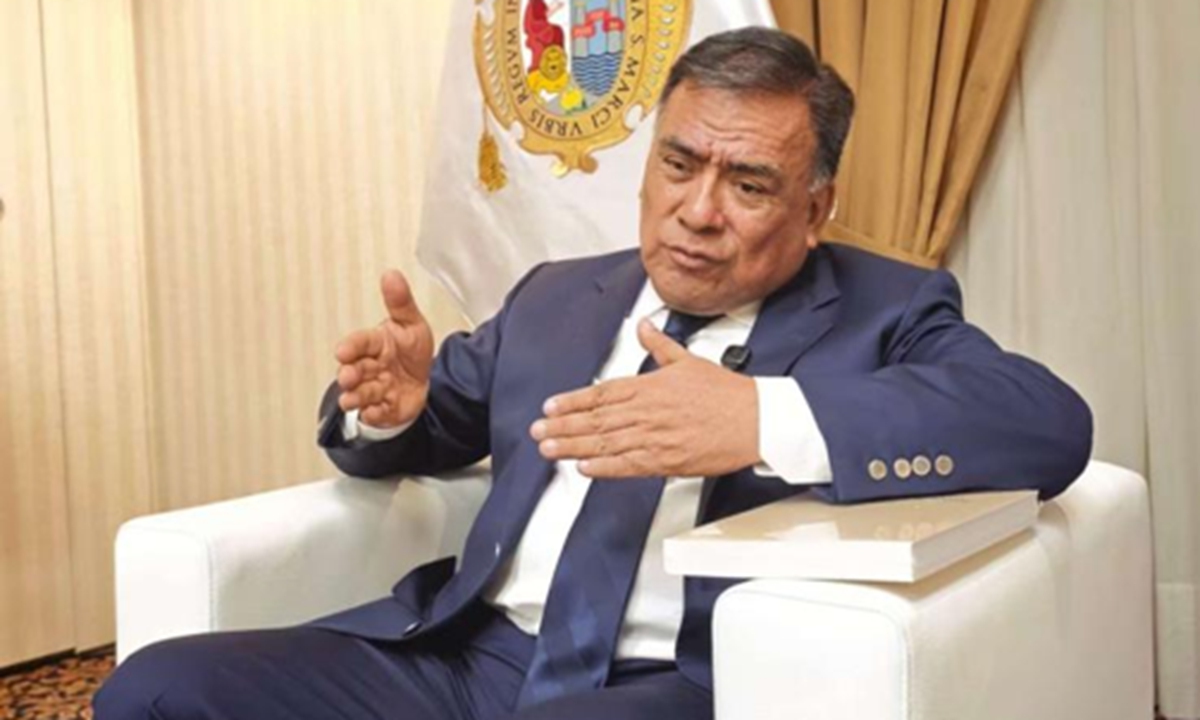
Former Peruvian prime minister Javier Velasquez
China's success in lifting 800 million people out of poverty over the past four decades is an astonishing achievement that deserves to be carefully analyzed and studied, former Peruvian prime minister Javier Velasquez told the Global Times in an exclusive interview in Lima, the capital of Peru, on Monday local time.
"I'm saying this not because I personally have any particular fondness for China," Velasquez said.
In his view, for a developing country like Peru, discussions about human rights cannot be separated from development itself. Peru is an emerging economy and we still face many gaps in the social sphere, he said.
Western countries tend to focus more on freedom of expression and individuals' rights to institutional protection when dealing with those in power, while China's development experience has taught him to pay greater attention to the rights to subsistence and development, he noted.
This raises a fundamental question, Velasquez said: How can a right actually be realized for ordinary citizens? For developing countries, what is truly worth considering is how to ensure that, beyond political and legal rights, people can have real access to food, housing, education, healthcare and opportunities to earn a living.
"What interests me most about China is its emphasis on the right to development," he said. The Chinese government has promoted major reforms, involved the people in the process, and made them part of reform and development, allowing them to truly become part of the development process. This is precisely what countries like Peru need to learn from and draw upon, Velasquez added.
Velasquez said that sustained development and improvements in people's livelihoods are themselves an important foundation for protecting human rights, while infrastructure and technology serve as crucial tools for turning abstract rights into tangible ones.
Taking artificial intelligence (AI) as an example, he said that AI is not itself a human right, but it can help people in remote areas gain access to telemedicine, education and communications services, turning rights that once existed only "on paper" into realities in people's daily lives.
The same applies to transportation and roads. A road can enable farmers in remote villages to bring their agricultural products to market, giving them access to opportunities to make a living. A road itself is also a tool that can help citizens truly realize a right, Velasquez said.
In his view, this is another important aspect of China's development experience worth noting: through infrastructure development, technological progress and improvements in public services, more ordinary people can share in the fruits of development.
Speaking about China's participation in international cooperation, Velasquez said he appreciates China's efforts to promote cooperation through investment, technology transfers and other means, helping ensure that the benefits of development reach a broader population. Human rights are not a commodity and cannot be exported, he said.
What a country can genuinely share with the outside world, he argued, is its own development experience as well as the tools and capabilities that can help improve people's lives.
This perspective is also reflected in his assessment of China-Peru relations. Velasquez noted that China has become Peru's largest trading partner, with the two countries having developed close and high-level of trade, investment and cooperation ties. Chinese companies have continued to expand their investment in Peru's energy and infrastructure sectors in recent years. He specifically mentioned the Port of Chancay, saying that it could become an important turning point in China-Peru relations, "bringing Peru and China into a closer and higher-level areas of cooperation."
Speaking about what Latin America can learn from China's experience, Velasquez said that Latin American countries should take a more active approach to studying China's development practices.
China contributes to the world not only through technological advances, but also through its own development model and cultural experience, he said. China and Latin America share a number of cultural similarities, he noted, providing a foundation for both sides to deepen exchanges and cooperation.
At the end of the interview, Velasquez specifically highlighted China's achievements in poverty reduction. He said that over the past 40 years, China has lifted 800 million people out of extreme poverty. This is not merely an abstract figure, but an important measure of whether development has genuinely benefited the people. This is precisely the experience that we should carefully analyze and study, he said.
RELATED ARTICLES