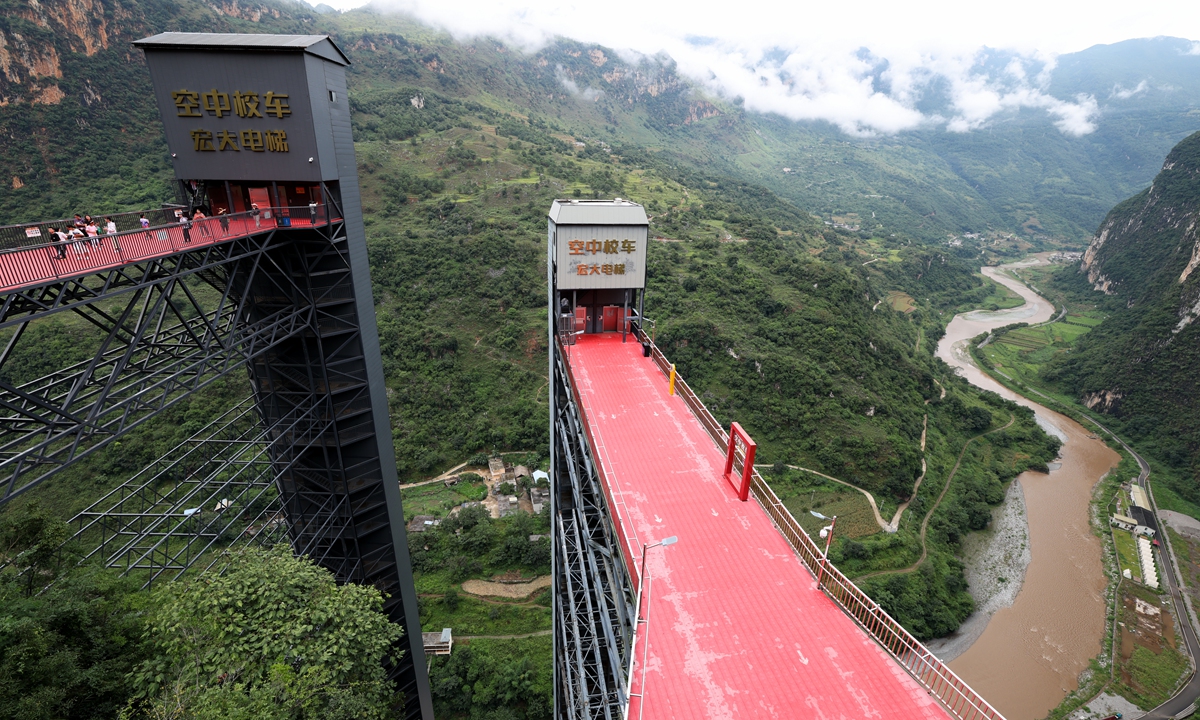
Primary school students from Nizhu River Grand Canyon in Southwest China's Yunnan Province take the "Sky school bus" to register for school on August 29, 2026. Photo: VCG
Recently, the BBC posted a video on social media documenting schoolchildren in the Nizhu River Grand Canyon in Southwest China's Yunnan Province, riding the "sky ladder" to school, which has drastically shortened their education journey.In the video, two elevators standing over 200 meters tall stand out: the "Qingyun Elevator," completed in 2022, and the "Fuyao Elevator," which officially began operation on July 31 of this year. Together with a high-altitude cable car, these structures have reduced the mountainous students' treacherous commute - which previously took over three hours one way - to a mere 30 minutes.
Netizens also left numerous positive comments: "This project is brilliant!" "China's transport system for students is amazing and highly efficient!" "Prioritizing people's livelihoods is what gives governance its human touch." "This is a for-profit facility located within a scenic area … That also provides free services to local children," and so on. Still, the BBC's positive coverage of China's "sky school bus" struck some online users as "unexpected."
What felt unexpected wasn't the BBC itself, but rather the return of an accurate "Chinese narrative." In fact, this was by no means an "exclusive report" by the BBC. Since August, this story has been covered by numerous international media outlets, including the Huffington Post in the US, Radio France Internationale (RFI) in France, The Times of India and The Tribune in India, Lianhe Zaobao in Singapore, and Sin Chew Daily Online in Malaysia. The BBC was merely one of the latest foreign media outlets to join the coverage.
The El HuffPost wrote that this is not merely a school transportation project but also a symbol of the use of modern technology in remote regions. RFI noted that the "sky ladder" has changed the lives of many children, and that Chinese media's description of it as the "sky school bus" is well‑deserved.
Data indicate that Western media coverage of China is indeed undergoing certain changes. A 2025 study by South China Morning Post analyzed economic, technological, and environmental reports on China from 2019 to 2025 by 10 major British and American media outlets, including the BBC, CNN, and The New York Times, and found that the proportion of negative coverage had dropped from nearly 70 percent to about 40 percent, while neutral and positive coverage had increased.
An analysis published in March of this year by the US-based Eurasia Review also concluded that Western media narratives on China have begun to move from ideological dismissal to a "grudging acceptance" of economic reality.
There is still a long way to go before Western media correct their biases against China. But one thing is certain: China's achievements - whether cutting-edge technological breakthroughs or stories of beautiful rural communities - are gradually eroding the space for Western media biases to survive.
As more foreigners set foot in China and witness its development, false narratives that "call a deer a horse" will increasingly lose credibility. The BBC's praise for Yunnan's "sky school bus" is a prime example.
RELATED ARTICLES