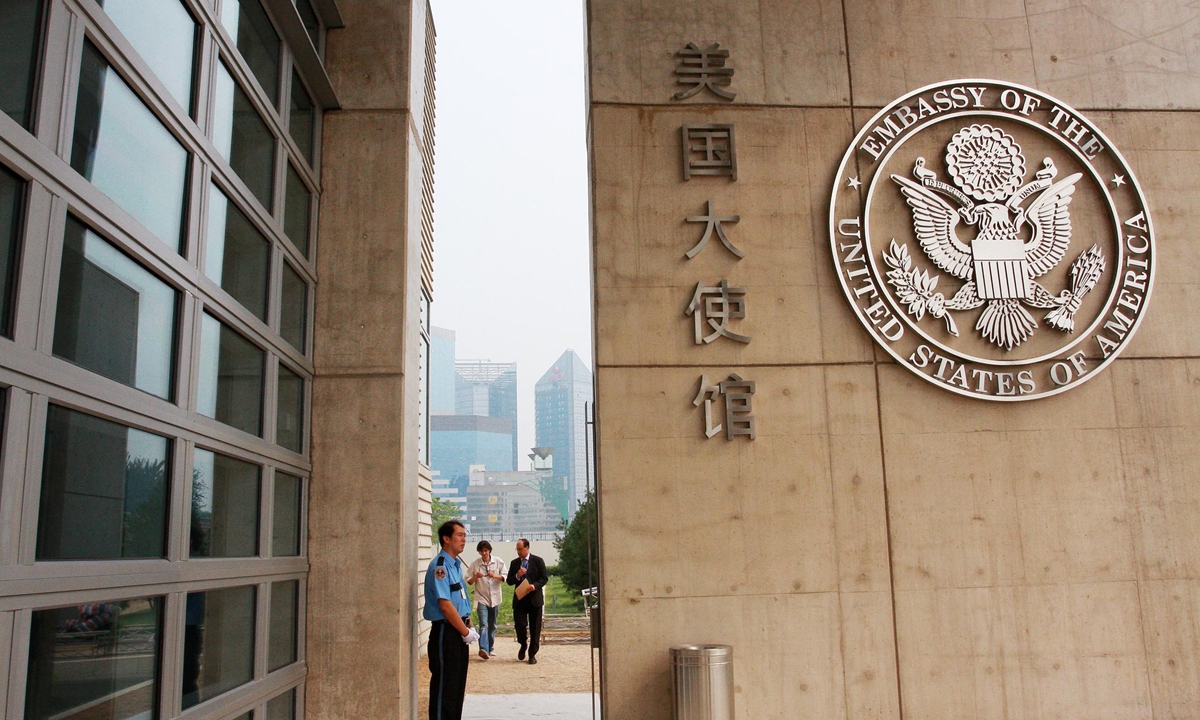
US Embassy in China Photo: cnsphoto
The August 26 mudslide severely hit border regions between China and Nepal, with the race-against-time rescue operations drawing close attention from all sides. Given that a number of foreign nationals have been killed or missing on both sides of the China-Nepal border, it is understandable that relevant countries are paying close attention and hoping to obtain detailed information as soon as possible.However, over the past two days, the US Embassy in China has been posting on social media platforms that it "continues to request more information from Chinese authorities." This approach goes beyond the scope of normal consular protection, raising questions about its intentions.
The US Embassy in China claimed that Chinese official media reported 16 deaths and 546 missing persons as of August 29, including 261 missing foreign nationals from 23 countries, among them US citizens. It asserted that "Chinese authorities have not published an updated count since that date." The reality, however, is that the affected areas are still grappling with severed roads, power outages, and communication blackouts, with personnel registers destroyed and ongoing risks of secondary landslides and rockfalls.
China immediately mobilized all available resources for rescue operations. It was not until the morning of Wednesday that the land route to the Gyirong Port was fully reopened, allowing large numbers of rescuers, relief supplies and equipment to reach the core disaster area. Under such circumstances, it is hardly unusual that no overall update was issued over a period of just a few days.
In similar search-and-rescue operations in the US, it is also common for casualty figures to remain unchanged for days, identification of victims to take weeks or even months, and rescue efforts themselves to proceed at a sluggish pace. Why, then, does the US Embassy in China appear so impatient when it comes to China's rescue efforts?
Moreover, the request for China to provide information on entry and exit records at the Gyirong Port is not only overreaching - it borders on outright obstruction. China has clearly stated that this disaster struck with unprecedented speed and force, with mudslides wreaking havoc on infrastructure and destroying personnel registration systems across the affected zone, making victim identification and tracking exceedingly difficult.
With records likely already missing, the US Embassy in China has chosen to go to social media to publicly "press for information on entry and exit records." That looks more like a political gesture than a practical request - as if to signal that China is hiding the records. So we have to ask: Is the US side simply ignorant of disaster response protocols, or is it eager to strike a self-serving pose to shape the narrative?
Overall, the US side has plenty of diplomatic channels through which to convey its "concerns" to China. In fact, China activated an emergency mechanism for foreign nationals immediately after the disaster, with foreign affairs, police, tourism, and emergency management authorities working together on a full-scale, name-by-name search and cross-referencing effort, while keeping the embassies of relevant countries informed without delay.
By adding "continuing to request more information from Chinese authorities" into a safety advisory for travelers and simultaneously posting it across social media, the US Embassy in China is more interested in showing third parties that "China is not cooperating" than accelerating the verification of individual cases. In addition, the timing of the social media post almost coincided with some Western media outlets spreading rumors about alleged "information concealment" by China. The US Embassy owes the public a clear answer as to whether that is just a "coincidence."
If the US Embassy in China is genuinely concerned about the search and rescue progress, it should closely follow Chinese television, newspapers and online media, where the latest developments are released to the public as soon as they become available. What does it truly mean to put people and their lives first? The US Embassy in China might want to learn something from "Chinese-style rescue" and share those insights back home. Everyone knows that whenever a major natural disaster hits the US, one of the loudest grievances voiced by Americans themselves is the "lackluster and sluggish rescue efforts."
RELATED ARTICLES