HK unveils 1st five-year plan, marking new chapter in ‘one country, two systems’ practice
By Published: Sep 16, 2026 04:16 PM

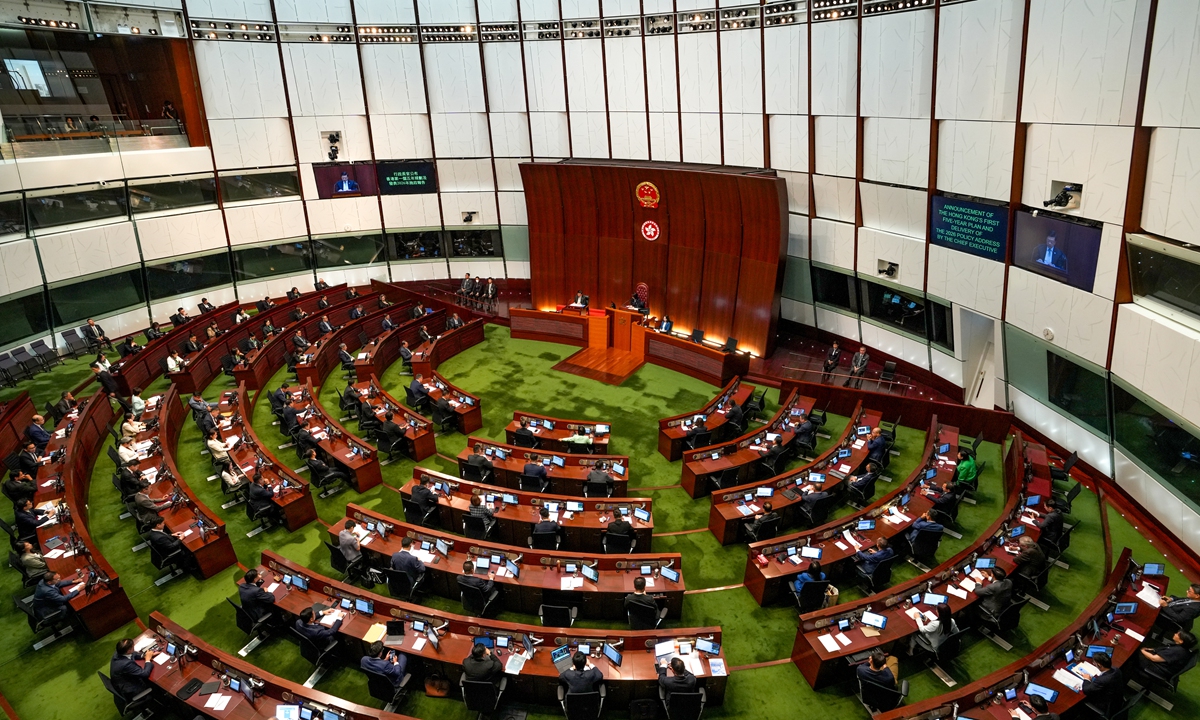
John Lee, chief executive of the Hong Kong Special Administrative Region, delivers his policy address and unveils inaugural five-year plan at the Legislative Council on September 16, 2026. Photo: VCG
The Hong Kong Special Administrative Region unveiled its first Five-Year Plan for Economic and Social Development (2026-2030) on Wednesday. The plan will provide a medium- to long-term roadmap for the city's development, with a focus on optimizing resource allocation, stabilizing expectations, protecting the interests of investors, and strengthening Hong Kong's role as a bridge and gateway between the Chinese mainland and the rest of the world.Some political, business, and academic figures in Hong Kong said the plan marks not only a milestone in the city's innovation of governance since its return to the motherland, but also a proactive step in advancing the practice of "one country, two systems," upholding and improving executive-led governance, and pursuing high-quality development.
In unveiling the plan alongside the Chief Executive's 2026 Policy Address at the Legislative Council on Wednesday, the HKSAR Chief Executive, John Lee, said reading the two documents together would provide a clearer understanding of how the HKSAR government will translate the five-year strategy into concrete policies and measures in 2026.
The first five-year plan consists of seven parts and 28 chapters, totaling about 60,000 Chinese characters, Lee said.
The plan covers seven major areas: opening a new chapter for Hong Kong's development; strengthening the city's four major centers and building a talent hub to consolidate and enhance its international competitiveness; accelerating the development of the Northern Metropolis to optimize the city's spatial structure; deepening development of the Guangdong-Hong Kong-Macao Greater Bay Area and building a global cooperation network; improving people's well-being and the social security system; coordinating development and security while enhancing public governance; and strengthening mechanisms to ensure the implementation of the plan.
A new chapter
Central government authorities in the HKSAR called the plan of milestone significance for advancing the practice of "one country, two systems."
The plan aligns with the country's overall development strategy while setting out a vision for Hong Kong's future, demonstrating strategic foresight and forward-looking planning and reflecting broad public opinion and a scientific, democratic approach to policymaking, the central government's liaison office in the HKSAR said on Wednesday.
It will surely help accelerate Hong Kong's transition from stability to prosperity and enable the city to achieve high-quality development while better integrating into and contributing to the country's overall development, said the Hong Kong and Macao Affairs Office of the State Council.
Hong Kong's first five-year plan not only marks a new chapter in the practice of "one country, two systems," but also provides the world with an example of a new form of capitalist development, Liang Haiming, an economist on Hong Kong and dean of the Hainan University Belt and Road Research Institute, told the Global Times on Wednesday.
Compared with traditional Western capitalism, the practice places greater emphasis on balancing social equity and economic efficiency. Compared with the mainland's socialist market economy, it incorporates more international and diverse elements. This unique development model not only demonstrates the institutional strengths of "one country, two systems," but also offers innovative ideas for global economic governance and the development of capitalism, Liang said.
Lau Siu-kai, a consultant to the Chinese Association of Hong Kong and Macao Studies, told the Global Times on Wednesday that Hong Kong's long-held governance principles of "positive non-intervention" and "small government, big market" have long been outdated and are increasingly out of step with the city's development needs and expectations across society.
Under Hong Kong's capitalist system, the HKSAR government's simple, low-tax regime means it has far less capacity than governments at various levels on the Chinese mainland to control and mobilize development resources, and also lags far behind other capitalist economies and regions such as Singapore, Lau noted.
"Hong Kong needs an active and proactive SAR government to chart a development strategy for the city's future, while relying primarily on market forces to achieve its strategic goals," the expert said.
Lee said that the plan is guided by seven principles, including upholding the "one country, two systems" principle, putting people's livelihoods first, maintaining an executive-led system of governance, pursuing reform and innovation, combining an "efficient market" with a "proactive government," coordinating development and security, and ensuring that the plan is pragmatic and action-oriented.
Among the targets, Hong Kong aims to increase total local expenditure on innovation activities to 3 percent of GDP after 2030. For the development of the Northern Metropolis, the plan aims to produce 900 hectares of developed land within five years, representing a cumulative increase of 7.5 times, and complete 70,000 housing units.
Clear direction
Several Hong Kong Legislative Council members reached by the Global Times on Wednesday said they welcome the city's first five-year plan, saying the medium- and long-term blueprint aligns Hong Kong's development with the country's overall development strategy, builds on the city's unique advantages, and provides a clear direction for its development over the next five years.
Tang Fei, a Hong Kong Legislative Council member and vice chairman of the Hong Kong Federation of Education Workers, told the Global Times that the plan highlights Hong Kong's positioning as a city that is "backed by the motherland and connected to the world," while maintaining its free-market system and international rule-of-law environment and addressing deep-rooted challenges involving the industrial structure, housing and land supply, and the commercialization of scientific and technological innovation.
At the industrial level, the plan seeks to consolidate Hong Kong's traditional strengths in finance, shipping, and trade while promoting innovation and technology, accelerating the development of the Northern Metropolis, and creating a new "finance in the south, innovation and technology in the north" development pattern, Tang said.
On people's livelihoods, the plan focuses on issues of direct concern to residents, including increasing public housing supply and improving support for youth development, education, and healthcare. It also seeks to expand opportunities for cross-border development in the Guangdong-Hong Kong-Macao Greater Bay Area and deepen regional cooperation, enabling more residents to benefit from development, he noted.
"The five-year plan is not merely a blueprint, but also an action plan," the lawmaker said, noting that it reflects a broad social consensus and seeks to promote coordination between an effective government and an efficient market. He expressed hope that the plan's implementation would help Hong Kong achieve higher-quality development under the "one country, two systems" framework while delivering tangible improvements to people's lives.
Hong Kong Legislative Council member Nixie Lam said the plan could bring substantive changes in three areas. First, it will reshape the city's industrial and spatial development pattern by strengthening its four traditional centers and accelerating the development of the Northern Metropolis, helping ease long-standing constraints on Hong Kong's development, upgrade industries, and create quality jobs.
Second, it will strengthen the livelihood security system by incorporating issues including childbirth incentives, elderly services, and youth development into a long-term policy framework, helping to address the fragmentation of previous livelihood policies. Third, it will improve public governance by making policymaking more forward-looking and consistent, Lam told the Global Times.
"This is the first time Hong Kong has systematically planned its long-term development around a five-year cycle. It marks a shift in governance thinking from annual policy adjustments to medium- and long-term strategic planning," Lam said, adding that the plan is of milestone significance for Hong Kong's deeper integration into the country's overall development, its efforts to address deep-seated socioeconomic challenges, and its pursuit of high-quality development.
Hong Kong resident Chu Ka-kin said he was particularly impressed by the plan's systematic approach to investing in the future. He highlighted plans to develop the Northern Metropolis through legislation and planning into one of Hong Kong's most promising areas, integrating housing, universities, innovation and technology, medical schools, and hospitals to provide homes, nurture, attract, and retain talent, and foster emerging industries.
The plan's emphasis on a green transition, ecological conservation, resource recycling, and turning waste into resources also represents a commitment to environmental protection and a contribution to China's goal of achieving carbon peaking by 2030, Chu told the Global Times on Wednesday.
Another highlight, Chu said, is the promotion of Chinese standards in areas including railways, the low-altitude economy, traditional Chinese medicine, national hospitals, green hydrogen, and low-carbon hydrogen. He said Hong Kong could leverage its international connections and platforms to help Chinese standards "go global," expand related markets, and enhance its influence, while helping tell the stories of Chinese products and China's institutional strengths.
RELATED ARTICLES