ARTS / CULTURE & LEISURE
Former Nanjing Museum director at center of donated paintings sale scandal sentenced to 3 years
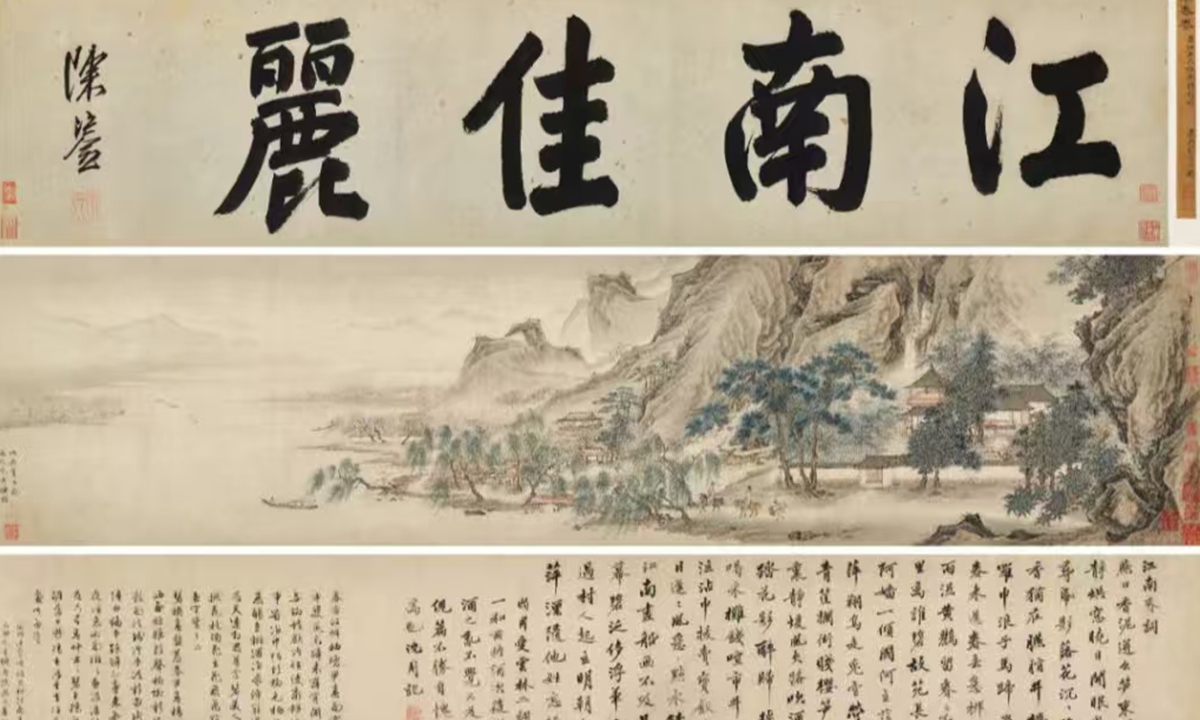
A partial view of the scroll painting "Spring in Jiangnan" by renowned Ming Dynasty painter Qiu Ying Photo: The Paper
Xu Huping, former director of Nanjing Museum in East China's Jiangsu Province, who was at the center of the incident where some ancient paintings donated to the museum were found to be sold, has been sentenced to three years in prison for illegally providing assistance to others in securing construction projects and facilitating business cooperation, and accepting property from others in return, the Xinhua News Agency reported on Wednesday.
Xu, who served as executive deputy director and director of the Nanjing Museum, was convicted of bribery and was also fined 200,000 yuan ($29,800), the report said.
Other relevant former officials and personnel from the Jiangsu provincial Department of Culture and Tourism, the provincial bureau of cultural relics, Nanjing Museum and the former provincial cultural relics store were held accountable for their respective responsibilities in connection with the improper transfer and sale of paintings and calligraphy works, Xinhua reported. They were given various disciplinary and administrative penalties, including dismissal, removal from office, demotion, Party disciplinary warning, reassignment, and criticism and education.
The Nanjing Museum was under spotlight for the whereabouts of some of its collections last December, and Jiangsu Province established a joint investigation team to conduct a probe into the management of donated cultural relics at the museum. China's National Cultural Heritage Administration also formed a working group to investigate the matter.
Descendants of late renowned collector Pang Laichen discovered that five of 137 ancient paintings and calligraphy works donated by their family to the Nanjing Museum in 1959 could no longer be located, according to reports in December.
The Paper reported that one of the "missing" paintings, "Spring in Jiangnan" by renowned Ming Dynasty (1368-1644) painter Qiu Ying, appeared in a preview exhibition of a Beijing auction house in May 2025 with an estimated value of 88 million yuan.
The five paintings were illegally transferred to the provincial cultural relics company and sold in the 1990s and early 2000s, resulting in the loss of state-owned cultural assets, according to the probe findings released by local authorities in February, China Central Television reported.
The probe concluded that Xu failed to follow required procedures and unlawfully signed off on applications to transfer relevant relics. Even after national administrative authorities had clearly banned the unauthorized sale or disposal of museum collections, he still approved the sale of the relevant cultural relics.
The local authorities said that a province-wide campaign has been launched to strengthen the safety management of cultural relics in the collections of state-owned museums, with efforts to improve and refine cultural relic management systems and ensure the bottom line of cultural relic safety is upheld.
RELATED ARTICLES