Hong Kong’s first five-year plan: Why does it offer hope to residents and opportunities for investors?: Hai Feng
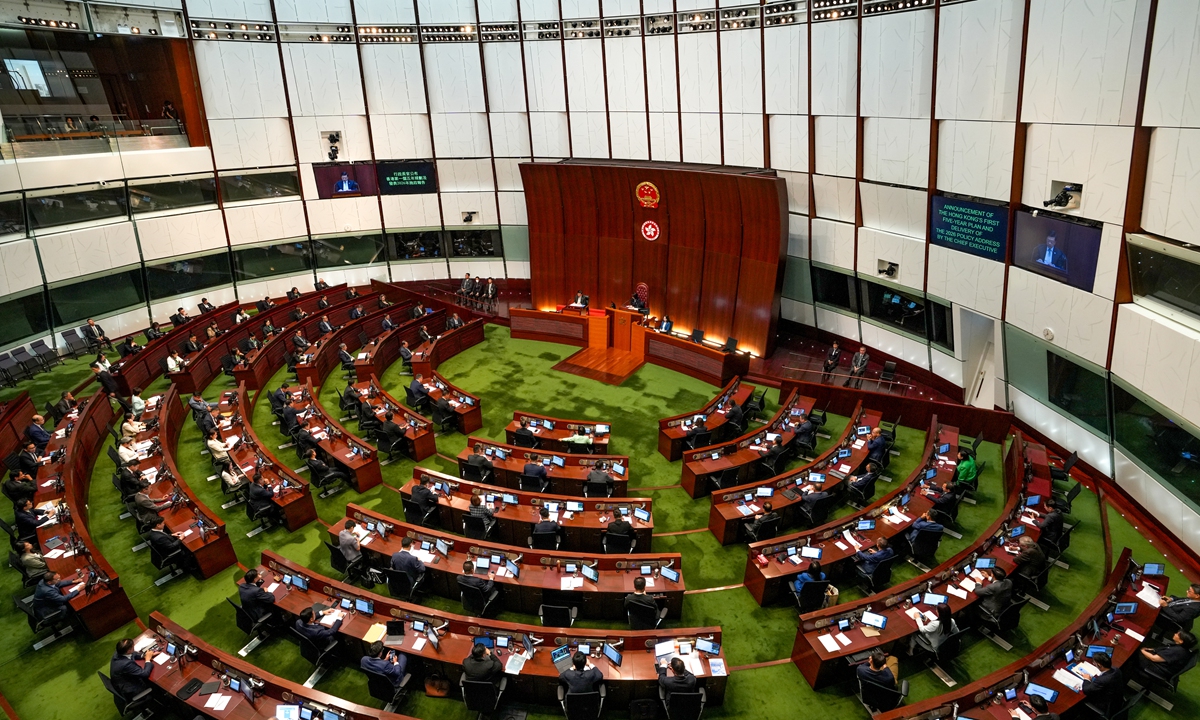
The Hong Kong Special Administrative Region (HKSAR) unveiled its first five-year plan for economic and social development (2026-2030) on September 16, 2026. Photo: VCG
On September 16, the Hong Kong Special Administrative Region (HKSAR)'s first five-year plan for economic and social development was announced alongside the latest Policy Address. The plan has attracted widespread attention from all sectors ever since its formulation was announced earlier this year. During the two-month public consultation period, more than 17,000 submissions were received, 80 percent of which came from ordinary citizens. This reflects the earnest hopes of all sectors for Hong Kong's prosperous and stable development and the steady and far-reaching implementation of "One Country, Two Systems."
As a pioneering initiative, it inevitably raises concerns: Why would an international metropolis accustomed to advancing development through annual Policy Addresses and fiscal budgets make the historic move of formulating a five-year plan? Will it undermine Hong Kong's market vitality? Will it alter the institutional arrangements under "One Country, Two Systems"?
The answer is exactly the opposite. Hong Kong's first five-year plan aims to provide the market with a more predictable direction and establish more stable responsibilities for the government. For ordinary citizens, the primary concerns are whether they can live in more spacious homes, have more stable jobs, ensure their children receive quality educational opportunities and receive proper care in their old age. For investors, the primary concerns are whether policies will be consistent, whether the direction of industries is clear, whether infrastructure and talent can keep pace, and whether costs and returns are transparent and calculable.
A good plan should address the concerns of these groups simultaneously.
Planning is a modern governance tool, irrespective of socialism or capitalism
Some people, upon hearing the term "five-year plan," equate it with a "planned economy." This view not only ignores history but also fails to reflect reality.
Planning is essentially a modern governance tool and an important means to boost certainty in development. Issues such as population growth, housing supply, industrial development, urban renewal, rail transit and environmental governance often require long-term investment and sustained implementation - problems that the market's spontaneous adjustments alone cannot effectively resolve. The government needs to scientifically formulate medium- and long-term goals, coordinate the allocation of land, infrastructure, public services and institutional frameworks, and provide a better foundation for market operations.
The world's first national-level modern urban planning legislation originated with the UK's 1909 Housing and Town Planning Act, enacted primarily to address the increasingly pressing issues of public environmental governance and workers' housing following the rapid urban population growth driven by industrialization. Since then, examples such as the UK's social welfare planning, France's development guidance plans and Japan's industrial development strategies have all demonstrated that planning has never been the exclusive domain of any single system.
Planning has nothing to do with whether a system is socialist or capitalist. What truly matters is whether planning respects market laws and the principle of fairness, whether it can resolve social pain points, whether it creates stable expectations for enterprises and whether it ensures that the fruits of development benefit ordinary people to a greater extent. Western countries also formulate infrastructure, industrial and urban development plans, but political party alternations, budget negotiations and policy fluctuations often create uncertainty for projects requiring long-term implementation. Without policy continuity, social reform is prone to stalling.
The significance of Hong Kong's first five-year plan lies in leveraging stable medium- and long-term arrangements and target-oriented guidance to better form a governance closed loop, featuring "a blueprint at the macro level, construction roadmaps on an annual basis, resource schedules for fiscal allocation and review mechanisms for implementation."
'Alignment' rather than 'inclusion': Highlighting the unique advantages of 'One Country, Two Systems'
Hong Kong's formulation of its own five-year plan precisely embodies the institutional arrangements of "One Country, Two Systems" and the Basic Law. Hong Kong's economic and social development is not incorporated into the indicator system of the national five-year plan; the HKSAR continues to maintain its capitalist system, its status as a separate customs territory and its highly international character. At the same time, Hong Kong proactively aligns itself with the strategic direction and development opportunities outlined in the national 15th Five-Year Plan (2026-30). This is precisely the essence of "One Country, Two Systems": upholding the foundation of "one country" while making the most of the advantages of "two systems."
Hong Kong retains its unique advantages of alignment with international rules and the free flow of capital, personnel, goods and information, while leveraging national development, the construction of the Guangdong-Hong Kong-Macao Greater Bay Area (GBA), and the mainland's massive market to gain broader development prospects. As the world seeks opportunities to connect more closely with China's market, industrial chains and innovation resources, it is both appropriate and timely for Hong Kong - as China's most international city - to proactively align with national development strategies.
It should also be noted that the chief executive and the HKSAR government bear primary responsibility for Hong Kong's first five-year plan. The plan is led by the chief executive and formulated and implemented under the direction of the HKSAR government, with the central government providing strategic support and policy guidance. Far from undermining "Hong Kong people governing Hong Kong" and a high degree of autonomy, this arrangement actually enables the SAR government to fulfill its responsibilities for Hong Kong's long-term development with greater coordination capabilities.
Why are Hong Kong residents happy? Because the plan targets the toughest challenges in people's livelihoods
Hong Kong has never lacked market vitality or international competitiveness. What has truly plagued Hong Kong society for many years are deep-seated contradictions such as housing, land use, industrial structure, youth development and an aging population. These issues cannot be resolved piecemeal through a few short-term measures, nor can they be left solely to the market to resolve on its own.
In Hong Kong's first five-year plan, the Northern Metropolis has been given a prominent position and is tasked with playing a strategic role in leading Hong Kong's future development. Over the next five years, the Northern Metropolis will increase the supply of residential and economic floor space, advance projects such as the Hong Kong-Shenzhen Western Rail Link and the Northern Link, and promote the construction of a university town and innovation and technology parks. For residents, this means more housing options, more convenient transportation and richer employment opportunities. For businesses and investors, it means space for industrial development, platforms for talent aggregation and channels for cross-border collaboration.
The housing issue, in particular, is closely tied to the dignity and future of every family. In Hong Kong's first five-year plan, measures such as the regulation of Light Public Housing, shortening the waiting time for public rental housing, increasing per capita living space, and boosting the supply of both public and private housing collectively embody the approach of resolving livelihood challenges through long-term supply expansion. Beyond housing, issues such as primary healthcare, traditional Chinese medicine services, childcare support and elderly care services have also been incorporated into the plan, fully demonstrating that economic development and social welfare are integrated into a single framework.
Why do investors feel reassured? Because traditional strengths are becoming certainties for future development
What investors value most is not just a single tax incentive or short-term subsidy. They place greater emphasis on whether the institutional environment is stable, whether the direction of development is clear, whether there is an adequate talent pool, whether infrastructure and services are well-developed, and whether an industrial ecosystem has taken shape.
The strategic value of Hong Kong's first five-year plan lies in expanding the scope for future development. As an international hub for finance, trade, shipping and aviation, Hong Kong has built up core competitiveness over the long term. The plan continues to consolidate these strengths while establishing an international innovation and technology hub, focusing on life sciences and health technology, artificial intelligence, microelectronics, advanced manufacturing, green finance, commodity trading, and high-value-added supply chain services. This means that Hong Kong's future development will no longer rely solely on a few traditional industries but will continuously tap into new growth drivers while maintaining its existing strengths.
The spatial layout of "South North Dual Engine" is particularly noteworthy. The Northern Metropolis, the Hetao Shenzhen-Hong Kong Science and Technology Innovation Cooperation Zone, and the university town will develop in synergy with the GBA, with multiple projects interconnected and deeply integrated to serve the complete chain of talent cultivation, scientific research and innovation, commercialization of research outcomes, industrial implementation, and international cooperation.
Hong Kong's greatest strength remains its internationalization. In the future, Hong Kong will not only continue to serve as a "super connector" but will also evolve into a "super value-adder": more efficiently and deeply linking international capital, international rules and international talent with the GBA's manufacturing capabilities, the mainland's technological resources and its massive market. Such a Hong Kong will not only help mainland enterprises "go global" but also assist global enterprises and international capital in entering the Chinese market more smoothly.
The plan provides a direction for development, the market determines the allocation of resources, and enterprises make their own investment decisions. The SAR government, through land, infrastructure, regulations, public services and cross-border coordination, reduces uncertainty for the market and creates greater certainty for investment.
By implementing each step thoroughly, the blueprint will surely become a reality
The value of Hong Kong's first five-year plan lies in the fact that it does not replace annual policy initiatives but rather establishes a clear division of labor with the annual Policy Address and the budget: The five-year plan sets long-term directions and phased objectives; the Policy Address outlines annual actions; the budget provides the necessary resources; and public oversight ensures implementation.
This arrangement not only maintains policy consistency over the medium to long term but also preserves flexibility in responding to changes in the economic environment, fundamentally ensuring that the plan will never end up as mere "paper plans hanging on the wall."
From public consultation to incorporating societal feedback, from government leadership to collaboration with the Legislative Council and from the overarching blueprint to annual implementation - whether this plan can truly earn the trust of the public and the market ultimately depends on whether every commitment can be transformed into verifiable progress, tangible changes and sustainable outcomes.
Hong Kong has a tradition of the rule of law, a free and open market environment, an international network and, above all, the unique advantage of being backed by the motherland and connected to the world. The first five-year plan adheres to the principles of "planning-oriented, infrastructure-led, industry-driven and people-oriented," translating development goals into housing improvements, employment growth, industrial upgrading and investment confidence. Its impact will extend far beyond the arrangements for the next five years.
It will give the public hope, present opportunities to investors and enable Hong Kong to move more steadily and further along its new journey from stability to prosperity. The future of the "Pearl of the Orient" is indeed promising.
RELATED ARTICLES