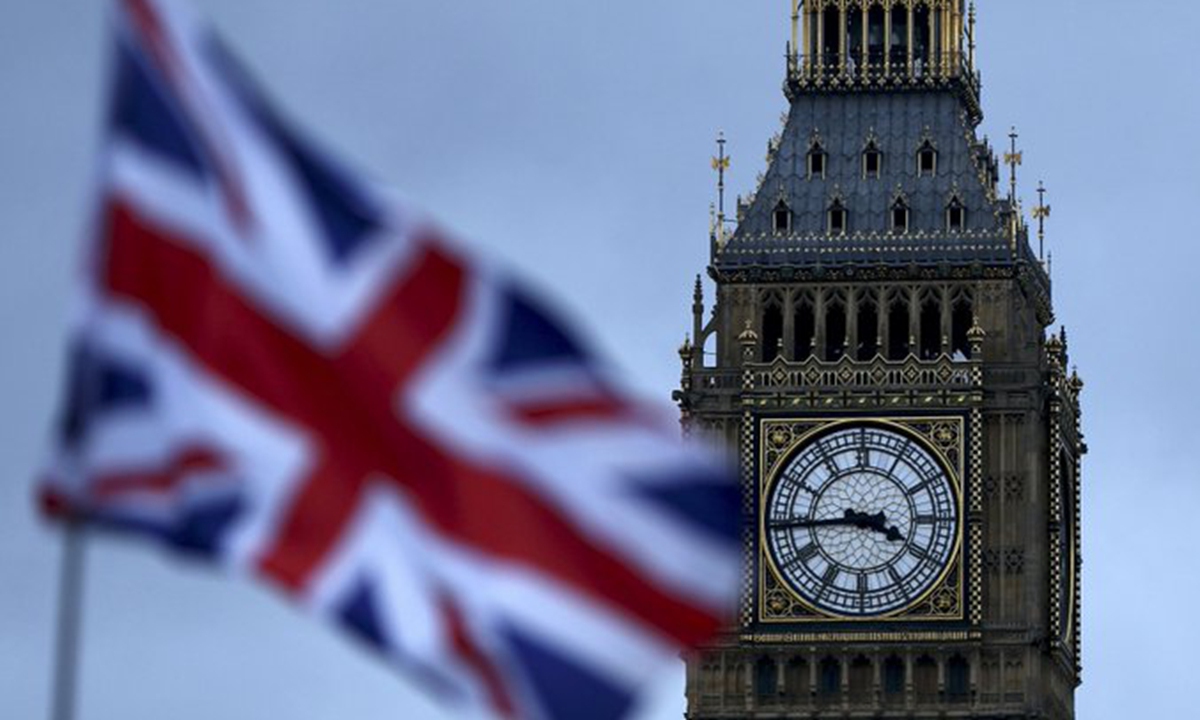
Photo: Xinhua
The leaders of Scotland, Wales and Northern Ireland met on September 14 in Cardiff, the capital of Wales. In a memorandum of understanding issued after the meeting, the three called on the UK government to prepare for, plan and facilitate constitutional change in each jurisdiction and demanded the right to hold independence referendums. Some British media outlets have described the meeting as "unprecedented," because the three regions are currently governed by the Scottish National Party, Plaid Cymru and Sinn Fein, respectively, all of which advocate either independence or constitutional separation. This political configuration is unprecedented in modern British history.
The question now is whether the three regions can turn their calls for independence from the UK into reality and, as some media have warned, set the UK on a path toward "breakup." However, the process is unlikely to be that straightforward. After all, the pro-independence positions of the three governing parties are one thing; the legal procedures and popular support required for leaving the UK are another.
Historically, separatist sentiments have long existed in Scotland, Wales and Northern Ireland, although their intensity has varied over time, and the circumstances in each region are different. Although all three are constituent parts of the United Kingdom of Great Britain and Northern Ireland, which is a unitary state in constitutional terms, their historical evolution as political entities has followed different paths.
At the same time, the UK's constitutional framework imposes different restrictions on referendums aimed at changing the constitutional status of the three regions. Under the Belfast Agreement and the Northern Ireland Act 1998, Northern Ireland is the only part of the UK with a statutory mechanism for a referendum on its constitutional status. However, this requires clear indications that a majority of people there might support such a change, and the power to call the referendum rests with the UK government. Scotland has no permanent statutory mechanism for an independence referendum. The 2012 Edinburgh Agreement provided a one-off authorization for Scotland to hold an independence referendum in 2014, and that authorization expired after the referendum. Brexit in 2016 gave fresh impetus to demands for Scottish independence. However, in 2022, the UK Supreme Court ruled that the Scottish Parliament did not have the power to legislate for an independence referendum without authorization from the UK Government and Parliament. Meanwhile, Wales has never had a statutory mechanism for a referendum on independence or constitutional status.
Against this historical and constitutional backdrop, although the leaders of Scotland, Wales and Northern Ireland have demonstrated a united position in seeking independence from the UK, it will be challenging for them to coordinate the specific steps and timetables required to turn those demands into reality.
In addition, public support for independence in Wales and Northern Ireland is clearly weaker than in Scotland. Wales has a relatively small economy and relies heavily on funding from the UK central government. Although support for Welsh independence has increased in recent years and local media have increasingly used the Welsh language, this trend remains primarily cultural and has yet to become mainstream public support for political separation from the UK. Society in Northern Ireland remains divided in terms of political and national identity, making it difficult to form a unified consensus in favor of leaving the UK. As for Scotland, although support for independence has grown, it remains some distance from forming an overwhelming majority.
I have previously conducted field research in Scotland and other parts of the UK. The message I heard from people across different sectors was primarily a desire to protect local culture, promote regional economic development, and improve people's livelihoods and well-being.
The fact that all three regions are currently governed by pro-independence parties is partly a matter of political circumstance. To some extent, it reflects growing dissatisfaction among local voters with Britain's mainstream political parties, with voters using their support for alternative parties to express that dissatisfaction. This does not necessarily mean that they support leaving the UK.
Nevertheless, the three devolved governments joining forces to seek the right to hold independence referendums does reflect the numerous political, economic and social problems confronting the UK and the adjustments it is undergoing. Whether Britain's "Westminster era" is indeed coming to an end remains to be seen, but the alarm bells are certainly ringing.
The author is a research fellow at the Institute of Russian, East European and Central Asian Studies at the Chinese Academy of Social Sciences. opinion@globaltimes.com.cn
RELATED ARTICLES