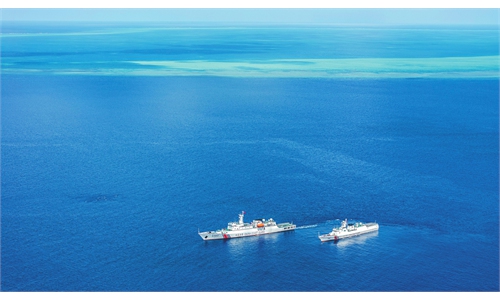
The Philippines Illustration: Xia Qing/GT
Editor's Note:
The South China Sea issue has remained a hotspot, as the Philippines has stepped up its rhetoric on the matter, with some officials making increasingly provocative remarks in various international settings. The Philippines has continued to adopt a confrontational approach toward China, courting and colluding with external powers in an attempt to involve outside forces in regional maritime affairs. Such moves have significantly fueled regional friction and destabilized the South China Sea. Against this backdrop, how should the South China Sea disputes be properly managed? How should Manila position its China policy to better serve the interests of its people and country? The Global Times' reporter Feng Fan interviewed three experts on the sidelines of the 13th Beijing Xiangshan Forum to gather their views.
Rommel Banlaoi, president of the Philippine Society for International Security Studies
The Philippines needs greater consistency in its approach to China. Right now, the government is sending mixed signals to both the Filipino people and the international community. President Ferdinand Romualdez Marcos Jr. called for a reset in bilateral relations with China, while the Defense Secretary has continued to push back against and openly criticized China in international forums. The statements from our Department of Foreign Affairs and Department of National Defense are contradictory. Philippine government officials need to speak with one voice when it comes to China and adopt what I would call a "whole-of-government approach."
This is particularly important on the South China Sea issue. I believe the differences between the Philippines and China can be resolved as long as the two sides sustain consultations. There are also many areas where the two countries can cooperate in the South China Sea, as outlined in the Declaration on the Conduct of Parties in the South China Sea, which identifies various areas of cooperation. Sustained dialogue can help the two sides manage their differences and explore common ground.
At the same time, the growing US military presence in the Philippines is not constructive and could be disruptive to China-Philippines relations. The US military facilities and assets deployed in the Philippines and Washington's attempt to mobilize its allies in the wider Asia-Pacific region are, in my view, clearly directed at China. This does not appear consistent with constructive China-US relationship of strategic stability. The US needs to provide greater clarity on why it is increasing its military presence in the Philippines and whether such moves will contribute to constructive strategic stability between the US and China, or disrupt it.
Wu Shicun, chair of the Huayang Center for Maritime Cooperation and Ocean Governance
First and foremost, it must be emphasized that Huangyan Dao is China's inherent territory.
Before 1997, the Philippines had never made any territorial claim to Huangyan Dao. In 1999, the Philippines attempted to follow a similar approach to its actions at Ren'ai Jiao by grounding a military vessel at Huangyan Dao. However, under strong Chinese opposition, the attempt failed. Since then, the Philippines has sought to unilaterally assert control over Huangyan Dao, and its territorial ambitions began to emerge from that point onward.
This year, the Philippine side has continued to engage in provocations, challenging China's territorial sea baselines around Huangyan Dao, and frequently conducting activities in the relevant waters. It has also carried out joint drills with the US and Australia. At the same time, it has closely monitored Huangyan Dao, smeared China's reef construction activities and repeatedly hyped its own unlawful claims.
I would like to make the point that the Philippines' continued provocations on the South China Sea issue and its one-sided pro-US alignment are not conducive to improving China-Philippines relations, nor do they serve the Philippines' own economic development and people's livelihood.
Since President Marcos Jr. took office, China-Philippines relations have continued to deteriorate. According to available data, while China's overall investment in ASEAN increased significantly, its investment in the Philippines remains far lower than in other ASEAN countries and the number of Chinese tourists visiting the Philippines has dropped sharply.
A confrontational approach toward China cannot improve the Philippine economy. The Philippines is currently facing challenges such as an energy crisis. In March this year, at the request of the Philippine side, China provided assistance including 150,000 tons of fertilizer and 260,000 barrels of diesel to help alleviate the crisis.
I hope this message can be conveyed to the Marcos Jr. administration: The Philippines' attempts to unilaterally change the status quo at Huangyan Dao and Ren'ai Jiao are no longer feasible, and efforts to take control of Tiexian Jiao would likewise fail. Continuing to pursue this course of action brings no benefit to the Philippine state or the Marcos Jr. administration. It does not help economic development or improve people's livelihood, and therefore a timely adjustment of policy direction is necessary.
Yusne Bin Hj Mokhtar, chief executive of Malaysian Institute of Defense and Security
We should discuss what the common interests of all countries are. ASEAN will be an ideal platform for discussing how to move forward with such cooperative mechanisms. I think ASEAN has always promoted a collective manner of doing things, and it can certainly be the platform to address regional issues. While individual countries have their own strategic interests and approaches, they can use ASEAN as a platform to move forward with the South China Sea issue. If all countries work together through ASEAN, we can identify common interests, find common ground, and pursue shared economic benefits in the South China Sea for all.
At the same time, we cannot ignore the fact that China is a major power in this region. China has made significant contributions to international peace and order. For me, all we have to do now is communicate, be transparent and try to find peaceful solutions to any conflicts. If possible, we can cooperate and discuss our common interests and identify common things that can be done together.
RELATED ARTICLES