Descendant of former Japanese Kwantung Army member donates replica of ‘apology monument’ to China
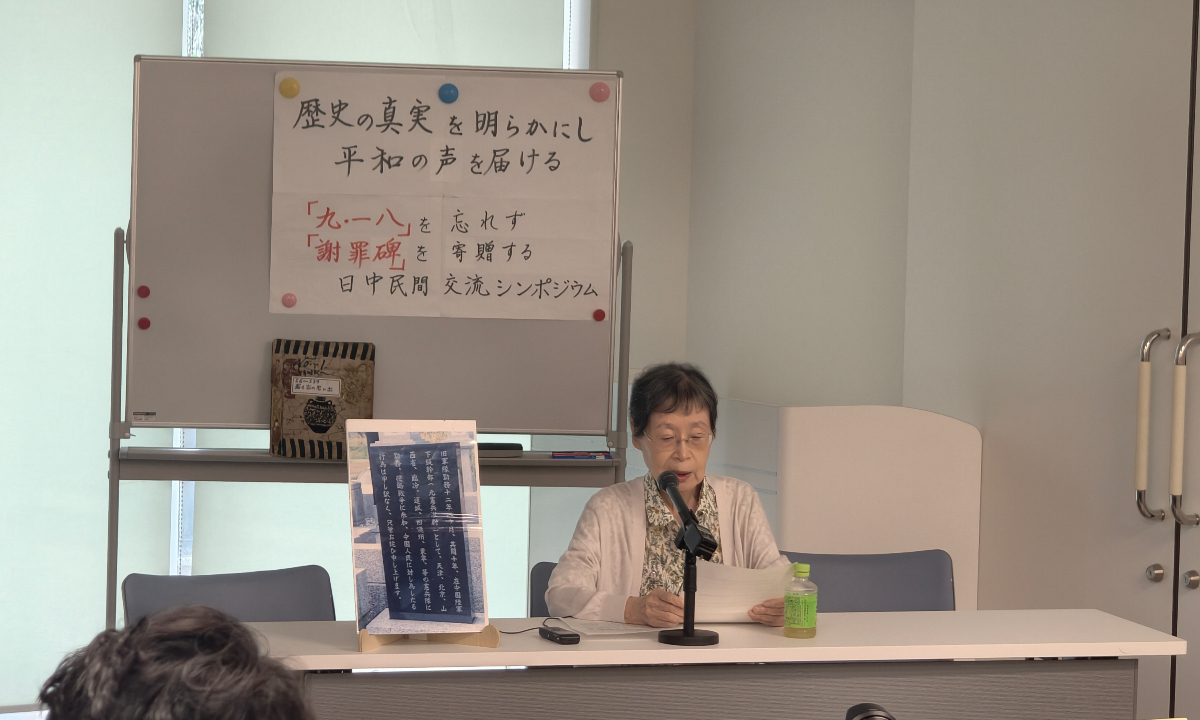
Ayako Kurahashi, a member of the Sino-Japanese Oral History and Culture Research Association who donates a replica of a monument bearing her late father’s apology to China on September 16, 2026. Photo: Chu Xin/GT
A China-Japan civilian seminar commemorating the coming anniversary of September 18 Incident was held simultaneously in Tokyo, Japan, and Changchun in Northeast China’s Jilin Province, on Wednesday, with the descendant of a former member of the military police troop of the Japanese Kwantung Army during Japan’s invasion of China donating a replica of a monument bearing her late father’s apology to China.
The seminar, titled “Remember September 18, Donation of an ‘Apology Monument,’” was jointly organized by Sino-Japanese Oral History and Culture Research Association and Changchun Normal University. Historians from China and Japan, nongovernmental peace groups, descendants of the war perpetrators of Japan’s aggression against China, and university faculty and students attended the event both online and in person.
The centerpiece of the seminar was the donation by Ayako Kurahashi, 79, a member of the Sino-Japanese Oral History and Culture Research Association, of a replica of an “apology monument” erected by her late father, Yukichi Osawa, to China.
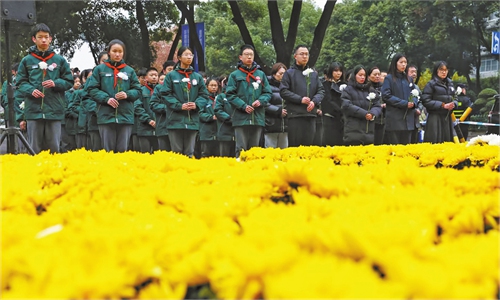
The seminar opened with bell ringing, an air-raid siren and a moment of silence, as participants bowed their heads in tribute.
Osawa was stationed in places including Tianjin, Beijing, and Dongning in Northeast China’s Heilongjiang Province. In 1986, as he was seriously ill, he took a note from under his pillow and instructed his children to have the words engraved on his gravestone: “I took part in the war of aggression and deeply regret everything I did to the Chinese people. I can only offer my profound apology to the Chinese people.”
In 1998, Kurahashi erected a separate monument at her family’s cemetery in Yoshioka, Gunma Prefecture, Japan, bearing her father’s full apology.
At the donation ceremony, Ayako Kurahashi read out the inscription on the monument and completed the handover to the Chinese side via video link.
She also recounted the complicated journey of fulfilling her father’s dying wish over more than four decades, acknowledging that her father had never detailed what he had done in China, but insisted on leaving a message of apology before his death.
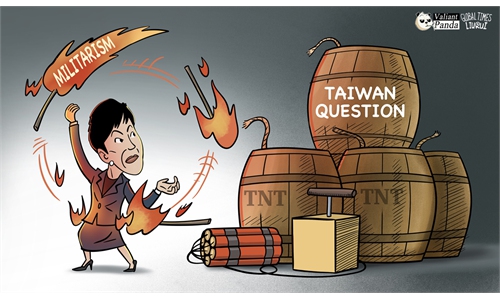
At the Tokyo event venue, Kurahashi, called on Japan to reflect on its history of aggression and expressed hope that her father’s apology would reach more people. Amid what she sees as a growing rightward shift in Japan and the resurgence of “neo- militarism,” Kurahashi said she feared the apology monument could be vandalized and decided to donate a replica to Changchun Normal University this year.
“What disappears from sight can also disappear from people’s hearts. I sincerely hope that this monument will never be damaged and will continue to safeguard the truth of history,” Kurahashi said.
Li Suzhen, executive vice president of the Sino-Japanese Oral History and Culture Research Association and a distinguished professor at Changchun Normal University in China, said the apology monument is a rare piece of tangible historical evidence from a perpetrator’s perspective and serves to preserve a record of remorse rather than deepen tensions.
Several Japanese participants addressed the history of Japanese aggression at the seminar. Takakage Fujita, the secretary-general of the Association for Inheriting and Propagating the Murayama Statement, acknowledged the fact that the September 18 Incident was staged by the Japanese Kwantung Army itself and was a premeditated act of aggression by Japanese militarism, which subsequently expanded into a full-scale war of aggression against China and eventually a war across the Pacific Ocean. He said that the Japanese people must never forget this war of aggression.
He also criticized incumbent Prime Minister Sanae Takaichi for portraying the war as “self-defense” and rejecting the Murayama Statement and the Tokyo Trial, saying her erroneous remarks regarding China’s Taiwan had caused a deep rift in Japan-China relations and warned that Japan should not turn Asia into a battlefield again.
Japan should not avoid or conceal historical facts that are unfavorable to it. Instead, it should truthfully convey the harm it once caused to other countries and look toward the future on the basis of a correct understanding of history, a Japanese attendee of the seminar told the Global Times on Wednesday, adding that past facts cannot be treated as if they never happened, and that historical wrongdoing should be acknowledged and apologies should be made where warranted.
Another Japanese attendee told the Global Times that awareness of the history of Japan’s war of aggression is waning in Japanese society. Knowledge of the September 18 Incident is lacking among both younger and older Japanese, partly due to limited teaching of modern history in schools and the dwindling number of wartime eyewitnesses.
Chinese Foreign Ministry spokesperson Guo Jiakun, in response to a related question on Wednesday at a regular press briefing, said the forced recruitment and enslavement of laborers is one of the serious crimes committed by Japanese militarists during their foreign aggression and colonial rule. China urges Japan to look history in eye, reflect on past crimes, earnestly heed and respond to the just calls and legitimate claims of the people of victim countries in Asia, and properly resolve relevant issues left over from history with a responsible attitude.
RELATED ARTICLES