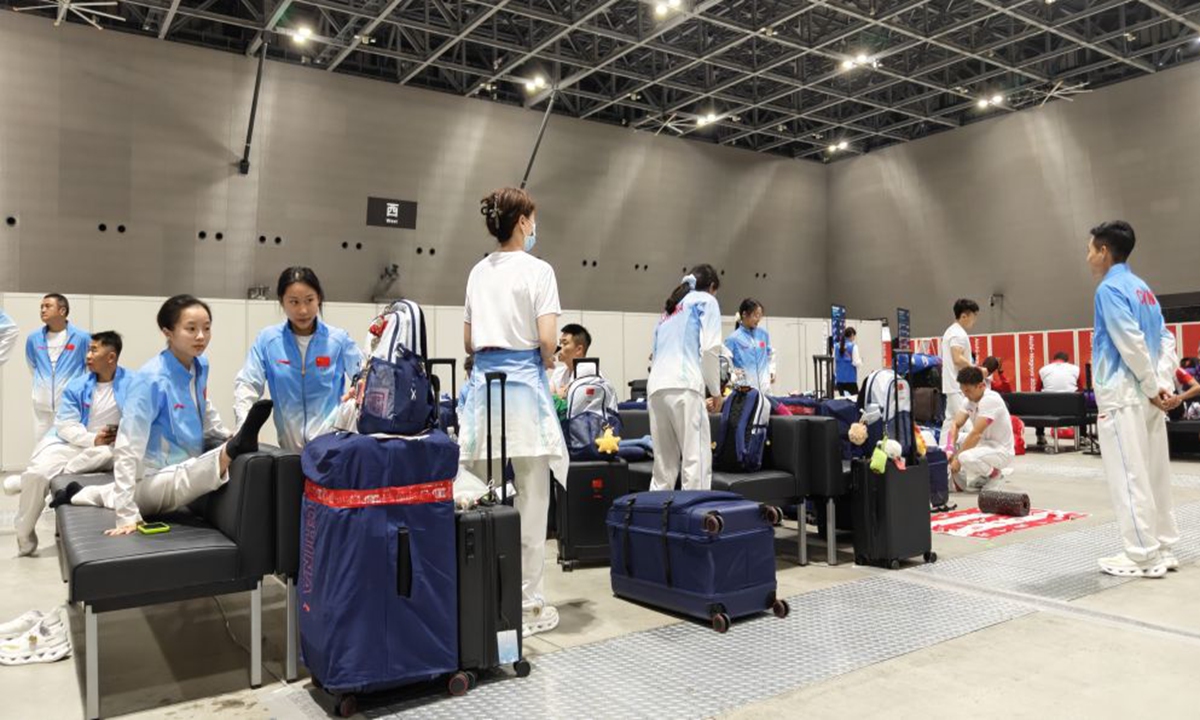
The Chinese gymnastics team is waiting at the Nagoya airport transportation center. Photos: Xinhua News Agency
Athletes from China and several other countries and regions were stranded for hours near Nagoya airport on Wednesday after transport arrangements broke down, leaving some waiting nearly six hours without food as they tried to reach their accommodations ahead of the Asian Games, Xinhua News Agency reported on Wednesday.
Members of the Chinese delegation headquarters and several teams arrived at Nagoya airport around 12:15 pm local time, ready for the upcoming Games. Their plane landed on time, but they were unable to board buses to their lodgings.
Under the plan, delegations arriving that day were to take buses from near the airport to their accommodations. By 2 pm, however, a Xinhua reporter at the airport transport center saw athletes from a number of countries and regions resting on the floor or slumped in seats as they waited, visibly exhausted, the report said.
According to the Xinhua report, an Indian rowing coach said his team had landed at about 10 am but had been waiting at the transport center for more than four hours and still could not leave.
The staff's system could not find information on athletes, so they could not arrange a vehicle, the coach said, adding that teams that arrived even earlier had also failed to get buses after waiting two to three hours.
The Chinese gymnastics team faced a similar problem. Only the information for two of its 21 team members was displayed normally in the system, which completely stalled the team's departure and left the entire squad waiting at the airport.
As the wait dragged on, Chinese athletes laid out yoga mats and used foam rollers and resistance bands to train on the spot.
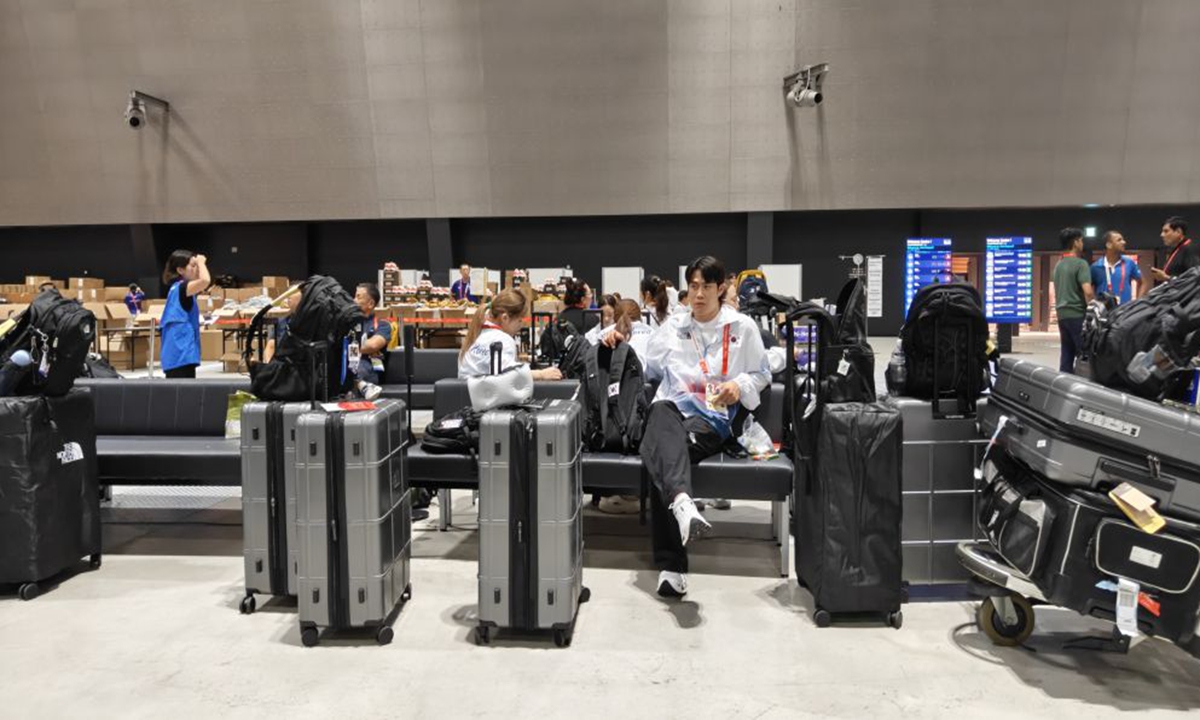
Members of the South Korean delegation are waiting at the Nagoya airport transportation center. Photo: Xinhua News Agency
Around 4 pm, Kazakhstan's shooting team prepared to leave. One athlete told Xinhua they had waited "only" more than two hours, but the staff did not tell them why they were waiting.
According to Xinhua reporting, a volunteer on site was also unsure of the specific cause of the logistical disruption, suggesting maybe one link did not connect with another. The volunteer explained that participating delegations were allowed to arrange independent transportation at their own expense.
The Chinese badminton team did not wait for the official bus and found its own way out. The squad initially attempted to take nearby public airport buses but was unable to secure enough tickets for all members. After part of the team departed separately, remaining athletes received assistance from staff at the Chinese Consulate-General in Nagoya, who coordinated vehicle rentals through local overseas Chinese communities. The entire badminton team successfully boarded chartered vehicles by around 4:30 pm, Xinhua reported.
It was not until around 5 pm that some members of the Chinese table tennis, wushu and rowing teams got buses, while the gymnastics team left at about 6 pm. By then, nearly six hours had passed since their arrival at Nagoya airport.
At the transport center, only water was provided, with no food, per Xinhua.
The incident sparked widespread discussion on Chinese social media. Hashtags including "delegations from multiple countries stranded at Nagoya airport for hours" and "Chinese table tennis team stranded at Asian Games airport with only water, no food" topped the trending list on China's X-like Sina Weibo.
Many Chinese netizens criticized the Japanese organizers for poor arrangements and inadequate logistics.
"Transport and accreditation are the most basic guarantees for a major event. This large-scale, prolonged stranding exposes insufficient pre-event testing and a lack of emergency plans by the organizing committee," one netizen wrote.
"Throughout the whole process, the organizing committee did not provide any practical help. I dare not imagine how much the training and competition of our national delegation's athletes will be affected in the coming days," one netizen commented.
"With the Games approaching, transport and accommodation are falling short. The athletes have been traveling nonstop and are physically drained. I hope it won't affect their form, and I look forward to seeing them perform well in the competition," another netizen wrote.
Global Times