Hualong One nuclear power unit goes commercial in Hainan, can support China's computing power
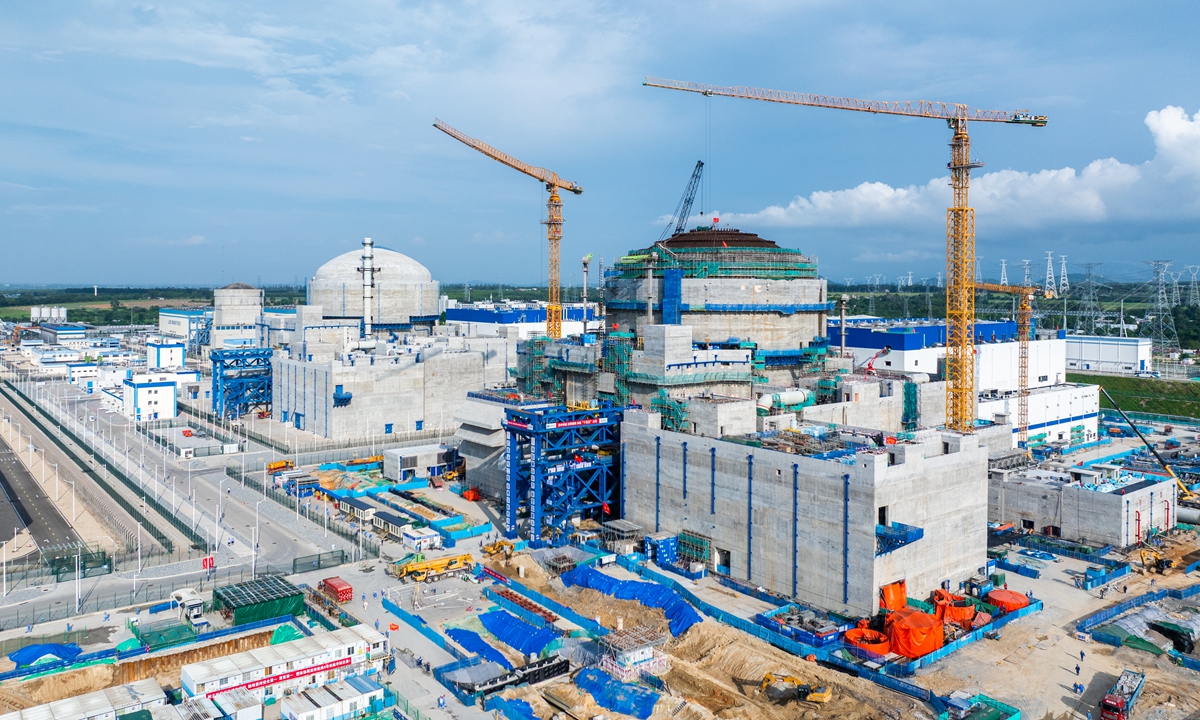
Unit 3 and Unit 4 of the Huaneng Changjiang Nuclear Power Plant in South China's Hainan Free Trade Port Photo: Courtesy of China Huaneng Group Co., Ltd
China's nuclear power sector has welcomed another major milestone, with Unit 3 of the Huaneng Changjiang Nuclear Power Plant in South China's Hainan Free Trade Port, the first Hualong One nuclear power unit in the place, entering commercial operation on Thursday, the Global Times learned from China Huaneng Group Co., Ltd.
The Global Times reporter saw at the site that Unit 4 is also undergoing further commissioning work after successfully completing its cold functional test eleven days earlier on September 6.
The Phase II project consists of two 1.2-million-kilowatt nuclear power units - Unit 3 and Unit 4. Once both units are operational, they are expected to generate 18 billion kilowatt-hours of electricity annually, saving about 6.326 million tons of standard coal and reducing carbon dioxide emissions by 11.68 million tons each year, according to information obtained by the Global Times.
The project is expected to strengthen energy security and contribute to China's "dual carbon" goals of peaking carbon emissions before 2030 and achieving carbon neutrality by 2060.
At the plant's production command center, a domestically developed large-scale nuclear power production management system integrates technologies including video surveillance, 5G communications and artificial intelligence to enable online closed-loop management of the entire nuclear power production process, with operations fully traceable.
The system can also support fourth-generation nuclear power units, providing an intelligent foundation for the digitalization and independent development of China's nuclear power industry.
"Hainan's power grid used to have a voltage level of 220 kilovolts, which on the mainland would generally be the level for a county. The 500-kilovolt grid was later introduced in Hainan, and after million-kilowatt-class units were connected to the grid, we could ensure a surplus power supply and avoid electricity shortages," Che Yu, Deputy Secretary of the Party Committee and Chairman of the Trade Union of Huaneng Changjiang Nuclear Power, told the Global Times on Thursday.
"The commissioning of nuclear power has provided a stable foundation for Hainan and helped ensure the implementation of various policies. Nuclear power is both stable and green, helping ensure the green development of the Hainan Free Trade Port," Che said.
As China accelerates the development of its new power and energy systems, nuclear power is also being explored for emerging applications beyond conventional electricity generation.
As of the end of June, China's operational nuclear power capacity had reached 66.14 million kilowatts, up 8.6 percent year-on-year. The country added 3.62 million kilowatts of net nuclear power capacity during the first half of the year, while nuclear power generation reached 234.6 billion kilowatt-hours during the period.
Breakthroughs have also been made in key technologies, including high-temperature gas-cooled reactors, small modular reactors, fast reactors and fusion reactors, with nuclear power providing increasing support for energy security and the development of new power and energy systems.
The rapid development of AI has meanwhile made computing power an increasingly important resource, while also creating growing demand for electricity.
"The end point of computing power is energy, and the end point of energy is electricity. The US is already grappling with this issue as computing power becomes increasingly dependent on energy," Che said.
"At present, given Hainan's overall power generation capacity and electricity output, we are fully capable of supporting the establishment of a computing power center in Hainan. Its eventual implementation will depend on the country's overall planning for computing power," he added.
The plant has also strengthened its preparedness for extreme weather. From the site-selection stage, long-term data on earthquakes, typhoons, tsunamis and other extreme weather events were comprehensively assessed, according to Che. To avoid affecting the ecosystem, the company also changed the construction plan and adopted an undersea shield-tunneling method to bypass the coral area, with an additional cost of 300 million to 400 million yuan to ensure that the surrounding ecosystem would not be damaged.
RELATED ARTICLES