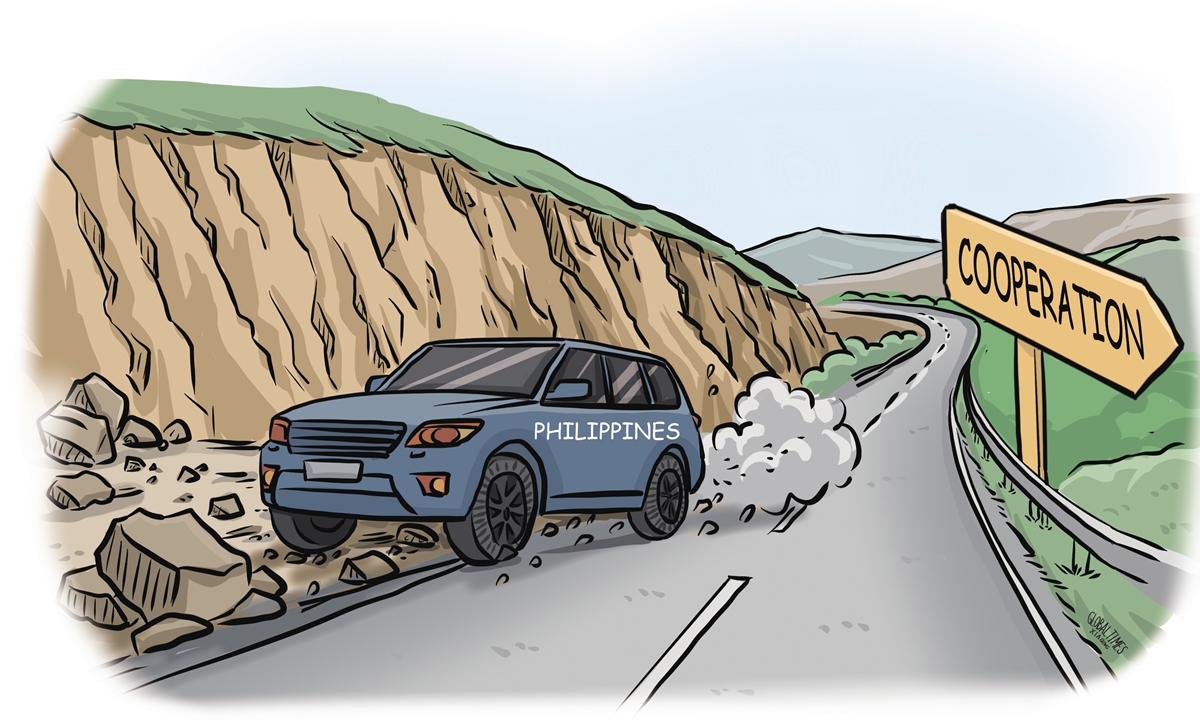
The Philippines Illustration: Xia Qing/GT
Lai Ching-te authorities of the Taiwan region are up to another mischievous gambit in Southeast Asia.
Recently, Lin Chia-lung, head of the Taiwan region's so-called external affairs authorities, confirmed that Taiwan was preparing to open a "representative's office" in Cebu, the Philippines, and plan to use it to create a "Taiwan-Philippines economic corridor" that would link up with the so-called "Luzon Economic Corridor," a project launched by the Philippines, the US and Japan. He also framed discussions on the Taiwan region and the Philippines within the context of the "first island chain" and "single theater of operations."
This arrangement goes beyond routine economic and trade cooperation and carries a clear intent to expand the Taiwan authorities' "diplomatic presence," embed them into US regional strategy, and strengthen security linkages between the Taiwan region and the Philippines. If the Philippines were to facilitate this, it would directly undermine the one-China principle, exacerbate the interlinkage of risks in the Taiwan Straits and the South China Sea, and harm regional peace as well as Philippines' own interests.
The "Taiwan-Philippines economic corridor" envisioned by the Lai authorities carries political functions far exceeding those of economic and trade cooperation.
The policy details released by Taiwan's "external affairs department" confirm that this is a collusive gambit between the Taiwan region and the Philippines designed to build ties of interest through economic projects, establish a long-term foothold via "representative's office," promote official interactions through industrial security, and thereby create the false impression that the Taiwan region possesses a "independent international status."
This represents a further escalation of the Lai authorities' strategy of "seeking independence through economic means" and marks a shift in the "New Southbound Policy" from an emphasis on economic, trade and people-to-people exchanges toward supply chain restructuring, security cooperation and bloc confrontation.
The deeper danger of the "Taiwan-Philippines Economic Corridor" lies in its attempt to link the Taiwan Straits with the South China Sea, thereby incorporating the Philippines into a security network built around the Taiwan question. The Lai authorities are cooperating with the US to promote the integration of regional security mechanisms, attempting to consolidate the Bashi Channel, northern Luzon and the island of Taiwan into a unified military and strategic operational space. This concept blurs the lines between economic, security and military issues, making it prone to serious spillover risks. When the Cebu "office" assumes its functions of political coordination and strategic liaison, its nature will undergo a fundamental change, exposing the Philippines to the very real danger of being drawn into a conflict across the Taiwan Straits. The so-called strategic position gained by the Philippines is, in essence, an increase in its exposure to risk.
If the Philippines colludes with the Lai authorities, it will not only harm the Philippines' national interests but also run counter to the widespread aspiration of Southeast Asian nations to maintain strategic autonomy. Southeast Asia needs connectivity, industrial upgrading and stable markets. It has no desire to become a frontline of major-power rivalry.
Deviation from the one-China principle will inevitably deplete the Philippines' national interests. In doing so, the Philippines is burning its own national credibility.
When a country's national credibility is depleted, the stability of its foreign relations and policy reliability will suffer. The Philippines, in particular, needs to weigh the economic costs arising therefrom.
The Lai authorities are attempting to use economic cooperation to achieve a political breakthrough, while a handful of Filipino politicians are trying to use the Taiwan question to gain leverage in their strategic competition with China. The political calculations of both Lai authorities and the Philippines are based on misjudgments.
The historical trend toward China's reunification will not be altered by a single "representative's office," nor will the regional trend toward peaceful development in Southeast Asia be reversed by a few political forces. The Lai authorities should cease "relying on foreign forces to seek independence," while the Philippines should demonstrate through concrete actions its commitment to the one-China principle and refrain from taking any actions that would harm China-Philippines relations.
The author is director of the Institute of Political Science and professor at the Institute of Taiwan Studies, Beijing Union University. opinion@globaltimes.com.cn
RELATED ARTICLES