China-ASEAN Expo kicks off in S.China's Guangxi
CAFTA 3.0 implementation takes center stage, bringing certainty amid global protectionist headwinds
By and Zhang Yashu in Nanning Published: Sep 17, 2026 10:18 PM
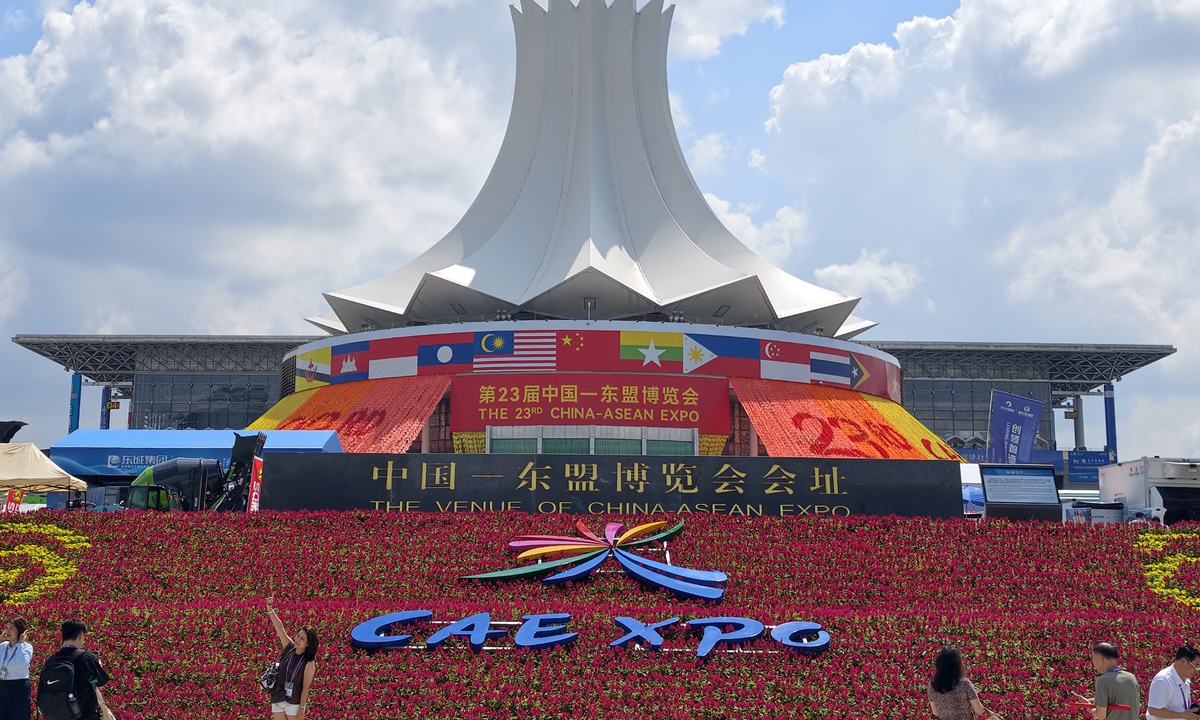
Visitors head to the Nanning International Convention and Exhibition Center to attend the 23rd China-ASEAN Expo (CAEXPO) that opens on September 17, 2026. Photo: VCG
The aroma of coffee, scent of fruits and a chorus of chatting between Chinese buyers and company representatives from the Association of Southeast Asian Nations (ASEAN) dominated the Nanning International Convention and Exhibition Center on Thursday as the 23rd China-ASEAN Expo (CAEXPO) and China-ASEAN Business and Investment Summit kicked off in Nanning, China's Guangxi Zhuang Autonomous Region.From Timor-Leste's "state gift coffee" and various Chinese medicinal herbs from Laos to Indonesian garments and Vietnamese cold-chain food, large, medium and small enterprises from ASEAN countries pulled out all the stops to attract the attention of Chinese traders.
With the spotlight on new business opportunities under the China-ASEAN Free Trade Area (CAFTA) 3.0 framework and on the application of emerging artificial intelligence (AI) technologies, the 2026 CAEXPO served as a catalyst for further deepening the win-win economic and trade cooperation between China and ASEAN member states, participants to the expo and analysts said.
The CAEXPO has drawn the participation of more than 3,400 companies from over 70 countries and regions, event organizers said on Wednesday. Covering about 170,000 square meters and showcasing the latest achievements in China-ASEAN cooperation, the event is scheduled to run from Thursday to next Monday.
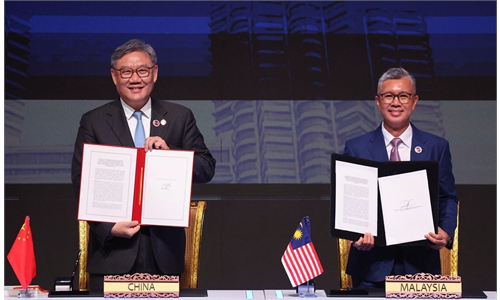
The year 2026 marks the fifth anniversary of the establishment of the China-ASEAN Comprehensive Strategic Partnership and a crucial year for implementing the China-ASEAN Free Trade Area (CAFTA) 3.0 Upgrade Protocol after it was officially signed in Kuala Lumpur, Malaysia in October 2025.
Highlighted by robust bilateral trade, the CAEXPO serves as an exemplar of mutually beneficial and win-win cooperation between nations and injected much needed certainty and stability amid rising protectionist and unilateral headwinds into the world, analysts said.
FTA highlight
Under the theme "CAFTA 3.0 Opportunities, Better Life", this year's expo features products and projects in areas ranging from traditional industries to digital communications, green development and AI.
Pham Thi Thanh Huong, CEO of Viettutea from Vietnam's Quang Ninh, told the Global Times on Thursday that her company is attending the CAEXPO for the third time and is in the process of building up a business network with Chinese buyers.
In recent years, trade facilitation between China and Vietnam has allowed us to export tea products to China with zero tariffs, helping our business, Pham said.
Ong Tee Keat, president of the Belt and Road Initiative Caucus for Asia-Pacific, told the Global Times on Thursday that the CAEXPO is a primary state-level catalyst for expanding trade, investment, and regional integration between China and ASEAN member states. "To a large extent, it is a multilateral trading platform mirroring the aspirations and priorities underscored by the CAFTA," he said.
With the fruition of the upgrade protocol CAFTA 3.0, CAEXPO acts as a testing ground for implementing advanced provisions under the broader CAFTA framework, Ong said.
"In recent years, the CAEXPO has been spotlighting applications in digital intelligence and artificial intelligence, alongside e-commerce platforms to make the expo event time-relevant. Electric vehicles, battery technologies and photovoltaic products are earmarked as the new economic drivers dominating the China-ASEAN partnership," noted Ong.
As one of the event's highlights, Timor-Leste participated for the first time as a full ASEAN member and a co-host of the expo, bringing all 11 ASEAN member states together in Nanning following the bloc's expansion.
Nuno Ridenio, founder with Ava Siak, a coffee and roastery company from the country, said this is the first time he attended the event and was impressed by its size.
"We work with some 100 coffee growers back in Timor-Leste. China is one of the biggest markets in the world, and it represents a great opportunity for my country, my company and products in my country," Ridenio told the Global Times on Thursday.
The latest trade figures also underscored the strong connectivity between China and Southeast Asian countries.
China has remained ASEAN's largest trading partner for 17 consecutive years, while ASEAN has been China's largest trading partner for six successive years, according to the Xinhua News Agency.
In the first eight months this year, China-ASEAN trade reached $862.75 billion, up 25.6 percent year-on-year, data from China's General Administration of Customs showed. Both imports and exports posted double-digit growth.
Wichai Kinchong Choi, a senior expert at Thailand's Kasikorn Bank, told the Global Times on Thursday that this year's CAEXPO is set to focus on the concrete implementation of CAFTA 3.0, opening markets and expanding business opportunities.
Being a crucial year, Chinese and ASEAN leaders are expected to formulate relevant plans, vigorously promote an AI-centered digital economy, strive to develop green and low-carbon new energy industries, and further increase the high-tech content of investment cooperation, Choi said.
In recent years, the technological content of Chinese investment in Thailand has been rising steadily, notably in the fields of electronic components, circuit boards, smart home appliances, data centers and electric vehicles. These investments are highly consistent with the direction of Thailand's industrial development, Choi said.
Xu Liping, director of the Center for Southeast Asian Studies at the Chinese Academy of Social Sciences, told the Global Times on Thursday that the robust trade and investment performance between China and ASEAN in the first eight months of the year has demonstrated what further institutional opening up can bring to an already immense trade relationship.
Institutional opening via the implementation of the CAFTA 3.0 Upgrade Protocol, cooperation that benefits the people and increasingly high-tech content became the dominant themes of this year's expo, Xu said.
Mega infrastructure
This year's CAEXPO is coupled with the opening of the Pinglu Canal, a landmark project strengthening regional land-sea connectivity on Wednesday.
The 134.2-kilometer-long Pinglu Canal is expected to reduce overall logistics costs by 18 to 30 percent and save more than 5 billion yuan in transportation costs each year.
Some attendants from ASEAN countries have noted the value of this mega infrastructure project, which is a part of the New International Land-Sea Trade Corridor, a strategic trade route connecting China's inland regions with ASEAN and other global markets.
"Congratulations for the launch of this very interesting project of the Pinglu Canal. This will be a very impressive project to make logistics and transportation between the southern part of China and ASEAN much more productive and effective," Siwadee Suksawate, director of the Guangzhou Office of Thailand's Board of Investment, told the Global Times on Thursday.
"This will be such a big opportunity for both Chinese entrepreneurs and Thai entrepreneurs and even ASEAN entrepreneurs all around the region," the Thai official said.
Xu said what the Pinglu Canal brings is not just hard connectivity but also closer people-to-people exchange and rising awareness for a community with a shared future.
With the mega canal and an expo that boosts trade and investment, China is opening up wider to the world to share its development dividends, Xu said, noting that a win-win relationship between China and ASEAN injects greater certainty and stability into global trade amid rising protectionist and unilateral headwinds.
RELATED ARTICLES