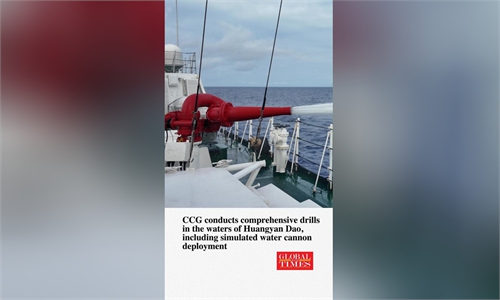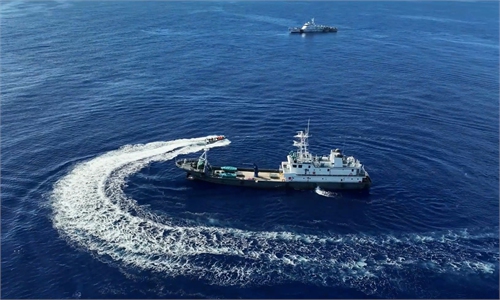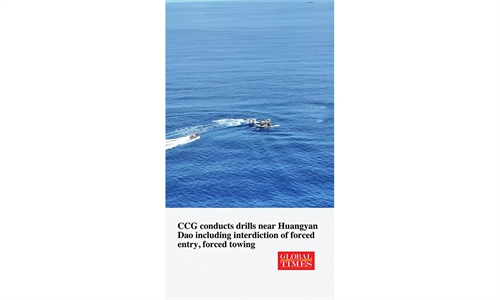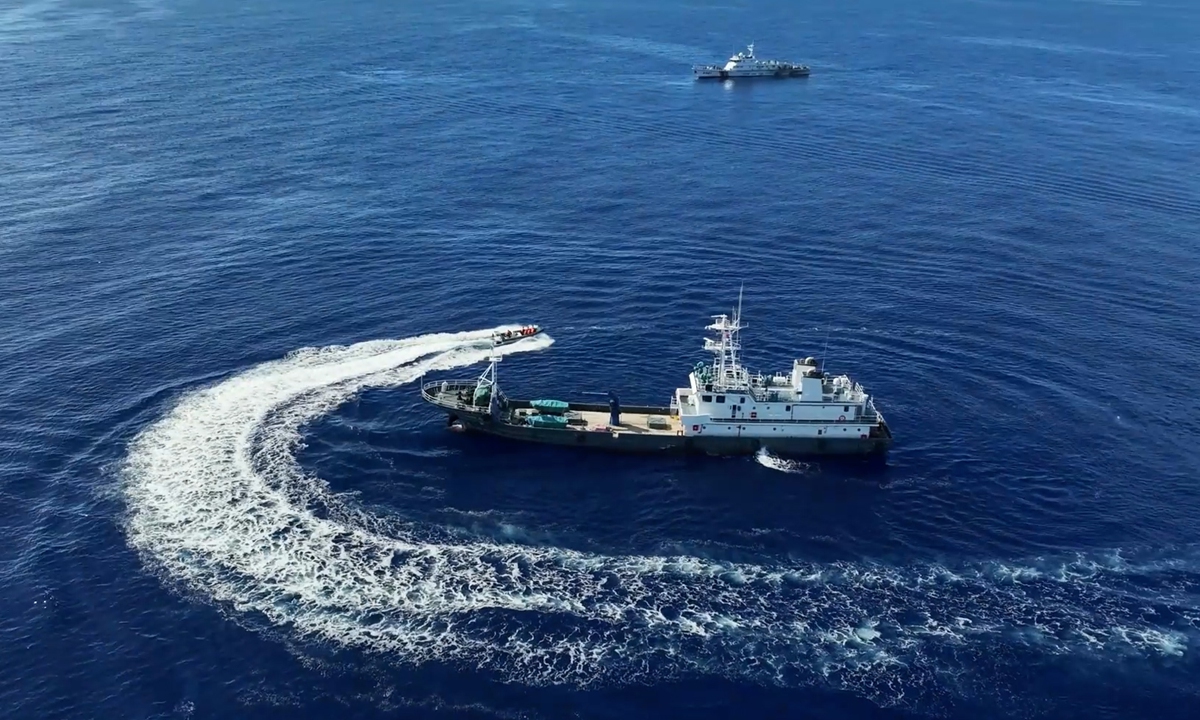
China Coast Guard (CCG) vessels conduct drills on rights-protection law enforcement, as well as management and control in the waters near China's Huangyan Dao on August 1, 2026. Photo: Courtesy of CCG
On September 18, a Chinese Coast Guard (CCG) vessel, named the Sanzhou'ao, was conducting lawful rights protection and law enforcement operations in accordance with the law in waters near Xianbin Jiao in the Nansha Islands. Philippine vessel 3015 ignored repeated warnings from the Chinese side, deliberately altered its course and suddenly accelerated diagonally across the bow of the CCG vessel, resulting in a collision.This was a dangerous maritime incident entirely provoked by the Philippine side; the Philippines' deliberate provocation was extremely reckless and irresponsible.There are basic rules for navigation at sea. The bow of a vessel is a critical blind spot and high-risk area during navigation. Actively accelerating to cut across another vessel's bow course is a classic example of dangerous coercive maneuvering at sea, which can easily lead to loss of control, severe damage to the vessel, or even serious maritime accidents resulting in the vessel's destruction and loss of life. The Philippine crew were fully aware of the enormous risks involved in this maneuver. Despite knowing they had no chance of success, they still took the risk, with the sole purpose of creating friction and incidents, maliciously fabricating the false impression of "Chinese pressure," and garnering public attention for their infringing actions.
As expected, the Philippines immediately pulled a well‑rehearsed trick after the incident. A spokesperson for the Philippine Coast Guard accused China of "ramming" the Philippine vessel, claiming that the ship was conducting a fuel subsidy mission for "Philippine fishermen."
The pretext of a "civilian mission" cannot conceal the essence of their dangerous provocation, nor can it alter the fundamental fact that Xianbin Jiao is an inherent part of China's Nansha Islands and that China possesses indisputable sovereignty over it and the surrounding waters.
September 18 is a date of special significance to Chinese people. Whether by coincidence or design, the Philippine side's choice to provoke on this day will not yield it any advantage whatsoever; it will only plunge itself into a more dangerous situation.
China loves peace and cherishes stability, but it fears no conflict and will never yield on its bottom line. Faced with Manila's egregious behaviour of deliberately triggering dangerous incidents and openly defying China's jurisdictional red lines, China's restraint is not boundless.
If Manila simply wants to demonstrate that it is "butting its head against a stone," then let it do so; Each challenge of this kind will surely cost it dearly. China will never indulge such coercive posturing.
RELATED ARTICLES