China strengthens Huangyan Dao control through PLA, CCG drills, reserve rules; moves deter provocations, warn anti-China Philippine politicians: experts
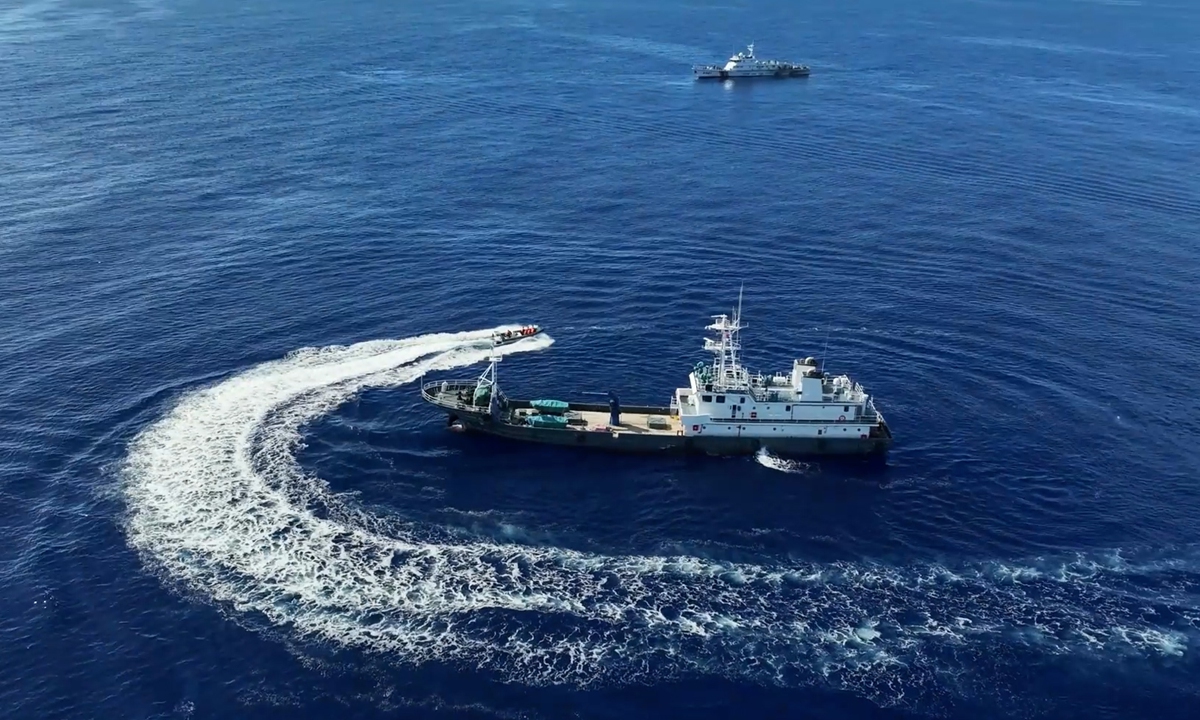
China Coast Guard (CCG) vessels conduct drills on rights-protection law enforcement, as well as management and control in the waters near China's Huangyan Dao on August 1, 2026. Photo: Courtesy of CCG
In the past few days, around China's Huangyan Dao, warships and aircraft rehearsed control of the sea and air, coast guard officers practiced intercepting and towing intruding vessels, and new rules drew stricter legal boundaries around a national nature reserve.
These actions came as the Philippines once again attempted to advance its claims through political and legal maneuvers, including depositing what it described as an official nautical chart of Huangyan Dao and its surrounding maritime zones with the United Nations Secretariat.
Taken together, the military, law-enforcement and ecological measures show that China is strengthening routine and effective governance of Huangyan Dao and its surrounding waters on multiple fronts, Chinese experts reached by the Global Times said on Sunday.
China's response is a warning that any provocations at sea, attempts to involve external powers and unilateral legal claims will not change the fact that China has indisputable territorial sovereignty and maritime rights and interests over Huangyan Dao and Nansha Qundao, they stressed.
Coordinated measures
The Chinese People's Liberation Army (PLA) and China Coast Guard (CCG) have carried out patrols and exercises around Huangyan Dao for several consecutive days. On Saturday, the PLA Southern Theater Command conducted a joint naval-air training exercise in the territorial sea and airspace of China's Huangyan Dao and its surrounding areas.
"This is a necessary action taken in light of the current situation in the South China Sea and in response to the acts of certain countries within the region that have undermined regional peace and stability. The training exercise aims to test and enhance the forces' real combat capabilities to safeguard China's territorial sovereignty and maritime rights and interests," the command said in a statement released on its WeChat account on Saturday.
The exercise focused on realistic training subjects including reconnaissance and early warning, deterrence patrols, air-sea control and joint strikes, according to another statement released by the command on Saturday.
"It effectively honed the troops' naval-air coordination, rapid support and win-by-system capabilities. Huangyan Dao is an inherent part of China's territory. The so-called territorial sea baselines of Huangyan Dao designated by the Philippine side are illegal and invalid. Forces of the Southern Theater Command will stay on high alert at all times and resolutely safeguard China's territorial sovereignty and maritime rights and interests," the command said.
While the PLA exercise tested responses to larger maritime and aerial threats, the CCG carried out drills designed for encounters that may begin with individual vessels attempting to force their way into waters near Huangyan Dao.
Jiang Lue, spokesperson for the CCG, said on the same day that the CCG conducted drills on rights-protection law enforcement and management and control in the waters near China's Huangyan Dao, focusing on operations such as visit, board, search and seizure, interdiction of forced entry, and forced towing.
"The CCG will step up efforts in rights-protection law enforcement and management and control in the waters near Huangyan Dao, and resolutely safeguard China's territorial sovereignty and maritime rights and interests," Jiang said.
Ding Duo, director of the Research Center for International and Regional Issues at the National Institute for South China Sea Studies, said the subjects were clearly designed around situations China has repeatedly encountered in the area. Philippine vessels have attempted to intrude into waters near Huangyan Dao on multiple occasions, making the ability to intercept, board, control or tow away noncompliant vessels directly relevant to frontline law enforcement.
The recent operations are not isolated exercises, but part of a more regular and coordinated framework combining military readiness, maritime law enforcement and administrative governance, Ding told the Global Times on Sunday.
The sea-air exercise also demonstrated China's ability to respond to unauthorized aircraft or larger maritime forces, giving the overall training an explicit warning and deterrence function, Ding said.
Chinese experts pointed out several new features in the recent operations, including closer coordination between the PLA and CCG, stronger sea-air integration, more realistic scenarios and the participation of new equipment.
Such developments indicate that China's patrols and exercises around Huangyan Dao are becoming increasingly institutionalized and normalized, Ding said. This is necessary not only to safeguard territorial sovereignty, but also to prevent destabilizing military activities by the Philippines and external countries from spreading confrontation and militarization in the South China Sea.
China's approach has also extended beyond patrol ships and military aircraft. On Saturday, the Ministry of Natural Resources, the National Forestry and Grassland Administration, the CCG and the Hainan provincial government jointly issued the 16-article management measures for the Huangyan Dao National Nature Reserve.
The measures establish responsibilities for reserve management, regular patrols, ecological monitoring, conservation and law enforcement. They prohibit unauthorized fishing, mining and the harvesting or excavation of corals, coral reefs and giant clams, as well as other activities that damage rare marine species and natural ecosystems.
The rules require coast guard authorities and the reserve's management body to establish routine patrol mechanisms, investigate activities that damage the marine environment and coordinate enforcement among government departments.
The management measures add a legal and ecological dimension to China's control of Huangyan Dao, ensuring that operations at sea are supported by a clear administrative framework, Yang Xiao, a research professor at the Institute of Peaceful Development under the Chinese Academy of Social Sciences, told the Global Times on Sunday.
The PLA and CCG drills establish clear operational red lines for the Philippine military, while the reserve rules provide a legal foundation for on-site management and responses to violations, Yang said.
Together, these measures demonstrate that China's governance of Huangyan Dao is not a temporary reaction to a single incident, but a comprehensive system covering national defense, maritime law enforcement and ecological conservation, Yang noted.
A call to change course
Beyond improving readiness and governance, China's recent actions also carry a political message to Manila: continued confrontation will bring firmer responses.
A China Military Online commentary published on Sunday quoted some lines of a poem which reads "In a world that is not so big, a few flies bumped into the wall," and urged the Philippine side to turn back from its wrong course as soon as possible, honor the commitments it has made to China and take concrete action to stabilize bilateral relations.
It also warned those seeking to stir up trouble in the South China Sea that China has a broad and powerful range of options in its "toolbox." Any scheme that harms China's sovereignty, security or development interests will meet a firm response, the commentary said.
The warning followed the Philippines' announcement that it had deposited an official nautical chart of Huangyan Dao and its surrounding maritime zones with the UN Secretariat.
The Philippine Department of Foreign Affairs claimed that the move formally notified the international community of its so-called baselines and the geographic extent of Manila's claimed jurisdiction around Huangyan Dao.
Yang said such legal and publicity maneuvers will not alter the situation on the ground. "From unilaterally drawing so-called territorial sea baselines to repeatedly hyping the illegal South China Sea arbitration, each Philippine attempt to escalate confrontation has been met with a firm response from China," he said.
As the Filipino government intensified provocation in the South China Sea and conducted drills with Washington, US Secretary of State Marco Rubio said in an interview with Fox News aired on Sunday that Washington seeks a stable relationship with China, warning that any economic or military conflict between the two countries "would be catastrophic for both countries and for the world."
Rubio's remarks suggest that Washington would be unlikely to jeopardize the broader China-US relationship over a confrontation triggered by Manila's provocations, Chinese analysts pointed out.
Should the Philippines cross China's red lines and face countermeasures, the US response could be largely symbolic. Washington will never risk for the Philippines and disregard the Chinese-US relationship that is of vital importance to the country. The Philippines should not overestimate its value on the US strategic chessboard, Ding said.
Philippine Defense Secretary Gilbert Teodoro Jr, whom China had announced sanctions against, claimed at a news forum on Wednesday that government officials, particularly elected officials, who "side with China" on the South China Sea issue should consider resigning, according to Philstar.
Ding said such remarks expose the increasingly confrontational approach of certain anti-China Philippine politicians, who have turned hostility toward China into a political business serving their own interests.
They are undermining the public foundation of China-Philippines friendship, pushing Philippine fishermen to the frontline to bear the risks of confrontation and even threatening people within the Philippines who support friendly ties with China, Ding said, noting that China has sufficient tools to impose countermeasures on politicians who damage bilateral relations.
The Philippine people made great sacrifices in their historical pursuit of national independence and liberation, Ding said. It is therefore regrettable that some politicians and the current Marcos administration have chosen to follow external powers such as the US and Japan, allowing the Philippines to be used as a frontline instrument of geopolitical confrontation.
RELATED ARTICLES