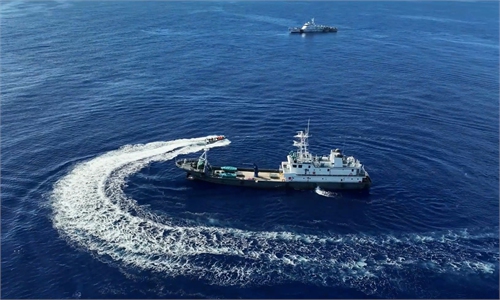
Exclusive footage shows Philippine vessel repeatedly cutting across CCG vessel’s bow before collision
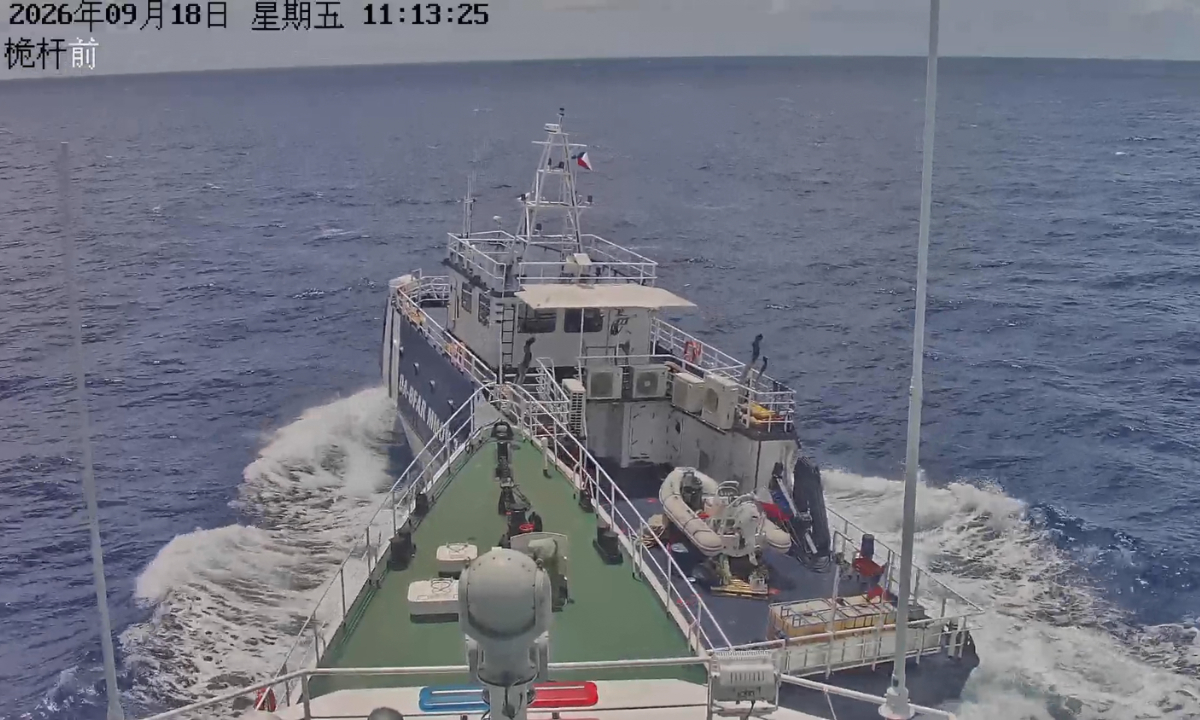
A Philippine vessel deliberately cuts across the path of the Chinese coast guard vessel Sanzhou’ao, causing a collision on September 18, 2026.
Exclusive footage obtained by the Global Times on Friday shows a Philippine vessel twice cutting diagonally across the bow of the China Coast Guard (CCG) vessel Sanzhou'ao within 10 minutes, with the second maneuver causing a collision. A Chinese maritime expert said the maneuvers are deliberate interference with the Chinese vessel's navigation.
The two clips show a vessel bearing the markings "DA-BFAR MMOV 3015" crossing in front of the Chinese vessel from its right side at 11:04 am and again at 11:13 am on Friday. The Philippine vessel showed no visible attempt to avoid a collision during either maneuver. After completing the first crossing and reaching the Chinese vessel's left side, it appeared to begin turning back toward the right.
During the second crossing, the Philippine vessel accelerated as it approached the Sanzhou'ao. Instead of adjusting its course to avoid contact, it continued accelerating and struck the Chinese vessel.
The Philippine vessel is an approximately 300-ton government vessel operated by the Bureau of Fisheries and Aquatic Resources, an agency under the Philippine Department of Agriculture. Observers noted that Philippine vessels of this type have frequently taken part in confrontations in the South China Sea in recent years, including multiple collisions with CCG vessels.
The 1972 Convention on the International Regulations for Preventing Collisions at Sea requires vessels to take action to avoid collisions, Chen Xiangmiao, director of the World Navy Research Center at the National Institute for South China Sea Studies, told the Global Times on Friday.
The Philippine vessel's repeated, deliberate approaches and attempts to cross ahead of the Chinese vessel clearly violated the convention, Chen said.
"The Philippine vessel deliberately cut into the Chinese coast guard vessel's path from the starboard side twice. After the Chinese vessel avoided a collision the first time, the Philippine vessel again interfered with its normal navigation, ultimately causing a collision," Chen said, describing the maneuvers as deliberate interference.
Both the CCG and China's Foreign Ministry responded to the incident on Friday.
CCG spokesperson Jiang Lue said the Sanzhou'ao was conducting lawful rights protection and law enforcement operations in the area on Friday when Philippine vessel 3015 deliberately changed course and suddenly accelerated to cut diagonally across its bow, resulting in a collision.
The Philippine vessel's actions seriously violated international law and basic norms governing international relations and threatened the safety of CCG vessels and personnel, Jiang said. The Chinese vessel's operations were professional, standardized, reasonable and lawful, thus the responsibility lay entirely with the Philippine side, he added.
"We sternly warn the Philippine side to immediately stop all acts of infringement and provocation, or bear all consequences arising from them," Jiang said.
Asked about the incident, Chinese Foreign Ministry spokesperson Guo Jiakun urged the Philippines to immediately stop its acts of infringement and provocation at sea and stop spreading false narratives and distorting the facts.
China will continue to firmly defend its territorial sovereignty and maritime rights and interests, and firmly safeguard peace and stability in the South China Sea, Guo said.
The collision drew coverage from several Philippine media outlets and statements from Philippine officials.
Chen said this was not the first time Philippine vessels had carried out dangerous maneuvers and then portrayed themselves as victims. Philippine vessels have repeatedly engaged in dangerous actions in the South China Sea that violate maritime navigation rules and the United Nations Convention on the Law of the Sea, he said.
The CCG will continue conducting rights protection and law enforcement operations in waters under China's jurisdiction to safeguard national territorial sovereignty and maritime rights and interests, Jiang said.
RELATED ARTICLES