Motorist overtaken 18 times in 200 meters on road sparks debate over 'turtle-speed' driving
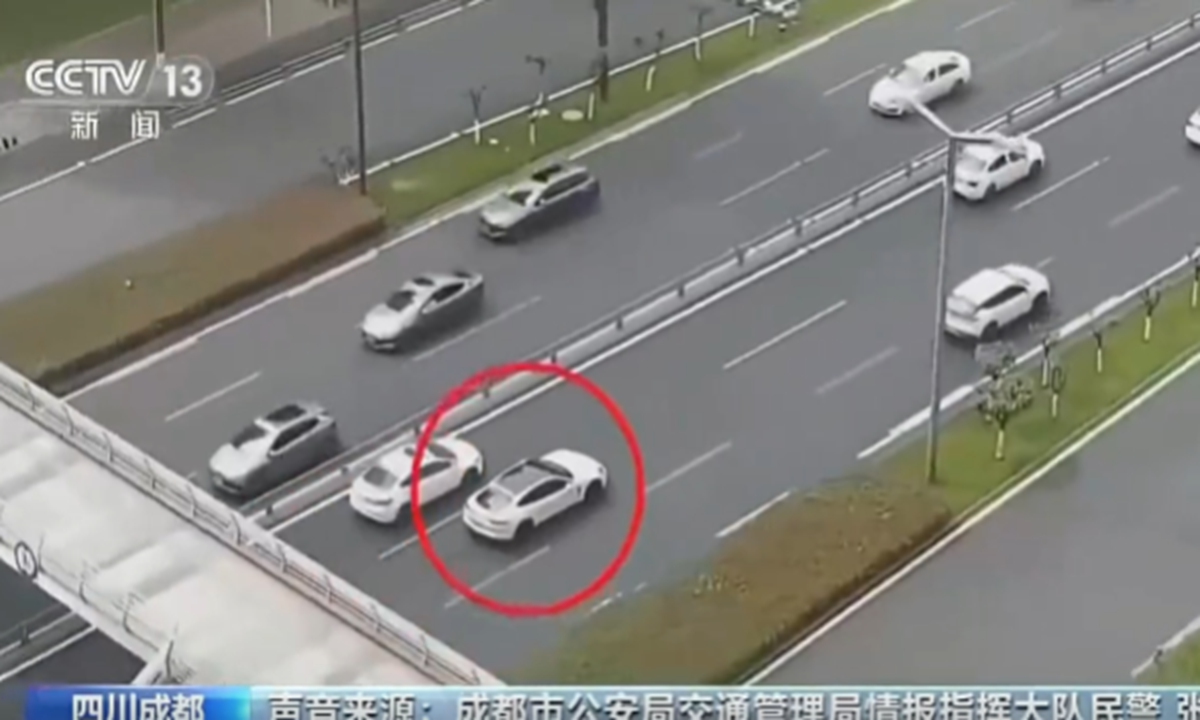
The vehicle circled in red was overtaken 18 times within just 200 meters. Photo: CCTV News
Ever found yourself getting frustrated with a painfully slow driver on the road? One motorist in Chengdu, Southwest China's Sichuan Province, recently tested the patience of quite a few drivers — being overtaken 18 times in a stretch of just 200 meters.The unusually slow drive has sparked heated discussion online after Chengdu traffic police released the case as an example of so-called "turtle-speed driving."
A review of surveillance footage revealed there was more to the story: The driver was scrolling on a mobile phone while behind the wheel. Police later penalized the driver, CCTV News reported.
Since April 2025, traffic police in Chengdu have used an intelligent monitoring system specifically designed to identify unusually slow-moving vehicles. When a vehicle is overtaken too many times and ranks among the slowest vehicles, the system can flag it automatically, alert the driver and help police check for behaviors such as using a phone while driving.
Driving slowly is not necessarily safer. "Turtle-speed driving" generally refers either to driving below a legally prescribed minimum speed or traveling far more slowly than the surrounding traffic under normal road conditions.
On Chinese freeways, for example, the minimum speed is 60 kilometers per hour.
The problem is not simply that slow drivers can be annoying. Data cited by CCTV News showed that road capacity drops by about 15 percent for every 10-kilometer-per-hour reduction in vehicle speed. Large speed differences can also force other motorists to brake, change lanes, or overtake more frequently, causing traffic risks.
And then there is road rage. Traffic congestion caused by extremely slow vehicles can easily fray other drivers' nerves.
Many netizens appeared to have little sympathy for the Chengdu motorist. Some called for drivers using electronic devices behind the wheel to be pulled over and fined, while others argued that extremely slow driving, particularly on highways, should face tougher penalties.
Global Times
RELATED ARTICLES