State media program confirms PLA Air Force J-35A codename Yunlong, expert says naming reflects both capabilities, cultural symbolism
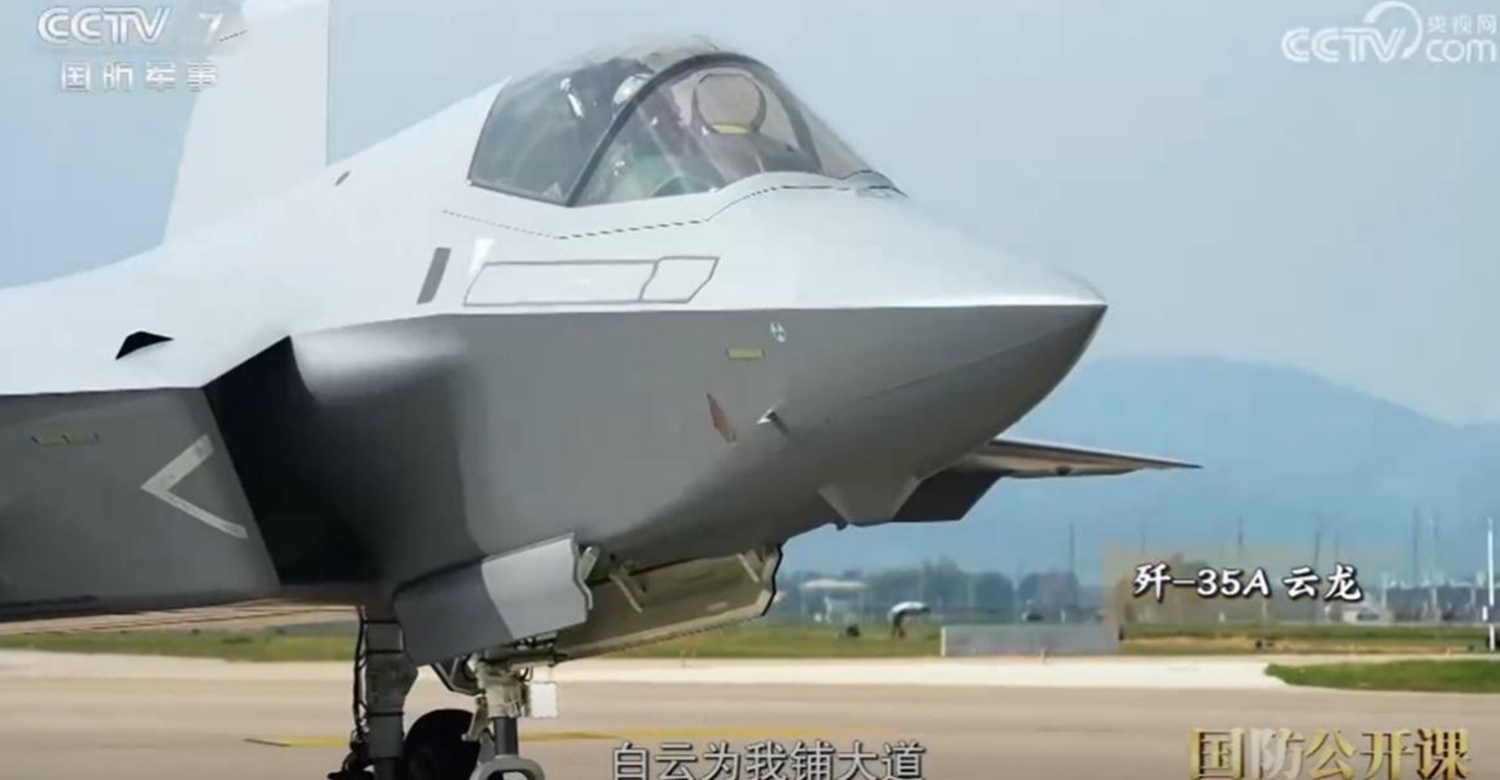
The PLA Air Force J-35A stealth fighter jet Yunlong Photo: Screenshot from CCTV News
A state media program aired on Saturday night labeled the J-35A stealth fighter with the codename Yunlong (Cloud Dragon/Loong). A Chinese military expert said this appears to be the first official confirmation of the fighter's codename, which reflects both its capabilities and Chinese cultural symbolism. China's proactive release of its own codenames for warplanes in recent years signals a new emphasis on commanding naming discourse, a shift from passive acceptance to active shaping, the expert said.The program was a special broadcast for China's 26th National Defense Education Day, telling defense stories from different historical periods and fields of endeavor. In one segment, several PLA Air Force aircraft were introduced one by one with their codenames: the J-10 Menglong (Vigorous Dragon), J-11 Yinglong (Winged Dragon), J-16 Qianlong (Hidden Dragon), J-20 Weilong (Mighty Dragon), J-35A Yunlong, H-6K Zhanshen (God of War) and Y-20 Kunpeng (Giant Roc).
In September 2025, a CCTV military channel program designed tail-fin artwork for four Air Force fighters - the J-35A, J-20, J-10 and J-16. When introducing the design concept, it noted that the designers integrated their inspiration with the names of the planes to create a cultural identity unique to Chinese warplanes.
Since the other three names could be matched to their designation numbers, some Chinese military enthusiasts on social media at the time suggested this implied that Yunlong was the official codename for the J-35A.
With CCTV now labeling the J-35A as Yunlong, Zhang Junshe, a Chinese military affairs expert, told the Global Times that this can be seen as official confirmation of the fighter's codename.
In traditional Chinese culture, a dragon can fly and swim, and is not only endowed with many auspicious meanings but also represents bravery and wisdom.
Zhang said that the naming convention for the PLA Air Force's "dragon" series of fighters follows the principle of "performance match plus cultural empowerment." The names precisely match the aircrafts' performance, reflecting their operational roles and characteristics.
For example, CCTV reported the J-16 is named Qianlong, or Hidden Dragon, fitting its core role in multi-role stealth strikes and electronic warfare suppression. Its electronic warfare pod can emit wideband jamming beams, cloaking the battlefield electromagnetic spectrum like a divine dragon's breath.
The all-weather, single-engine, single-seat multirole light fighter jointly developed by China and Pakistan was named Xiaolong (JF-17 Thunder). The name derives from its agility, speed and multirole adaptability - taking the keen sight of the owl (xiao) and the power and agility of the dragon (long), with standout features including long range flight, extended endurance, large combat radius and excellent takeoff and landing performance, CCTV said.
Zhang supposed that Yunlong comes from a line from the Chinese classic I Ching: "Clouds follow the dragon, wind follows the tiger." It suggests a fighter moving like a divine dragon weaving through clouds, appearing and disappearing without a trace, perfectly matching the J-35A's low observability and high maneuverability as a fifth-generation stealth fighter.
The cultural logic behind this naming system is not merely a replication of tradition but a reflection of the spirit of the times. From Menglong to Weilong and Yunlong, it reflects the PLA Air Force's evolution from agility to strategic deterrence, then to stealth air superiority, mirroring the confidence of China's aviation industry and the rise of major national assets, Zhang emphasized.
Previously, only some aircraft had officially designated nicknames. In July 2022, the Aviation Industry Corporation of China systematically released its brand naming rules for military and civilian aircraft for the first time, certifying some previous names and further refining and optimizing them into a naming system with Chinese characteristics, according to CCTV.
Zhang said this is of great significance for shaping the image and discourse system of the PLA Air Force.
Chinese warplanes have moved from primarily using or being assigned external designations by other countries to now proactively announcing codenames with cultural characteristics and positive meanings, Zhang said. This reflects China's heightened initiative in equipment publicity, international communication and discourse building, a shift from passive response to proactive shaping.
An independent naming system makes it easier for domestic and international audiences to remember and spread, helps form a clear Chinese equipment identity in international military exchanges and enhances international communication, Zhang added.
RELATED ARTICLES