ARTS / CULTURE & LEISURE
Qinqiang master Li Mei’s love for the stage: years of repetition turning the skill into muscle memory
Life devoted to ancient opera
By Published: Sep 20, 2026 11:38 PM

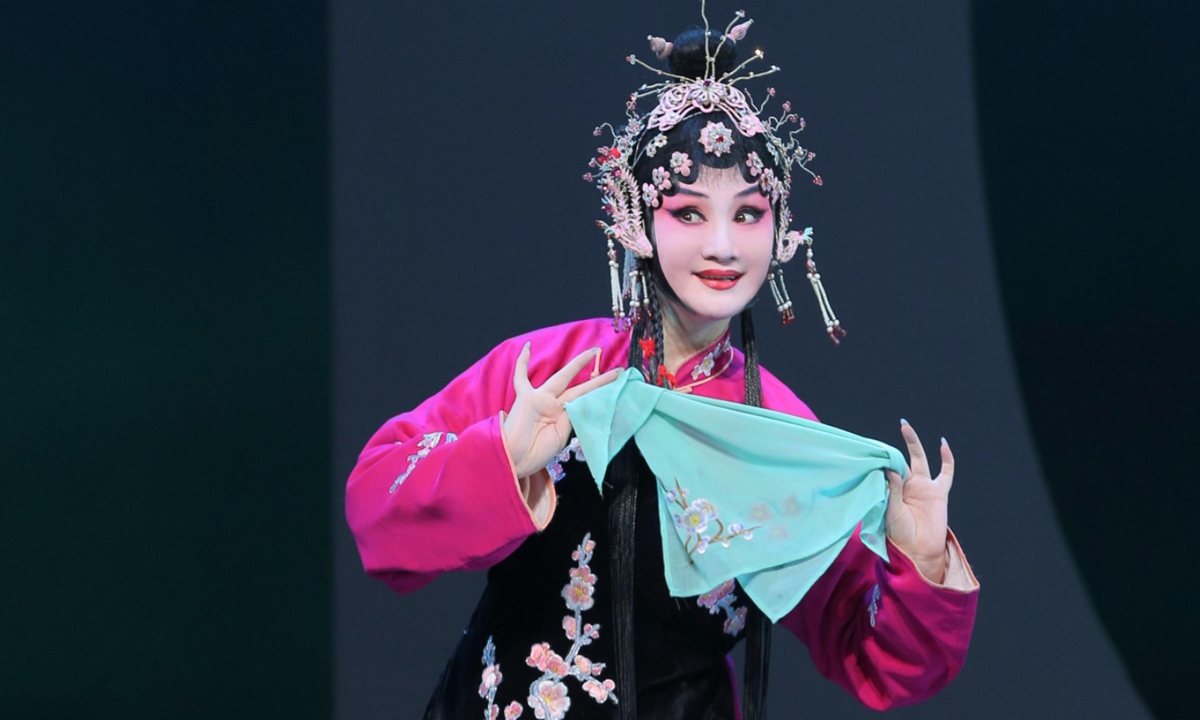
Qinqiang master Li Mei performs on stage Photo: Courtesy of Li Mei
After more than four decades on the Qinqiang stage, Li Mei is still taking on new roles. China's first-class actress, head of the Shaanxi Opera Research Institute and two-time winner of the Chinese Drama Plum Blossom Award, Li is best known for roles such as Li Huiniang, the wronged ghost in Wandering the West Lake, whom she has played more than 1,300 times.
That long association with classic Qinqiang roles is now being tested by a very different character. Recently, Red River Valley, a new Qinqiang opera by the Shaanxi Opera Research Institute, was staged at the National Theatre of China in Beijing as part of the 7th National Ethnic Minority Arts Festival.
Li plays Danzhu, a woman from Southwest China's Xizang Autonomous Region whose life is changed by the 1904 Gyantze battle, a character far removed from the traditional Qinqiang roles with which Li has long been associated.
That distance presents a new challenge for Li. Playing Danzhu means adapting Qinqiang's traditional performance language to a character and setting far removed from its northwestern Chinese roots, while making her feel like a woman from Southwest China's Xizang Autonomous Region, rather than simply a traditional opera character in a new costume.
"Form is the skeleton, life is the flesh, and the region is the soul," Li said. "I retain the formal techniques of Qinqiang while incorporating more natural, expansive movements associated with life in Xizang, using the art form's traditional language to build a new character."
That ability to reshape a traditional form has roots in the rigorous training she received as a child.
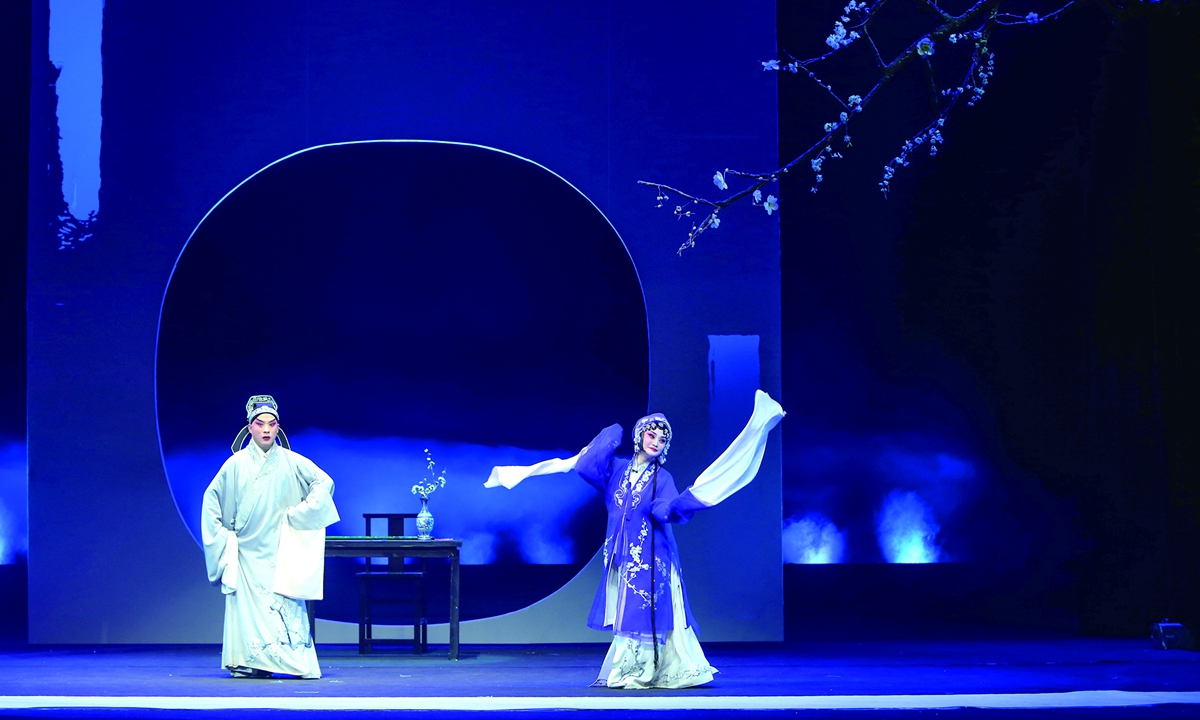
Li Mei (right) performs in a Qinqiang opera in Xi'an. Photo: VCG
Forged in the 'slaughterhouse'
Li Mei entered the world of Qinqiang opera at age 11. In 1980, her father took her to the Shaanxi Opera Research Institute in Xi'an, where boarding and training were free. She expected to study singing and dancing.
Instead, she was selected from thousands of applicants for professional Qinqiang training, a traditional form known for its high, raw vocal style and roots in northwest China.
The rehearsal hall was nicknamed the "slaughterhouse." Young students practiced splits until their legs shook, tightened headbands until their faces throbbed, and held the contorted "lying-fish" pose until they cried.
The physical demands were intense, and Li repeatedly questioned whether she had made the right choice. At a critical moment, composer Zhao Jiping urged her to stay.
"Don't go anywhere else," he told her. "The Qinqiang stage belongs to you."
She stayed, and by age 16 had taken on the role that would define her career: Li Huiniang, the wronged ghost in Wandering the West Lake.
Her performance of the "Ghost's Lament" first drew strong audience response. She has since performed the part more than 1,300 times, turning what could have been a limiting signature role into the foundation of her work.
Much of that work depends on techniques that demand extraordinary physical control.
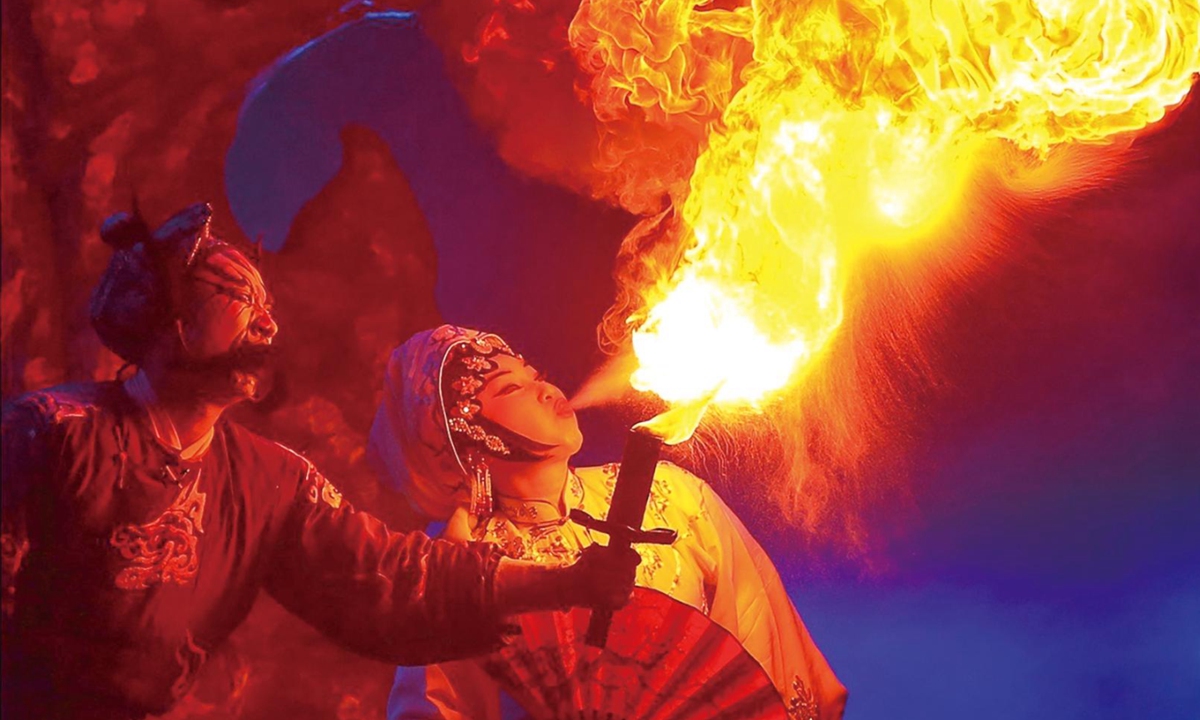
Li Mei performs fire-blowing Photo: Courtesy of Li Mei
The fire that remains
One of the most demanding is fire-blowing. The sequences in the ghost scenes require precise control of breath from the abdomen.
During performance, the stage goes dark. She turns her head, draws breath from deep in her body, and sends a flame into the blackness - once, twice, three times. The effect is a physical expression of danger and grief, as well as the ghost's refusal to yield.
Years of repetition turned the skill into muscle memory. Eventually, the technique disappeared into the character. When the plot calls for danger and rescue, the flames appear without conscious calculation.
"You stop thinking about the skill," she told the Global Times. "You are Li Huiniang."
The physical toll has been severe.
Her knees and lower back have suffered lasting damage, and her spine has developed an S-shaped curve. She has shown the CT scans without self-pity. She has performed while ill, collapsed afterward and returned to the stage.
"Opera is my profession," she told the Global Times. "Anyone who wants to achieve something must pay. I do not encourage everyone to practice the lying-fish pose or fire-blowing. However, for those of us who choose this life, the pursuit continues."
Innovation within tradition
Today, Li heads the same institute she entered as a child. Her responsibilities now extend beyond performing to developing new plays, attracting audiences and training the next generation. That role has also given her a broader view of what it takes to keep Qinqiang alive.
Yet she has never left the stage. Looking back at the 11-year-old girl in the "slaughterhouse," she feels gratitude.
Looking ahead, she remains focused on how Qinqiang can continue to reach audiences while preserving its distinctive character.
For Li, that means innovation without losing the form's identity. Red River Valley is one example of that approach, bringing a new story and character into the language of a traditional art form.
"Qinqiang is certainly an ancient form of opera, but it has never been static. Exploration and innovation have always been its most important source of vitality," Li Mei told the Global Times.
"We keep the core of Qinqiang and its aesthetic conventions unchanged, while allowing the spirit of snow-region culture to deeply permeate the characters," she said.
"In this way we achieve a unity of traditional techniques with new subject matter, and of the opera's style with its spiritual core," she added.
RELATED ARTICLES