Reshuffle in Japan’s cabinet and ruling party reveals potential internal divisions
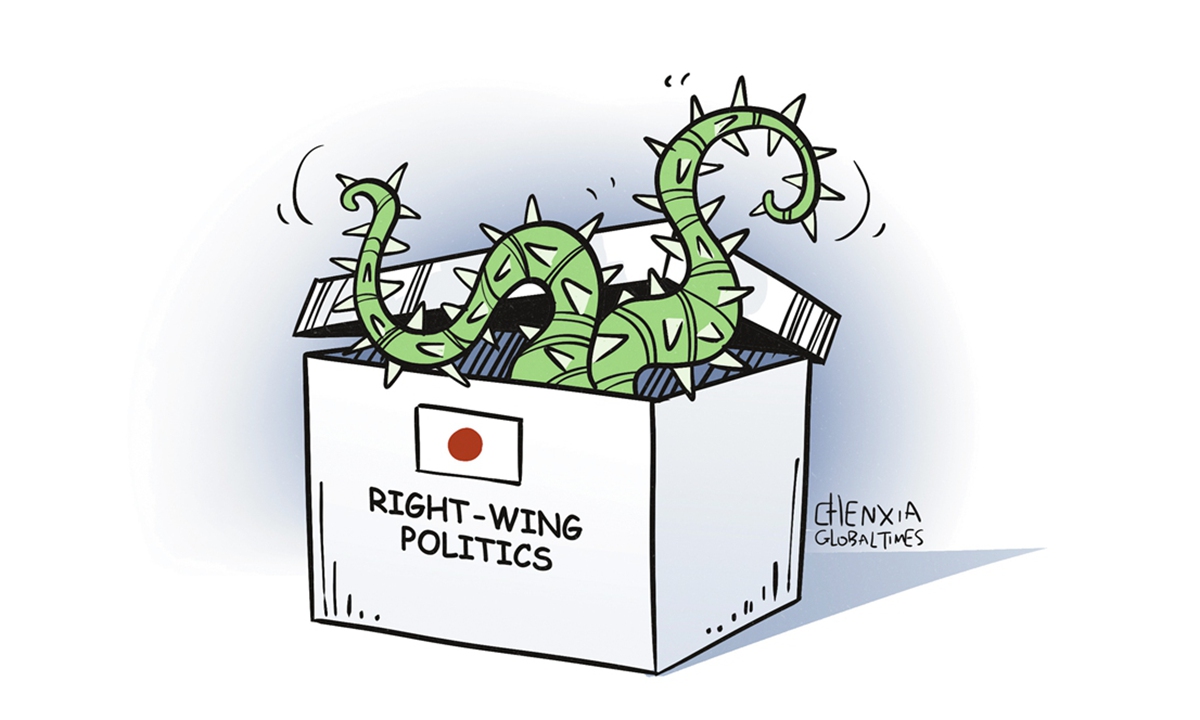
Japanese right-wing forces Illustration: Chen Xia/GT
Recently, Japanese Prime Minister and Liberal Democratic Party (LDP) President Sanae Takaichi completed a cabinet reshuffle as well as personnel changes in the LDP leadership. Specifically, former Abe-faction figures such as Koichi Hagiuda have retained key positions within the LDP, while the Japan Innovation Party will for the first time shift from "cooperation from outside the cabinet" to "cooperation from within the cabinet." Meanwhile, Junichi Ishii, LDP secretary-general in the Senate, was replaced from his post.
This shift represents Takaichi's attempt to create favorable political conditions for advancing policy agendas such as constitutional revision and security policies.
First, Takaichi has continued to promote key figures from the former Abe faction, allowing the conservative right wing to maintain its influence within the LDP and further pushing the party's political landscape to the right. In the latest changes, Yasutoshi Nishimura retained his position as LDP election strategy chief, Koichi Hagiuda remained as executive acting secretary general, and Hirokazu Matsuno continued to serve as Party Organization and Campaign Headquarters Chairperson. All three were key figures in the former Abe faction.
Second, the Japan Innovation Party's entry into the cabinet will further strengthen forces within the Takaichi administration that advocate constitutional revision and more aggressive security policies. After Takaichi came to power in 2025, the Japan Innovation Party, although participating in a coalition government with the LDP, had maintained a stance of "cooperation from outside the cabinet," meaning that it supported the coalition government with the LDP but did not send members to join Takaichi's cabinet. This was because the Takaichi administration was unstable at the time, and the Japan Innovation Party chose to wait and see, allowing it to quickly distance itself from the administration should Takaichi's government perform poorly.
However, after the LDP rapidly expanded its influence following the House of Representatives election at the beginning of this year, the Japan Innovation Party chose to strengthen its cooperation with the LDP. In the latest cabinet reshuffle, the Japan Innovation Party appointed former secretary-general Hiroshi Nakatsukasa to the cabinet and sent party lawmakers to serve as parliamentary vice-ministers and parliamentary secretaries in the Takaichi cabinet, directly participating in the decision-making process.
The Japan Innovation Party takes a more aggressive position than the LDP on constitutional revision. Therefore, the Japan Innovation Party's entry into the cabinet means that its more aggressive views on constitutional revision and security policy can enter the Takaichi cabinet's policy-making process.
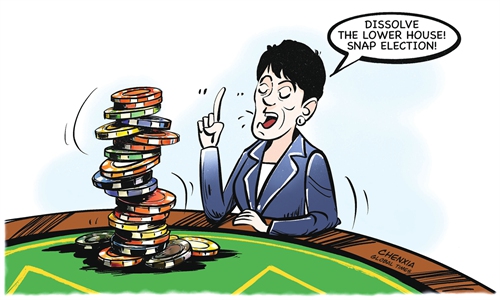
Finally, Takaichi's intervention in personnel arrangements for the LDP's House of Councillors, which has long maintained a degree of independence, has raised questions. Under LDP rules, personnel appointments in the House of Councillors are determined by the president of the House of Councillors, and the LDP president is unable to intervene. Otherwise, such intervention could easily trigger internal struggles between factions in the House of Representatives and those in the House of Councillors. Nevertheless, Junichi Ishii was replaced this time, mainly for two reasons. The LDP is currently a "minority ruling party" in the House of Councillors and faces considerable pressure in deliberations on legislation in the Diet. It urgently needs cooperation from LDP factions in the House of Councillors. However, Ishii has differences with Takaichi and was therefore removed, allowing Takaichi to strengthen her control over the party's House of Councillors factions.
Takaichi's intervention in personnel arrangements in the LDP's House of Councillors is aimed at laying the groundwork for the 2028 House of Councillors election. At a press conference on September 16, Yasutoshi Nishimura, in his capacity as LDP election strategy chief, explicitly stated that "thorough preparations" would be proceeded for "the House of Councillors election two years from now." This has led observers to link Takaichi's intervention in personnel arrangements with the 2028 House of Councillors election.
In addition to maintaining a long-term administration, constitutional revision is another important consideration behind Takaichi's focus on the House of Councillors. The Constitution of Japan stipulates that a constitutional amendment proposal initiated in the Diet must receive the support of at least two-thirds of all members of both the House of Representatives and the House of Councillors, and must then be approved by a national referendum. Takaichi has therefore moved early to arrange personnel within the LDP's House of Councillors, seeking to clear internal obstacles ahead of the 2028 House of Councillors election.
However, it should also be noted that the LDP's House of Councillors factions are unlikely to tolerate actions by Takaichi that undermine their independence, and potential internal divisions have already emerged. In addition, having spent a long time as an opposition party and scandals-hit, the Japan Innovation Party lacks experience in Diet debates and questioning. If lawmakers from the party cause turmoil in the Diet after joining the cabinet, it would be a major blow to the Takaichi administration and could also create cracks in the coalition. If any of these potential vulnerabilities were to escalate, it could undermine the foundations of the Takaichi administration.
The author is a lecturer at Shanghai University of International Business and Economics. opinion@globaltimes.com.cn
RELATED ARTICLES