China’s FAST telescope to advance with Phase II construction as project marks 10th anniversary
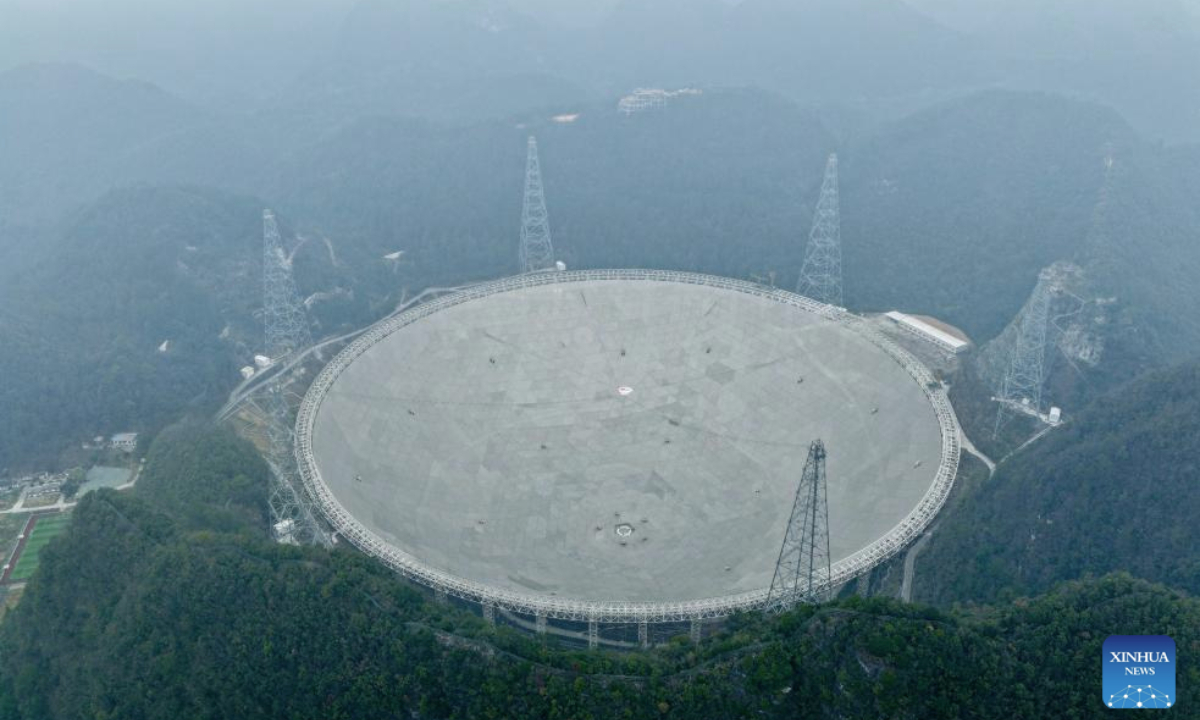
An aerial drone photo taken on Jan. 16, 2026 shows China's Five-hundred-meter Aperture Spherical Radio Telescope (FAST) under maintenance in southwest China's Guizhou Province. (Xinhua/Ou Dongqu)
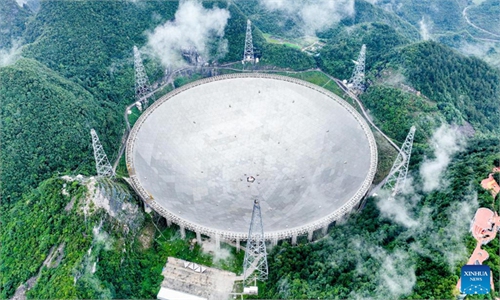
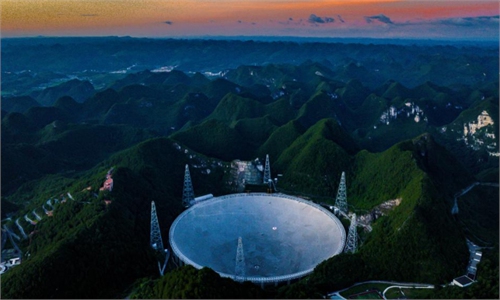
The Five-hundred-meter Aperture Spherical Radio Telescope (FAST), known as the China's "Sky Eyes", will mark the 10th anniversary of its inauguration on September 25. Since its launch, the facility has achieved a series of landmark scientific and technological breakthroughs.
Moving forward, the FAST team will continue to advance the Phase II of the project, further consolidate and enhance China's leading international position in radio astronomy, and produce more major original scientific breakthroughs, CCTV News reported on Wednesday.
FAST, the world's largest single-dish radio telescope, was inaugurated on September 25, 2016, in Southwest China's Guizhou Province. This marked the start of China's ability to "listen in" on radio waves from deep space and explore the evolution of the universe, new stars beyond Earth and the possibility of extraterrestrial life.
From Tuesday to Thursday, an academic conference marking the 10th anniversary of FAST's inauguration is being held in Pingtang County, Guizhou, drawing more than 200 experts and scholars from over 40 universities and research institutions across China.
The conference heard that since entering operation, FAST has delivered a series of landmark innovative results in engineering technology, frontier science and applications, according to CCTV News.
A series of technological breakthroughs in measurement and control technologies and methods, domestically developed steel cables, and high-performance receivers have underpinned the telescope's stable and efficient operation.
In the study of pulsars, neutral hydrogen galaxies, fast radio bursts and gravitational waves, FAST has produced a series of scientific results with international impact and has become one of the world's most important astronomical observation facilities. It has also made important progress in applications including cislunar space target detection, pulsar-based time standards and asteroid defense, supporting national space security and major strategic needs.
To date, FAST has discovered 1,284 pulsars, which is far more than the combined number found by all other radio telescopes worldwide over the same period. These include more than 170 millisecond pulsars and over 160 pulsar binary systems, including the binary pulsar system with the shortest known orbital period. In the discovery of rare celestial objects, FAST's achievements have far outpaced those of its international peers in scale, the Xinhua News Agency reported.
Behind this surge in scientific discoveries lies self-reliance in core technologies. When FAST was first built, many of its key components had to be imported. However, its decade of operation has been one of persistent effort and continuous breakthroughs in replacing imported equipment with homegrown alternatives.
FAST's primary measurement equipment, for example, used to be imported laser total stations, which failed to work during one-third of observation periods due to Guizhou's frequent rain and fog. A domestically developed microwave ranging system - the result of seven years of research - went into trial use in April 2026. It costs nearly half as much per set, can operate in all weather conditions, and offers accuracy of the same order of magnitude as laser total stations.
Through a decade of dedicated work, the FAST team has propelled China's radio astronomy through a historic leap, moving from following the global frontier to catching up and ultimately taking a leading position worldwide.
Going forward, the team will press ahead with the FAST Phase II project, further consolidating and enhancing China's leading position in radio astronomy, while continuing to produce more major original scientific achievements.
Global Times
RELATED ARTICLES