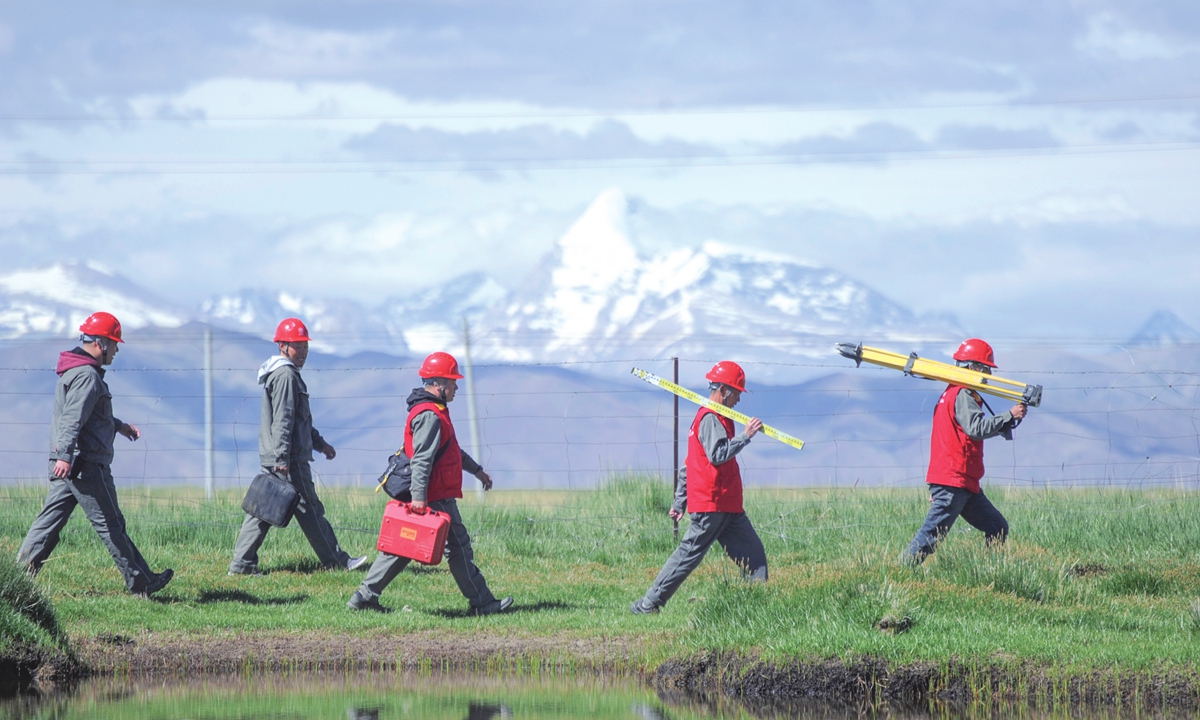
Power grid workers trek between work sites in Ngari prefecture, Southwest China's Xizang Autonomous Region. Photo: VCG
Editor's Note:
National support for Xizang's development has yielded remarkable achievements. Over the decades, numerous volunteers from across the country have come to Xizang, making indispensable contributions to the autonomous region's growth. Their efforts focus on various fields such as education, healthcare and infrastructure. Despite harsh conditions, these volunteers persevere in their roles, writing chapters of endeavor on the snowy plateau. Each diary they have penned serves as a vivid testament to the building of the Chinese national community. Against this backdrop, the Global Times launches the "My Xizang Diary" series, presenting firsthand reflections from these dedicated volunteers. This is the eighth installment of the series.
In 2024, I joined the State Grid Nagqu Power Supply Company in Southwest China's Xizang Autonomous Region as part of an assistance program to support the region's development.
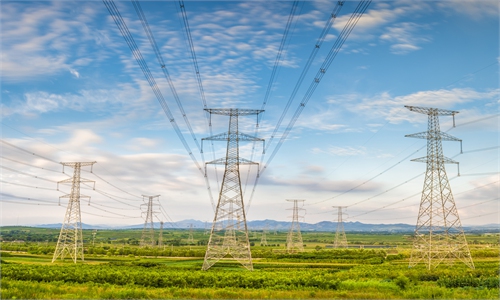
Over the following one and a half years, I mainly worked on upgrading the local power distribution network on the plateau, improving the maintenance and reliability of power lines, introducing more automated systems, identifying and fixing potential safety risks, and providing technical support and training for local teams.
Nagqu, China's highest city, sits at an average elevation of more than 4,500 meters, where vast distances, sparse population, cold temperatures and thin air make power grid maintenance particularly challenging. In some remote pastoral areas, workers still rely on manual maintenance. When a line trips, they may have to drive, or even walk, tens of kilometers to the site. In bad weather, it can take hours to find and fix a fault. For local herders, that means longer power outages, while even a short outage can bring livestock businesses and small local enterprises to a standstill.
The plateau is the real test
To address these challenges, I worked with my colleagues to assess the distribution networks across Nagqu, identifying aging lines, weak transformer stations and other potential hazards. We replaced outdated equipment, upgraded vulnerable sections and used automation wherever possible to make the grid more reliable and efficient. With smart switches and fault indicators, the system can now pinpoint faults automatically, isolate the affected section and quickly restore power elsewhere. In other words, we shifted from having workers "search for faults" to letting the system "point them out." We led the improvement of 11 lines, cutting the average duration of fault-related outages by more than 70 percent in Nagqu. The upgrades were also put to the test during major power supply operations, including the 60th founding anniversary of Xizang Autonomous Region in 2025 and the yearly national college entrance examinations.
But keeping a power grid running reliably on the plateau takes more than equipment and technology. Some problems can only be solved in the field. Once, a power line kept tripping, and we suspected the weather might be to blame. I led a team of technicians along the line to find the cause. After a full day trekking through wind and snow at a mountain pass 4,800 meters above sea level, we found an aging insulator. We replaced it, and the line has remained stable ever since.
Strong winds batter Nagqu more than 200 days a year, with its winter temperatures often below minus 20 C. Vehicle breakdowns and frozen car doors are part of the fieldwork. My local colleagues even taught me to keep a thermos of hot water in the vehicle to thaw frozen locks when needed. These small experiences helped me adapt to the plateau and taught me an important lesson: Keeping the power on at high altitude takes not only technical skills, but also a willingness to get out into the field, work with local people and adapt solutions to local conditions.
'Power Stations on Yak Backs'
Beyond building power lines, I also kept an eye on the everyday needs of herders living in remote pastoral areas. In Nagqu, herders move with their livestock in search of water and fresh pasture, and their homes can be scattered across vast grasslands. For many of these families, fixed power lines simply cannot follow them. In the past, when they moved to a new pasture, some had little choice but to light a yak-butter lamp at night, while even charging a mobile phone could be difficult.
That was why I joined a volunteer project called "Power Stations on Yak Backs," which brings lightweight and portable solar power systems to families on the move. We installed the systems free of charge in remote households and showed families how to use and maintain them, so that a small source of electricity could travel with them from one pasture to the next.
During a visit to Nyima county, a Tibetan woman took my hand and told me, "We used to light yak-butter lamps whenever we moved to a new pasture. At night, it was pitch black, but now, with this little device, we have plenty of light - and we can even cook."
Her words gave me a much more tangible sense of what assistance in Xizang means. For people on the northern Qinghai-Tibet Plateau, electricity is no longer just about having a light at night.
Reliable power makes heating, cooking, charging phones and using household appliances easier, while also supporting healthcare and education in remote areas.
More importantly, electricity is becoming a foundation for local economic development. Some herders are using reliable solar power to run small shops and restaurants along major roads and at seasonal gathering places. They sell daily necessities as well as Tibetan food and local specialty drinks, gradually moving from relying solely on herding to a mix of herding and business.
To me, that is the real value of electricity: It does more than make daily life easier - it opens new possibilities. And that is what assistance in Xizang is ultimately about: tackling both the big challenges and the small, everyday problems.
Whether it is a power line, a piece of equipment or a service call, everything ultimately comes down to one goal: Ensuring that every person on the plateau has reliable access to electricity and can make good use of it.
From the first time I arrived in Nagqu to my repeated trips into pastoral areas, climbs to mountain passes and inspections inside substations and electrical equipment rooms, my year-and-a-half experience here has given me a deeper understanding of the significance of China's paired assistance program. It is not simply about bringing in people, technology and resources. It is about sharing expertise, building local capacity and laying the groundwork for long-term development, allowing the results of the assistance program to take root.
As a power-sector professional working in the region, perhaps all I can do is make sure I do the small things well. But when night falls and lights begin to shine at the foot of snow-capped mountains, inside pastoral tents and along the streets of towns, I know that every road I have traveled, every cold wind I have endured and every night I have spent working has been worthwhile.
We have brought light deep into the snow-capped mountains, using electricity to create more possibilities for people's lives and livelihoods on the plateau. Electricity does more than light up homes. It also illuminates the path toward a better life for the people of the plateau.
The author is a deputy general manager of the Binhai Branch of State Grid Shaoxing Power Supply Company. opinion@globaltimes.com.cn
RELATED ARTICLES