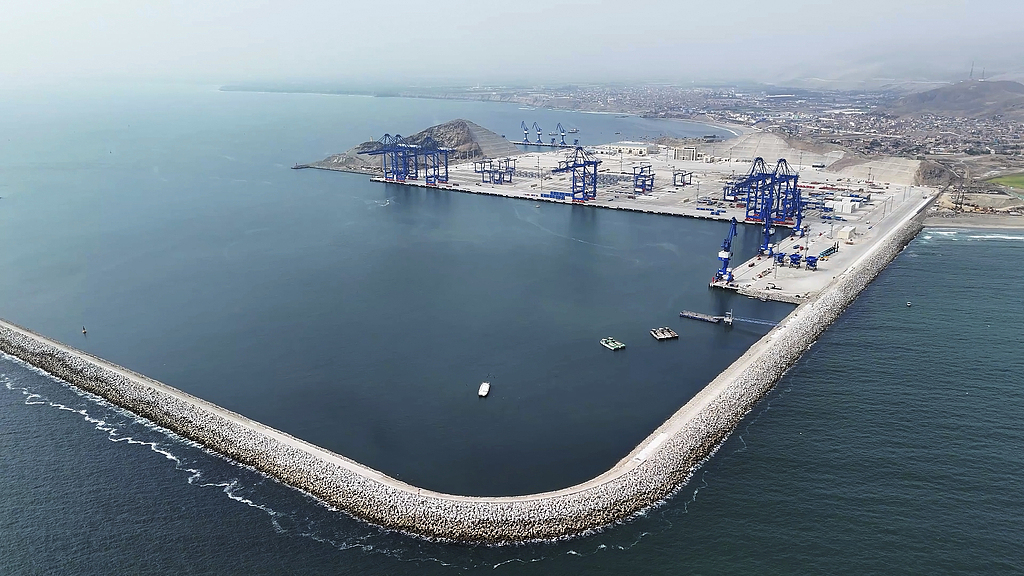
A view of the Port of Chancay in Peru, a key project in the China-proposed Belt and Road Initiative, on November 12, 2024 Photo: VCG
The Chancay-Shanghai shipping route has seen increasingly frequent sailings and booming two-way trade since the beginning of this year, according to a Sunday report by China News Service citing Shanghai Customs statistics.
In the first eight months, the route operated 170 voyages, carrying 141,000 tons of import and export cargo worth 4.04 billion yuan ($599 million), up 13.7 percent and 33.3 percent year-on-year, respectively.
Wang Peng, an associate research fellow at the Beijing Academy of Social Sciences, told the Global Times that the Chancay-Shanghai route is reshaping trans-Pacific logistics by sharply cutting shipping times between China and Peru.
Leveraging Chancay's hub capacity, the route can serve Peru, Chile, Ecuador and other Latin American countries, breaking the time-efficiency bottleneck of traditional routes and forming a high-efficiency logistics channel linking China with Latin America's Pacific coast, Wang noted.
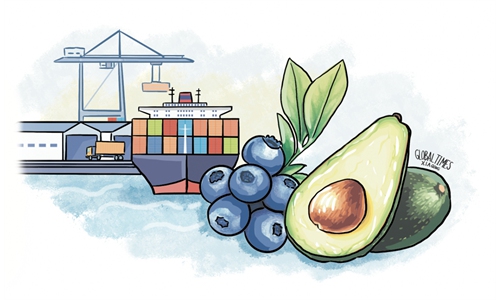
Meanwhile, more efforts are underway to further boost trade. Recently, a shipment of 12.2 tons of fresh blueberries was loaded into refrigerated containers at Peru's Chancay Port and sent to Shanghai via COSCO Shipping's WSA5 "Chancay-Shanghai" express route, the first pilot application of a mutual recognition model for cold-treatment probe supervision of imported fruit, according to China News Service.
Previously, customs officers at Chinese ports had to verify the placement and eligibility of cold-treatment probes in each container after Peruvian blueberries arrived, which was a time-consuming process. To get the berries to consumers' tables faster while keeping them safe and fresh after their long ocean voyage, Chinese customs authorities deepened coordination with Peruvian authorities on plant quarantine and jointly developed a data mutual recognition system.
"By crediting official Peruvian data, on-site operations at the port for verifying cold-treatment probes have been greatly streamlined, cutting inspection time per container by nearly half a day and effectively reducing comprehensive customs clearance costs, including logistics, inspection and warehousing, for foreign trade enterprises," Shanghai Customs said, according to China News Service.
As the core hub for Peruvian fruit imports, Shanghai Port handles more than 70 percent of China's imports of Peruvian fruit, serving as a key gateway for bilateral agricultural trade.
Peruvian bananas have also reached China recently. On September 2, the first batch of imported Peruvian bananas cleared customs in Shanghai under the supervision of Yangshan Customs, a subsidiary of Shanghai Customs, the first time fresh Peruvian bananas have entered the Chinese market since gaining access.
The 19.6-ton shipment arrived via the Chancay-Shanghai shipping route. The route carried 355,000 tons of imports and exports worth nearly 10 billion yuan between its launch in late 2024 and September 1, with the variety of goods rising from 34 to 75.
In the first seven months of this year, Shanghai Port imported 41,000 tons of Peruvian fruit, up 4.4 percent year-on-year and accounting for 87.2 percent of China's total, according to China News Service.
Beyond fruit trade, Chinese companies are also expanding into Peru via the Chancay-Shanghai shipping corridor, fueling two-way commerce.
At Haitong terminal in Shanghai's Waigaoqiao port area - China's largest roll-on, roll-off vehicle export hub - the roll-on, roll-off ship Huanghekou recently set sail for Chancay Port carrying 315 Chinese new-energy vehicles (NEVs). So far this year, Haitong Terminal has dispatched seven roll-on, roll-off vessels to Chancay, exporting 4,770 vehicles.
The route has also optimized bilateral trade structures, creating a complementary two-way pattern. Latin American agricultural products are flowing to China while Chinese industrial goods - NEVs and home appliances in particular - reach emerging markets in Latin America. This shifts China-Latin America trade from a largely resource-based exchange toward deeper industrial coordination, Wang said.
RELATED ARTICLES