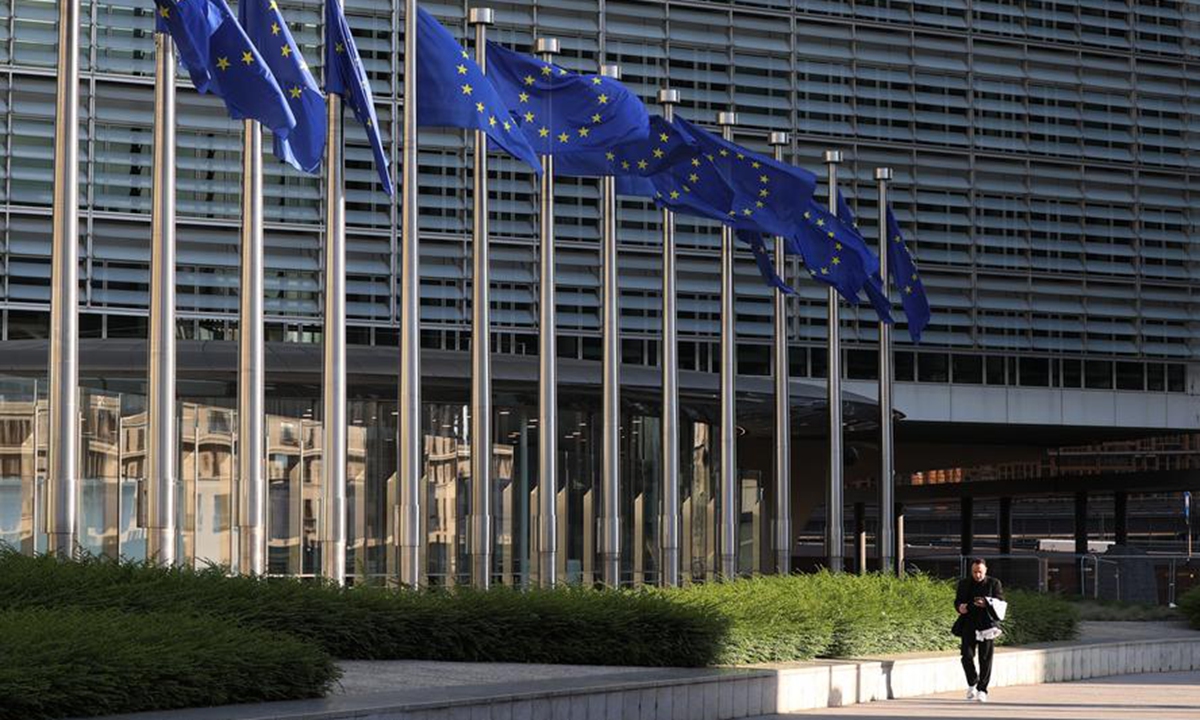
European Union flags fly outside the European Commission headquarters in Brussels, Belgium, on May 23, 2025. Photo: Xinhua
EU Energy Commissioner Dan Jorgensen said in a letter to EU countries' energy ministers that Europe is facing an energy price crisis as fallout from the Iran war roils oil and gas markets, urging countries to consider measures to curb their natural gas demand and step up preparations for the winter, Reuters reported on Saturday.
The signal is clear. Europe's energy predicament has moved beyond supply shortages to become a price crisis - one that has emerged as a major drag on the bloc's economic performance and made it all the more urgent for Europe to step out of the protectionist misstep in tackling its inflationary pressure.
While there is no longer any shortage or disruption in Europe's energy supply, the price pressure has become exceptionally acute. The benchmark Dutch Title Transfer Facility natural gas price has risen above 70 euros ($79.74) per megawatt-hour - a level not seen since the 2022 energy crisis. Skyrocketing energy bills have directly increased household electricity costs, weighing on Europeans' livelihoods, while eroding industrial competitiveness and fueling broader inflation across the EU economy.
In the short run, suppressing demand, accelerating storage, diversifying imports and conserving energy remain necessary to stabilize Europe's energy market. Yet these measures can only ease price pressures temporarily. They cannot fundamentally free Europe from the grip of international oil and gas market volatility. Unless the region's dependence on fossil fuels is significantly reduced, similar price crises driven by external geopolitical shocks will continue, leaving Europe passively exposed to swings in global energy markets.
In the medium to long term, accelerating green energy transition is the only viable path for Europe to mitigate systemic energy risks. Every step forward in wind and solar deployment, energy storage upgrading, grid renovation, electric vehicle adoption and other renewable infrastructure expansion reduces the bloc's reliance on fossil fuels.
However, Europe's transition pace is encountering a hard bottleneck in its domestic industrial capacity. Take wind power as an example. European governments have set ambitious targets for offshore wind totaling 142 gigawatts, equivalent to quadrupling the currently installed capacity by 2030. To reach the 2030 goal, Europe would need to install 21 gigawatts of new capacity every year until 2030 against a historic pace of two to three gigawatts per year. Such ramping up will lead to supply chain bottlenecks, according to Implement Consulting.
More critically, constrained by persistently high energy prices, soaring labor costs and stringent local production regulations, European manufacturers can hardly increase production or improve efficiency, a bottleneck that has directly slowed the bloc's progress in replacing fossil fuels with renewable green energy.
Against such industrial constraints, global supply chain cooperation represents the most practical and effective solution for Europe's energy transition. China's mature and complete new-energy industrial system is perfectly positioned to play a key role in this process.
China has built a full-value-chain industrial cluster covering wind power, solar photovoltaic (PV) facilities, energy storage, grid upgrading and all other core segments of green energy transition. The country boasts comprehensive advantages across the globe in cost control, large-scale delivery capacity and rapid technological iteration.
By providing cost-effective new-energy products and tailored solutions to Europe, China can help to substantially bring down the inflationary pressure now faced by many European countries. In essence, the value of China's supply chain lies in making Europe's green drive faster, steadier and far more affordable.
What makes the situation worrying, however, is that "de-risking" rhetoric has been growing inside the EU in recent years, with part of its policy orientation sliding into blatant trade protectionism. If Brussels acts under the guise of "de-risking" to raise trade tariffs and erect non-tariff barriers against Chinese technology and Chinese products, the result will only be counterproductive.
Artificially inflating the procurement cost of new-energy equipment will push up retail electricity prices, further weaken the competitiveness of European industries, delay the energy transition and make the bloc's climate neutrality goals even more distant. Most importantly, such barriers will only entrench Europe's dependence on traditional fossil fuels - the very opposite of its energy security goals.
Ultimately, trade protectionism cannot deliver genuine energy security; it only traps Europe in a costly and inefficient green transition. Only by integrating itself into efficient global supply chains, can Europe fundamentally break its cycle of energy price crises and build long-term energy and economic resilience.
RELATED ARTICLES