COMMENTS / EXPERT ASSESSMENT
China-EU trade frictions call for dialogue, not disengagement: German business leader
China EU relations
Editor's Note:
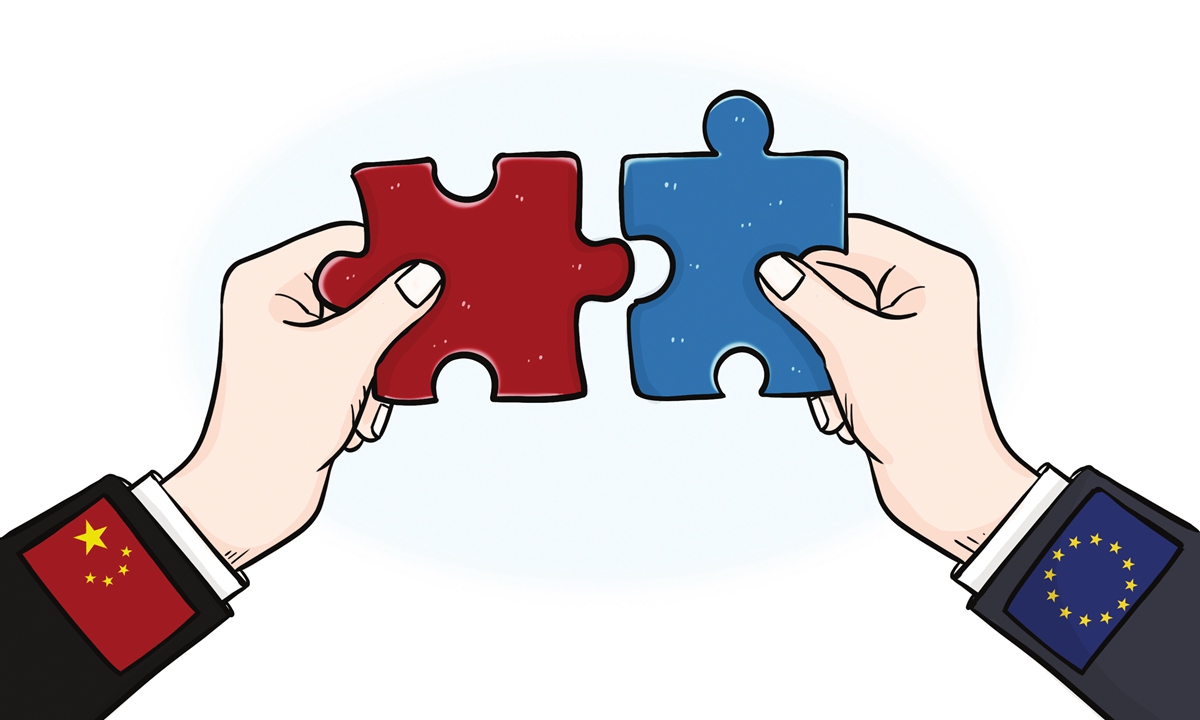
China-EU economic ties are set to face a key test in October, following months of increasingly intense debate in Europe over so-called trade imbalances and competition with China. The Global Times (GT) spoke with Michael Schumann (Schumann), chairperson of the board of Germany's Federal Association for Economic Development and Foreign Trade, who said that Europe should address specific trade concerns without allowing them to define the broader relationship, while keeping the door open to cooperation with China.

Michael Schumann Photo: Courtesy of Michael Schumann

GT: What have been the most significant changes in China-EU economic relations in recent months?
Schumann: The European debate about China has entered a more demanding phase. There are genuine economic strains, and industrial pressure across EU countries is measurable in production data, suppliers' order books and the anxieties of skilled workers whose livelihoods were built around industries that formed the backbone of European prosperity.
Europe is going through a period of considerable industrial adjustment, and nowhere is that more visible than in Germany. The structure of the German economy - with its strong automotive, mechanical-engineering, chemical and electrical industries - overlaps closely with sectors in which Chinese companies have become increasingly competitive. It is against this background that the tone of the debate has become sharper. But we should distinguish between competition and causation. Chinese competition is real; it is not, however, the principal explanation for Europe's and Germany's structural difficulties.
Many of those difficulties are home-grown. We have underinvested in infrastructure, accumulated too much bureaucracy, allowed energy and labor costs to rise and, in some industries, relied for too long on technological advantages we assumed would endure. Chinese competition has exposed some of our weaknesses and accelerated the need for change, but it did not create them.
Europe would make a serious strategic mistake if it responded to a competitiveness problem primarily with protectionism. Legitimate questions concerning reciprocity, market access and trade imbalances should be addressed seriously with Chinese partners. But the objective should be rebalancing, not disengagement.
For Germany, the fundamental task is to restore its own competitiveness while remaining open to one of the world's most important markets and centers of innovation. Trade policy may give industries breathing space to adjust, but it cannot substitute for the transformation itself.
GT: How do you view the "China shock 2.0" narrative and Europe's competitiveness challenges?
Schumann: Words carry responsibility in international relations. When concepts such as "risk," "dependency," or "shock" become the dominant vocabulary through which an entire country is perceived, there is a danger that specific and manageable problems become overshadowed by a general political narrative.
China has become an extraordinarily powerful industrial competitor. But competition itself should not be confused with hostility. Competition can be a powerful stimulus for innovation and renewal. Europe's competitiveness will ultimately be decided in Europe: by cheaper and more reliable energy, faster planning procedures, better infrastructure, greater investment in education and research, more entrepreneurial freedom and a renewed willingness to work, invest and innovate. China cannot do that work for us, and tariffs cannot do it for us either.
GT: What does the transformation of the automotive industry reveal about China's importance to German carmakers?
Schumann: The German automotive industry is perhaps the clearest illustration of why Europe cannot afford complacency in confronting its current industrial challenges.
For too long, parts of the industry relied on a position of global technological leadership that appeared almost unassailable. They were too slow to recognize that development cycles had become too long, cost structures too heavy, and the shift toward electric mobility far faster and more fundamental than many had anticipated. German manufacturers and suppliers are therefore now facing a painful transformation.
But it would be shortsighted to declare the German automotive industry finished. Germany still possesses extraordinary engineering capabilities, deeply specialized suppliers and an industrial culture that has survived more than one profound transformation. The interesting question is whether German companies can combine their traditional strengths with the disciplines they can now learn in China: speed, scale, digital integration, new forms of manufacturing and unusually short innovation cycles.
For decades, we spoke about technology transfer largely as something moving from Germany to China. That world has changed. Innovation increasingly flows in both directions. The companies that understand this change will have the best chance of succeeding in it.
GT: Why does a gap exist between Germany's political debate on China and actual business decisions of German companies?
Schumann: For several years, I have observed a widening discrepancy between the political vocabulary surrounding China and what German companies actually do in China. When "de-risking" became the dominant register of political discourse, one might reasonably have expected German businesses to retreat significantly from the Chinese market. In many parts of the economy, the opposite has happened.
About 5,000 German companies still operate in China. German firms invested more than 7 billion euros ($7.96 billion) in China between January and November 2025, a four-year high. A May 2026 flash survey by the German Chamber of Commerce in China found that 61 percent of participating companies planned to increase their investments in China over the following two years, the highest level since 2023.
That does not mean companies are unaware of geopolitical or commercial risks. But their decisions demonstrate that the reality of German-Chinese economic relations is more complex than the political debate suggests.
German companies are still investing, but the pattern of that investment is changing. Those that have already established in China are reinvesting locally, localizing supply chains, building research and development capacity and pursuing an "in China, for China" strategy. Increasingly, German headquarters also learn from their Chinese operations rather than the other way around.
GT: What is most needed to restore a more stable environment for China-EU and China-Germany cooperation?
Schumann: The most immediate answer is a serious, rules-based conversation about subsidies, capacities and standards, together with timely progress in the current EU-China dialogue on trade imbalances and protected corridors for cooperation in areas where shared interests are greatest.
During my visits to China this year, what struck me was the speed at which life-changing technologies are moving from research and development into industrial application. I saw advanced decentralized energy and storage technologies, as well as industrially manufactured ultra-low-energy housing systems that could cut energy use and emissions while improving living conditions.
These are not abstract technological achievements. They have potential applications in both developed and developing countries, including disaster relief, regions with unreliable electricity networks, and places where conventional infrastructure cannot adequately meet people's needs.
Governments have a legitimate responsibility to protect industrial capabilities and employment. But if technologies can improve living conditions, their availability is not merely a matter of trade policy. It is also a question of human development.
Europe should therefore judge a technology according to how it works, whether it is secure, whether it complies with our standards and what benefits it can provide - not simply according to the nationality of the company that developed it.
This is where German-Chinese cooperation can acquire significance beyond bilateral trade. By combining their expertise, the two sides can come together around technologies that may ultimately find important applications in third countries. Our responsibility is to ensure that the best of these technologies reach the people who need them most.
RELATED ARTICLES