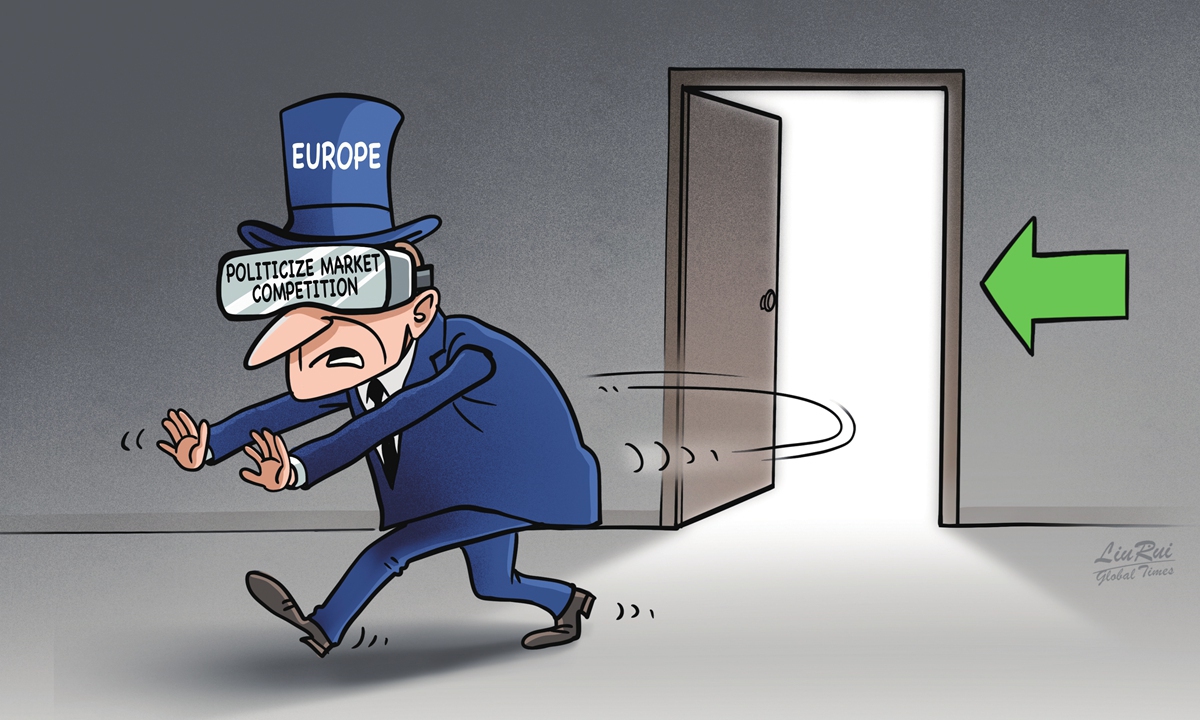
Illustration: Liu Rui/GT
German Chancellor Friedrich Merz and French President Emmanuel Macron on Friday claimed that China's rising trade surplus with the EU, along with their allegation of "undervalued Chinese yuan", posed an "existential threat" to European manufacturing, the Financial Times reported on Saturday.When it comes to trade with China, there has been a growing hype from the EU over the "undervalued yuan." The narrative that frames China's strong foreign trade competitiveness as a product of currency exchange rate advantages reduces deeply complex economic and trade dynamics to a single, oversimplified factor.
On the surface, the allegation seems to offer a convenient explanation for Europe's industrial predicament. As in essence, it serves as a scapegoat for the continent's declining industrial competitiveness and fading technological edge.
Actually, the allegation defies basic global economic principles and fails to address the root cause of Europe's persistent trade challenges, making it increasingly incapable of reversing its sluggish trade landscape.
Exchange rate fluctuations are determined by a combination of many economic fundamentals, market supply and demand metrics, and global macroeconomic conditions. In recent years, Chinese yuan has maintained a normal pattern of two-way movements, without experiencing sustained unilateral depreciation or deliberate undervaluation in pursuit of trade gains.
Last week, Zou Lan, deputy governor of the People's Bank of China (PBC), said at a press conference that the factors influencing the yuan's exchange rate today are highly diverse, with market forces pushing for both appreciation and depreciation existing at the same time. He emphasized that the yuan will continue to maintain two-way fluctuations at a reasonable and balanced level.
And, PBC Governor Pan Gongsheng said in March that China has no need or intention to seek competitive edge in foreign trade through depreciation of its currency. The central bank has always upheld the decisive role of market forces in exchange rate formation, maintained exchange rate flexibility, strengthened expectation management, and kept the yuan's exchange rate largely stable at an adaptive, balanced level.
Even if the yuan appreciated sharply, would that really change the EU's trade landscape with China? China's sustained competitiveness in global trade is rooted in the advantages built up over decades of dedicated industrial development, backed up by consistent investment in scientific research and technological innovation.
After decades of deep cultivation across all sectors, China now boasts the world's largest and most complete industrial system, covering everything from basic component manufacturing to high-end equipment exploration and development, and from traditional consumer goods production to cutting-edge technological breakthroughs in new energy and artificial intelligence.
China has maintained high-intensity investment in scientific research and technological innovation for many years. When combined with the scale effect of China's ultra-large home market, and the incessant improvement in enterprise efficiency driven by fully competitive domestic market, it becomes clear that these industrial advantages cannot be simply attributed to an "undervalued exchange rate."
By contrast, Europe's industrial predicament stems from long-accumulated structural problems of its own making. These internal issues should have been addressed by deepening reforms and promoting collaborative industrial innovation, but some in Europe have instead repackaged them as "unfair competition from China."
Some in the EU are even trying to hype exchange rate issues and introduce special measures to shift internal contradictions onto external targets. This approach will not only fail to help European industries resolve their own capability gaps, but also disrupt the stable industrial chain cooperation that China and Europe have built over decades.
At a time when the global economic recovery remains highly uncertain and trade protectionist measures keep rising, China and the EU should form the backbone of upholding multilateral trade rules. The right path to resolving trade differences has never been about applying pressure or imposing arbitrary restrictions, but about equal dialogue and rational consultation.
Raising hypes about "undervalued currency" might win some politicians in Europe short-term attention, but what will reshape trade patterns is not through accusations - it is the pragmatic action of facing up to one's own problems, advancing structural reforms, ramping up high-tech investment, and embracing open cooperation.
RELATED ARTICLES