US President expects talks with Iran to resume after rejecting truce proposal amid 'wide gaps over truce, Hormuz proposals'
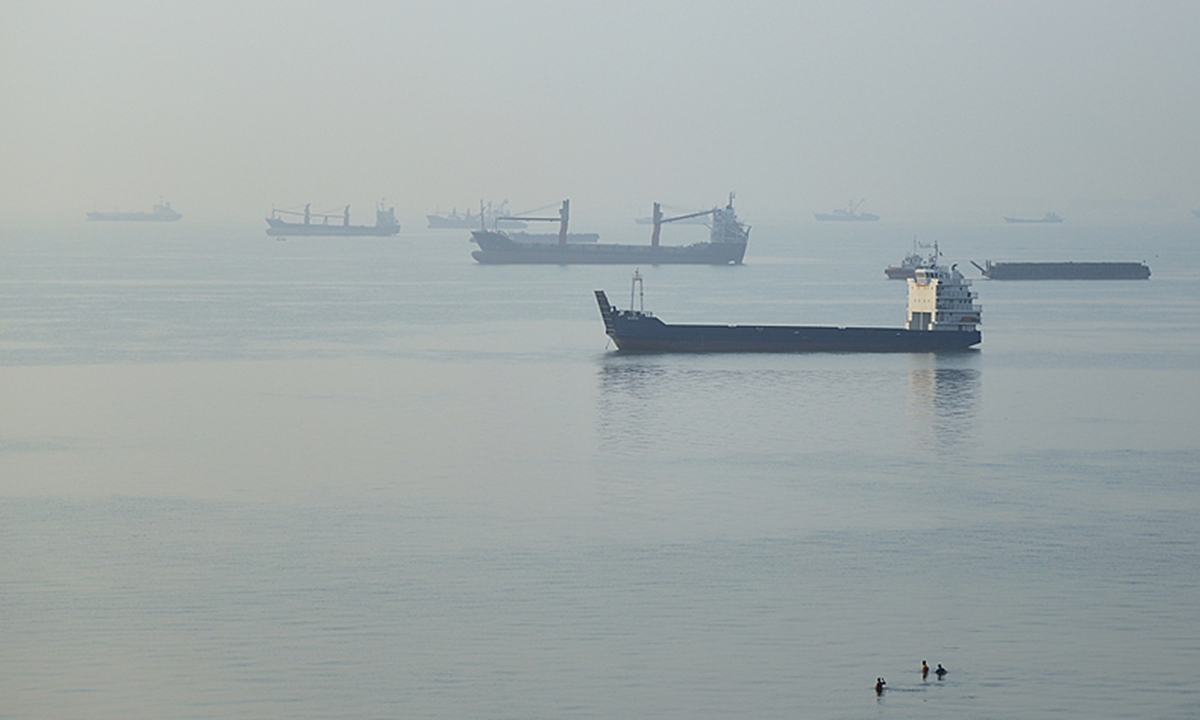
People wade in the water as cargo ships are anchored in the Strait of Hormuz off Bandar Abbas, Iran, on September 28, 2026. Photo: VCG
US President Donald Trump said Sunday that he expects talks with Iran to resume in the coming week, despite rejecting Tehran's proposal for a seven-day truce followed by the reopening of the Strait of Hormuz, which was put forward by Tehran at the UN General Assembly in New York, media reported on Monday.Trump dismissed the plan and has mused on resuming full-scale air strikes on Iranian targets, France 24 reported. Meanwhile, he told news platform Axios that he expects negotiations to resume. "They want to make a deal, but it is not the deal that I want to make," Trump told Axios. "It is what we would have maybe agreed to a year ago."
Citing sources familiar with the matter, Axios reported that Qatari mediators are expected to meet separately with Iran's Foreign Minister Abbas Araghchi and US envoys Steve Witkoff as early as Monday.
Following Trump's earlier rejection of the proposal, Araghchi said it is waiting on the "definitive" response to that proposal on reopening the Strait of Hormuz, despite Trump publicly rejecting the offer, CNN reported.
Under the plan, Iran would open the critical waterway within a week and resume nuclear talks if the US met certain conditions, including lifting a naval blockade and waiving sanctions on oil.
A Chinese Middle East affairs observer told the Global Times on Monday that though sporadic strikes are possible, the risk of escalation remains low, as the bottom line, associated costs and future benefits are mostly clear at this stage for both sides.
Both the US and Iran are open to negotiations, but a big gap persists between expectations and realities over their bargaining chips and demands. In addition, both sides are clearly employing their usual negotiation strategies, Zhu Yongbiao, an expert on Middle East affairs at Lanzhou University, told the Global Times.
The Iranian offer at the UN Assembly called for an end to all hostilities in the Middle East, including in Lebanon, and a return to the conditions in an earlier ceasefire deal that fell apart, per France 24.
That agreement, which collapsed during fighting over Hormuz, called for the release of frozen Iranian assets, the lifting of sanctions on Iranian oil and an end to the US naval blockade.
Washington's ambassador to the UN, Mike Waltz, accused Tehran of demanding too much in exchange for a return to the negotiating table.
While the tough rhetoric continues to be a tool used by both sides to pressure each other, Zhu still believes they have room for negotiation and perhaps concession, and the Islamabad memorandum of understanding remains a practical and feasible foundation for future talks.
Zhu said that there is relatively broad room for negotiation between the US and Iran on specific technical matters, including the removal of some embargoes and resuming shipping through the Strait of Hormuz, in a format that both sides can accept.
The international community should create favorable conditions for the parties involved to deescalate the situation, including making peace calls at multilateral platforms, while also jointly mitigating the impacts of the conflict, particularly the sharp swings in energy prices, Zhu added.
RELATED ARTICLES