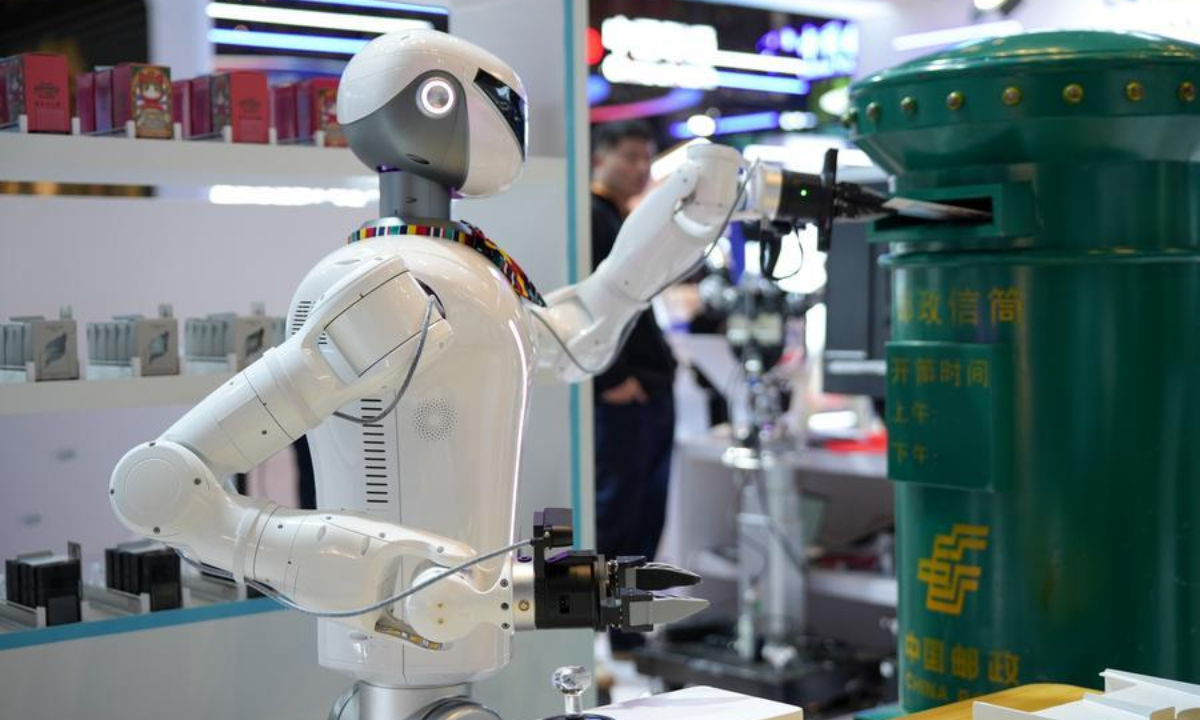
A robot inserts a letter into a mailbox during the 2026 China International Fair for Trade in Services (CIFTIS) at Shougang Park in Beijing, capital of China, Sept. 10, 2026. (Xinhua/Xu Hongyan)
China's widening lead in humanoid robot patents is drawing attention from South Korean media. In the first half of this year, China accounted for 60.8 percent of humanoid robot patents, while South Korea held less than 5 percent, with changes seen in the gap between the two sides in some core robot technology fields, the Aju Business Daily reported on Monday.
Such statistics may stoke industrial anxiety in parts of South Korea, but the far more meaningful question they raise is how countries should view technological disparities amid the ongoing artificial intelligence (AI)-driven industrial revolution and whether the other side of those disparities might hold new opportunities.
The rise of humanoid robots is merely a microcosm of the broader transformation in global emerging technology industries. Powered by AI technology, emerging industries including autonomous driving and brain-computer interfaces are reshaping the global industrial architecture at an unprecedented pace.
In such a fast-changing era, no single country can dominate every technological frontier. Even South Korea, which has long held advantages in science and innovation, cannot stay ahead in every emerging track. Adopting a more rational mindset toward structural shifts in global technology will help ease unnecessary industrial anxiety and refocus attention on long-term strategic opportunities.
China has moved ahead of South Korea in some fields, underpinned by its enormous domestic market, complete manufacturing ecosystem, and rapid engineering capabilities. Yet it is equally important to recognize that South Korea's long-established advantages in core components, high-end materials, and semiconductor foundations also make it an indispensable link in the global emerging industrial chain.
Some observers may simply use patent figures to measure the strength and potential of China's and South Korea's science and innovation industries, while overlooking the fact that the rise of a new industry is not a breakthrough in a single technology. It drives the restructuring of an entire supply chain, and every node along that chain can open a new window of opportunity.
China's lead in humanoid robot development generates enormous downstream supply chain demand, spanning precision servo motors, speed reducers, high-sensitivity sensors, lightweight high-strength materials and precision manufacturing. Each of these links is unlocking new possibilities for orders and cooperation globally, and each is precisely where South Korea has long built its strengths. In other words, the faster China advances, the more entry points South Korean industries will find to participate.
South Korea's economy stands at a critical stage of structural transformation. The country is striving to move beyond its established identity as a "memory chip powerhouse" and accelerate its expansion into high-value-added fields such as AI, advanced semiconductors, biomedicine and future mobility. This strategic direction is entirely understandable.
Yet at a time when emerging industries are evolving across multiple fronts and technology is iterating rapidly, building an independent and complete industrial system would come at an extremely high cost and may not deliver the desired results. Therefore, rather than striving to cover every link in the supply chain, it would be more feasible to seek the intersection between its strengths and China's industrial ecosystem, forming a mutually supportive and complementary supply chain collaboration model.
Acknowledging technological gaps in specific emerging fields does not undermine South Korea's industrial value. It marks the beginning of clearer industrial positioning and more efficient resource allocation. South Korean industry can concentrate resources on the areas where it truly holds irreplaceable strengths and connect these strengths with China's vast industrial ecosystem, integrating deeply with China's mature system integration capabilities and large-scale market deployment.
From a broader perspective, the new round of technological revolution offers a market large enough to accommodate shared prosperity across economies. The China-South Korea technology relationship is shifting toward a more sophisticated mix of competition and collaboration. If South Korea can set aside its anxiety about lagging tracks and instead seek points of intersection with China's industrial ecosystem, it stands a better chance of securing its own space for new growth by integrating into booming emerging industrial chains.
RELATED ARTICLES