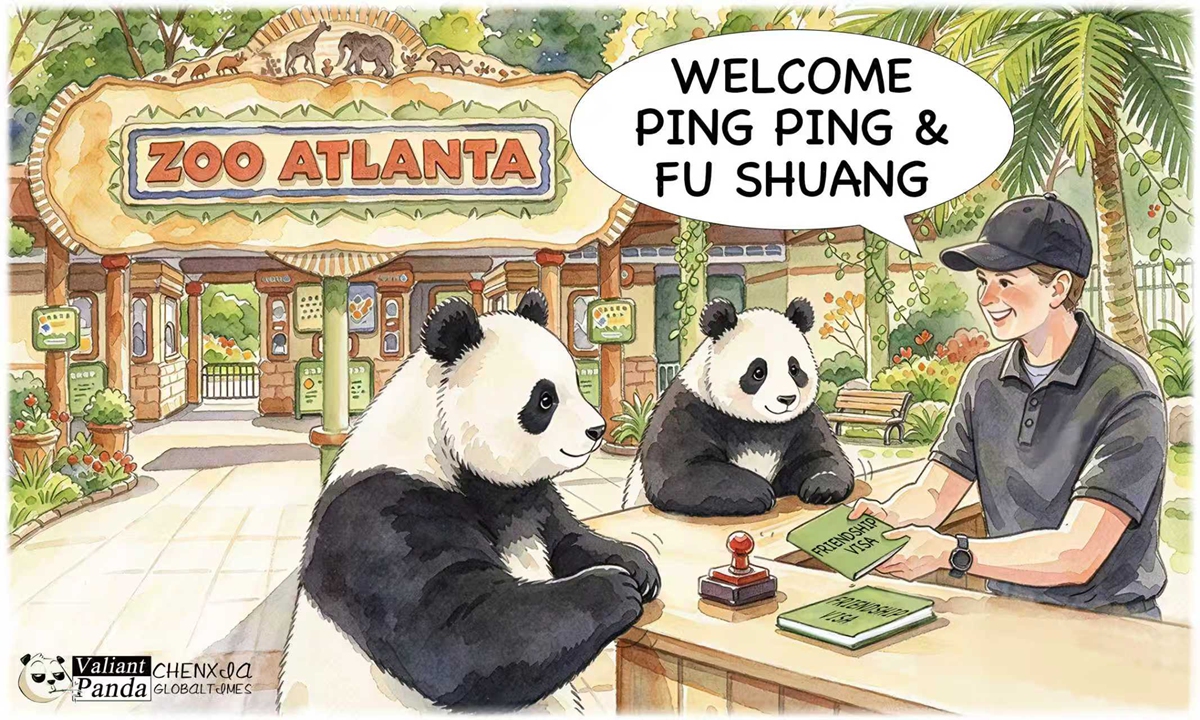
Strengthening friendship. Illustration: Chen Xia/GT
American society is hardly short of people willing to learn about China. Trends such as "China Travel" and "Chinamaxxing" have swept across Europe and the US, becoming some of the latest fads among young people in the West. Allowing the "panda huggers" to once again become a mainstream voice in shaping perceptions of China serves the interests of both China and the US and meets the expectations of the wider world.
"The giant pandas have arrived!" A chartered cargo plane carrying a pair of Chinese giant pandas, Ping Ping and Fu Shuang, landed in Atlanta in the southeastern US on Sunday, US Eastern Time. Zoo Atlanta expressed its joy with the words "thrilling" and "historic." CNN reported that Atlanta residents had eagerly awaited the pandas' arrival, with local businesses even putting up signs outside their doors welcoming Ping Ping and Fu Shuang in both English and Chinese. The arrival of the two pandas has once again sparked a "panda craze" in US public opinion. This long-missed enthusiasm also brings to mind the need for more "panda huggers" in American society - people who are willing to understand China and support exchanges and cooperation between the two countries and who deserve greater respect and space to make their voices heard.
Giant pandas have long been beloved by the American public and have also symbolized the friendship between the peoples of China and the US for more than half a century. In 1972, two giant pandas - Ling Ling and Xing Xing - arrived in Washington DC, following the visit of then US president Richard Nixon to China. More than one million people visited them in their first month of public display, and that year was dubbed the "year of the panda" by many Americans. Since 1999, Zoo Atlanta has cooperated with its Chinese counterparts. Lun Lun and Yang Yang lived there for more than two decades and had seven cubs, giving countless American families a chance to know China firsthand and better understand the value of conservation and cooperation. Before Lun Lun, Yang Yang and their family returned to China in 2024, nearly 10,000 visitors went to Zoo Atlanta for a farewell party. Two years later, the arrival of Ping Ping and Fu Shuang has been warmly welcomed. This is hardly surprising, as it builds on emotional memories that have long taken deep root among the peoples of the two countries.
There was a time when "panda huggers" referred to voices in US academia and strategic studies circles who advocated for engagement, mutual benefit and cooperation between China and the US. Familiar with China's history and realities, they understood that cooperation between the two countries served not only their own interests, but also those of the wider world. In recent years, however, some political forces in the US have relentlessly promoted the so-called "China threat," leaving less and less room for rational discussion of China-US relations. Those who call for cooperation can be dismissed as "weak," while efforts to present a more balanced and accurate picture of China can invite suspicion and negative labeling. "Panda huggers" have even become a term of ridicule in some circles. Such a poisoned public discourse not only harms people-to-people exchanges between the two countries, but also undermines the ability of the US to assess the situation and formulate sound policies.
American society is hardly short of people willing to learn about China. They are in university classrooms studying Chinese, on China-focused business teams at chambers of commerce, in joint laboratories at research institutions, and among educators at museums and zoos. They are also ordinary families who take their children to see pandas, visit exhibitions or simply sit down for a Chinese meal together. The problem is that these individuals have long lacked the political respect and space that their willingness to engage deserves.
When scholars are suspected of being "pro-China" simply for objectively describing China's economic achievements or social changes, when entrepreneurs are insinuated to be "endangering US national security" merely for maintaining normal business ties with China, and when local governments have to prove their innocence before promoting people-to-people exchanges, the long-term result will be fewer and fewer people who genuinely understand China, while the voices that remain will become increasingly extreme. In effect, this means allowing irrational emotions to dictate the handling of complex international relations issues.
Many Americans who advocate for zero-sum competition remain constrained by decades-old notions of superiority in national strength and values, refusing to acknowledge the progress brought about by China's development. Meanwhile, trends such as "China Travel" and "Chinamaxxing" have swept across Europe and the US, becoming some of the latest fads among young people in the West. This contrast further exposes how out of touch Washington's old guard has become with the times. In March, The New York Times published an article titled "US Leaders Need to See What's Happening in China," bluntly arguing that American policies are based on "stale assumptions, secondhand impressions and an incomplete understanding of what China is building." Although the article itself remains steeped in Cold War thinking, the fact that such an argument is being made at all is telling.
The US needs to allow the "panda huggers" to once again become a mainstream voice in shaping perceptions of China and foster a broader social consensus on "understanding China" objectively and rationally. Giant panda conservation cooperation itself offers a vivid example of pragmatic, mutually beneficial China-US cooperation. Chinese and American wildlife conservation experts have worked together on breeding research, ecological conservation, public education and other initiatives, overcoming numerous challenges in the protection of rare and endangered species and contributing valuable China-US experience to global biodiversity conservation. For the US, giant pandas have also generated tangible social and economic benefits. A spokesperson for Smithsonian's National Zoo in Washington said the sale of panda merchandise is a huge source of revenue. These visible and concrete achievements offer a glimpse of a simple truth: Both China and the US stand to gain from cooperation and lose from confrontation.
Only when "panda huggers" can speak openly without fear, when those who present China objectively are treated fairly, and when people who wish to visit China can travel freely and conveniently can the foundation for China-US cooperation grow stronger. This serves the interests of both China and the US and meets the expectations of the wider world.
RELATED ARTICLES