ARTS / CULTURE & LEISURE
Architect unites hands to preserve ancient homes, local wisdom
From old stones to new connections
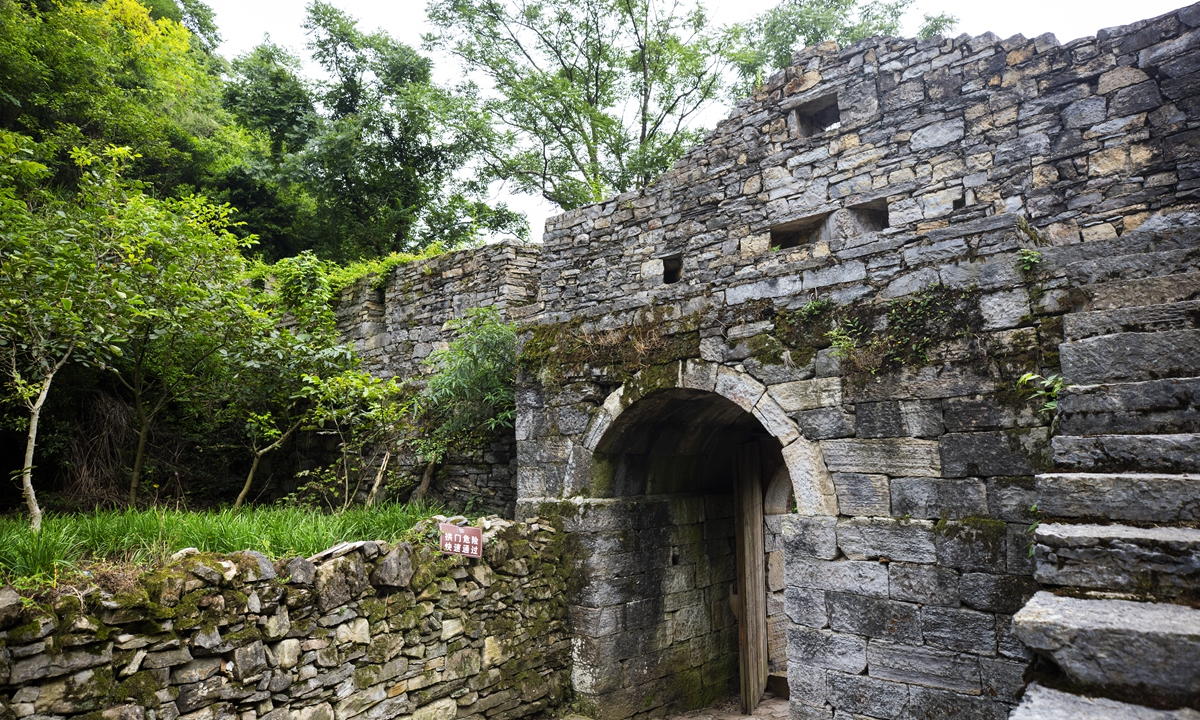
An ancient stone gate in Yunshan Tun in Anshun, Southwest China's Guizhou Province Photo: VCG
In Yunshan Tun, a centuries-old village in Anshun, Southwest China's Guizhou Province, Chinese and foreign volunteers recently joined local craftsmen in carefully removing weathered tiles, clearing walls and moving heavy timber beams as they worked to restore an old house.For more than a decade, a group of international helpers gathered at the village every autumn at the Tunpu work camp. The work camp was founded by Guizhou architect Yue Jian in 2014 and it has since become an annual part of efforts to protect the village's traditional buildings while bringing people from different backgrounds closer to the heritage they are helping preserve.
Tunpu means "fort" in Chinese and refers to the residential building complexes in villages in Anshun built in the style of a defensive fortress in ancient times.
In the Ming Dynasty (1368-1644), some troops were sent to Anshun, where they built villages and cultivated land for farming. Their descendants have lived there over generations, preserving their original living customs. Thus the unique Tunpu culture took shape.
Yunshan is part of Guizhou's distinctive Tunpu settlements. The traditional dwellings of the Tunpu people were built using locally sourced limestone, forming an enclosed stone-and-timber building that served both residential and military defensive functions.
In recent decades, however, some villagers have moved away for work, leaving some of the historic dwellings increasingly vulnerable to deterioration and collapse. The village's local households have dwindled from more than 300 to just over 30, according to Yue.
Since Yue launched the Tunpu work camp in 2014, it has attracted over 350 volunteers, including 89 internationals from countries and regions such as France, Australia, Germany and Greece.
Together, they have helped restore 14 historic buildings, Yue told the Global Times in a recent interview.
In recent years, Guizhou has carried out systematic surveys of surviving military and residential settlements dating from the Ming and Qing (1644-1911) dynasties, including Tunpu structures.
Preliminary documentation has now been completed for more than 300 Tunpu villages, covering their history, customs and cultural practices, the Xinhua News Agency reported in September.
Conservation efforts have also gradually expanded from individual buildings to encompass entire village layouts, traditional craftsmanship, intangible cultural heritage and residents' everyday lives.
Meanwhile, local authorities have stepped up efforts in restoring the historic buildings. A total of 230 million yuan ($34.4 million) has been invested to complete the restoration of 27 key Tunpu cultural heritage sites, according to a report by the Anshun Daily in July.
Restoring more than buildings
When Yue first visited Yunshan as an architecture student conducting field research on traditional architecture in 1998, he was deeply captivated by the architectural wisdom on display: how it adapted to local conditions, used locally available materials and built in harmony with the terrain. Yue there and then decided he would work to contribute to the protection of these ancient structures.
To explore viable approaches to preserving these ancient buildings, in 2013 he traveled to France to take part in a work camp focused on restoring a medieval castle. The experience inspired him to come up with a similar means to restore Tunpu buildings.
Heritage conservation is not just the work of experts and professional institutions. Ordinary people can also take part under the guidance of professionals, learning about architecture and traditional craftsmanship in the process, noted Yue.
Together with the Shanghai Ruan Yisan Heritage Foundation and REMPART, a French heritage conservation volunteer network, Yue launched the Chinese volunteer camp for Tunpu architectural heritage conservation in 2014.
Every autumn since then, international volunteers have worked alongside local carpenters to learn traditional construction techniques, including timber framing and mortise-and-tenon joinery.
They have also experienced local Dixi opera and the traditional wax-resist dyeing technique known as batik, both listed as national-level intangible cultural heritages.
The work camp has not only become a bridge between urban and rural communities, but also a bridge connecting Eastern and Western cultures. "We are not only restoring buildings, but also restoring a sense of nostalgia," Yue said.
He said he hopes that the work camp inspires more young people to learn about architecture, encourages villagers to pay renewed attention to their old houses, and brings more members of society into heritage conservation efforts.
Volunteers have apprenticed themselves to local craftsmen, learning traditional Chinese architectural wisdom from the ground up, starting with basic skills such as sawing timber, he said.
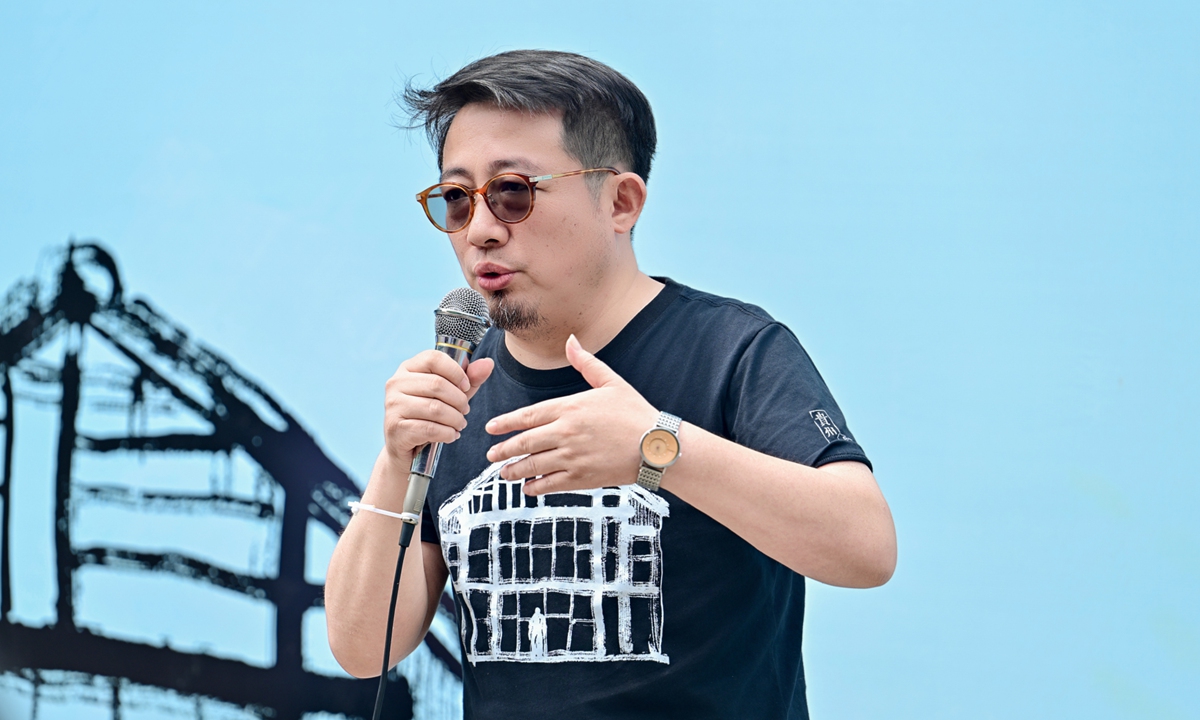
Architect Yue Jian Photo: Courtesy of Yue Jian
New purposesRestoring old houses is only the first step. The next challenge is figuring out how to keep them as a living part of modern life, Yue told the Global Times.
Under the supervision of the local village committee and the work camp, one of the restored buildings was leased as an artist's studio, he said.
Some of the restored old houses have been repurposed as tourism experience spaces, workshops for intangible cultural heritage crafts, book cafes and homestays.
Hu Qian, a Shanghai-based architect, said at this year's work camp that giving restored buildings a new lease on life means more than simply recommending the area to friends as a tourist destination.
Bringing in high-quality resources and activities, such as a drama festival, can help introduce the Tunpu communities to the world, Hu said.
Yue said that repurposing restored buildings as homestays is not adequate. "We need to think about what kind of architecture fits modern rural life." As times change and new circumstances emerge, new possibilities will continue to unfold, he added.
RELATED ARTICLES