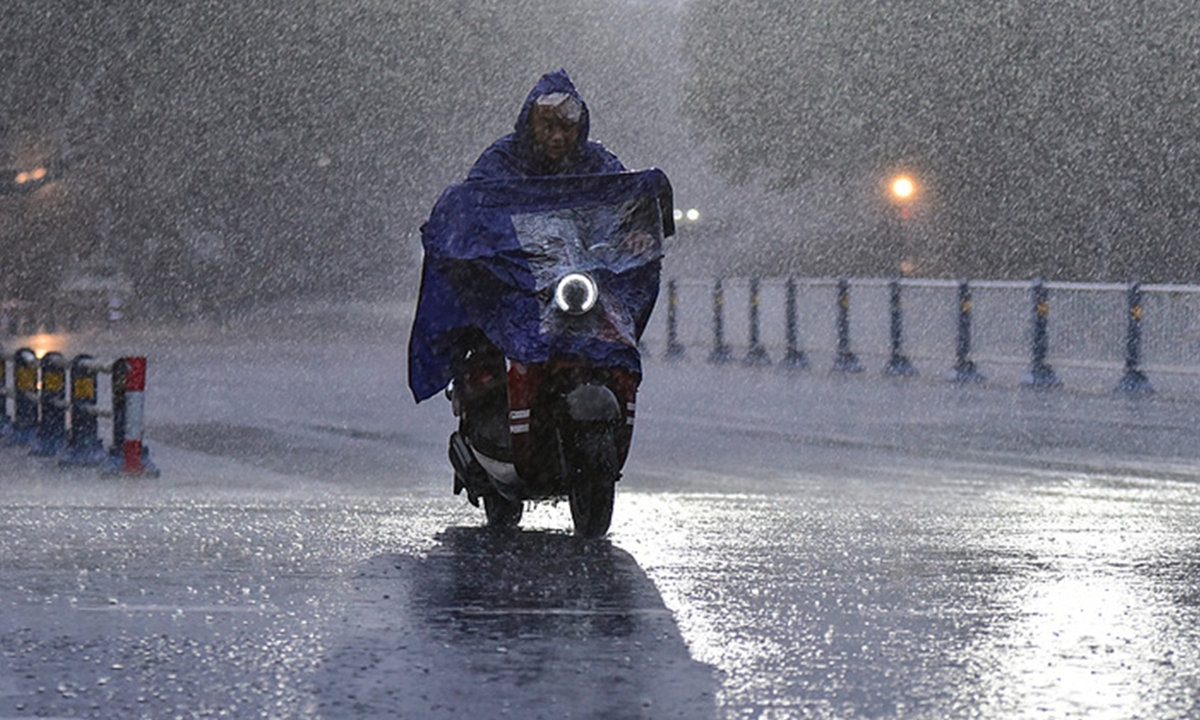
A resident in Fuyang, East China's Anhui Province, travels through heavy rain on August 30, 2026. The city experienced severe rainfall that day under the influence of the remnants of Typhoon Saudel. Photo: VCG
China's National Climate Center (NCC) has forecast that the ongoing El Nino event is likely to become the strongest on record, with the sea surface temperature index in the central and eastern equatorial Pacific expected to peak at 3.2 C to 3.5 C around November, according to a press conference of the China Meteorological Administration on Tuesday.
Monitoring by the NCC showed that the central and eastern equatorial Pacific entered El Nino conditions in May this year. The sea surface temperature index rose rapidly, averaging 2.09 C from June to August and reaching 2.59 C in August. Since September, sea surface temperatures have continued to rise, with the index exceeding 3 C for the first time on record on both five-day and 10-day periods.
Three super-strong El Nino events have previously been recorded, in 1982-1983, 1997-1998 and 2015-2016. Chao Qingchen, director of the NCC, said at the press conference that both the current sea temperature index and its rate of warming were significantly higher than at the same stages of those three events.
Under China's national standard, an El Nino is classified as super-strong when its peak index reaches or exceeds 2.5 C, according to the NCC.
The developing El Nino is expected to continue influencing China's climate through autumn and winter. The NCC forecast above-normal rainfall across much of central and eastern China in October and November, with precipitation in most of the areas located in the coastal area south of the Yangtze River, and parts of eastern parts of the regions in Southwest China expected to be 50 to 80 percent above normal, increasing the risk of extreme rainfall and related disasters, according to the press conference.
For the winter from December 2026 to February 2027, temperatures across China are expected to be generally above normal, although cold waves may occur slightly more frequently and bring sharp temperature swings. El Nino is forecast to weaken rapidly and come to an end during the spring and summer 2027, but its climate impacts are expected to persist, with more extreme weather events and stronger and more widespread summer heat waves, the press conference noted.
The World Meteorological Organization said in its latest El Nino update on September 3 that the event was firmly established and expected to strengthen further to a very strong intensity before peaking toward the end of the year. WMO forecasts showed a nearly 100 percent likelihood that El Nino would persist through February 2027.
Global Times
RELATED ARTICLES