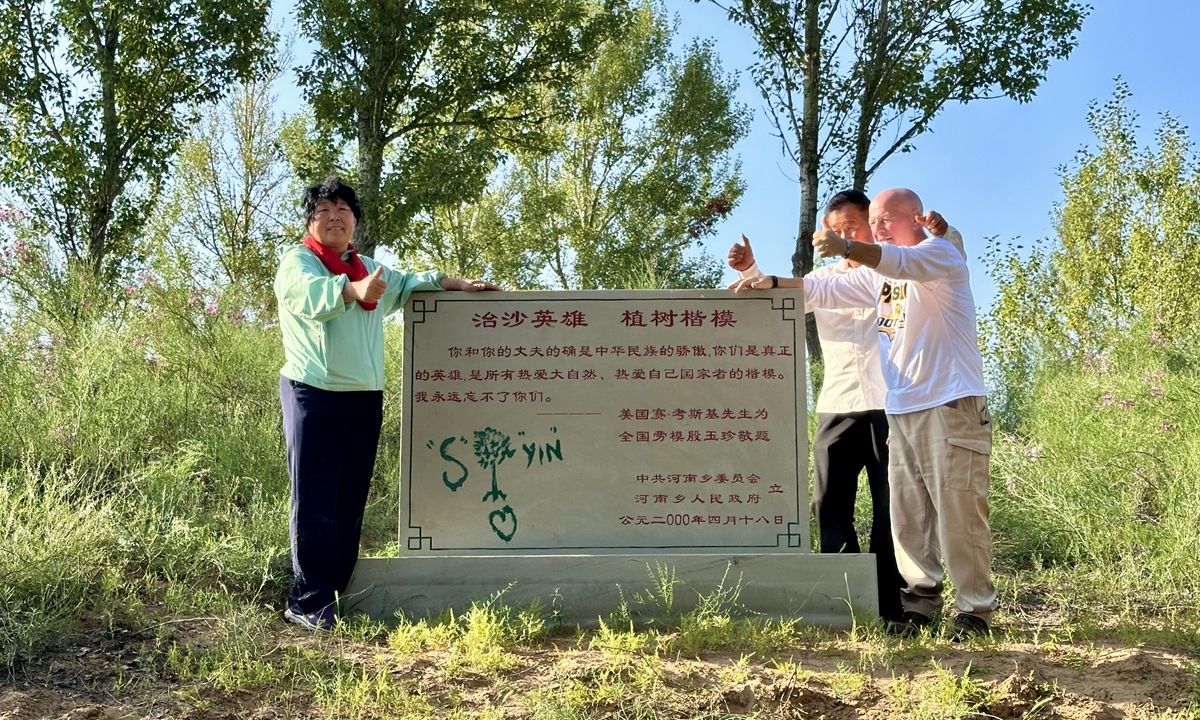
Yin Yuzhen (left), Ronald Sakolsky (right) and Yin's husband pose for a photo in Ordos, North China's Inner Mongolia Autonomous Region, on August 24. Photo: Lin Xiaoyi/GT
"It sounds like a Chinese story," an American correspondent in Beijing told me, "not an American one." He was answering a question I asked: Why Ronald Sakolsky's story travels so far in China, but so little in the US?That didn't sit right. The $5,000 donation began with an American. The 27 years of planting using that donation happened in China. The 50,000 trees are what the two of them left behind. This was never just a Chinese story.
It did not begin in the dunes of Inner Mongolia. It began in Plum, a suburb east of Pittsburgh, where Sakolsky taught high-school history. In 1999 he went to Luoyang, Central China's Henan Province, on an exchange program. One night on television he saw Yin Yuzhen, a farmer in Inner Mongolia. Sand had nearly swallowed her house. Hardly anything would grow. She was planting trees anyway, trying to hold the desert back. He did not know her, but decided to help.
He spent two months raising $5,000 to help Yin. In a poor desert village at the turn of the century, that was a fortune. Yin did not fix her house. She did not ease her own life. She turned all the money into seedlings that could survive wind and sand. In the spring of 2000, they met once. She showed him how to plant. She cooked him noodles. Then they lost touch.
Yin had already been wrestling the dunes for years. The American money — about 20 years of her income then — came at the hour she needed it most. The seedlings bought with that donation later grew into more than 50,000 trees. The larger forest around them is the work of her whole life. And she always wanted to find Sakolsky and tell him the money had not been wasted.
In mid-May 2026, standing in the forest that had risen from the sands, Yin faced the camera, her voice catching as she posted a short video asking netizens to help her find Sakolsky. Moved by the clip, more and more Chinese netizens joined the search. With little more than a name and the memory of a teacher who had once taught in Luoyang, the search crossed the ocean. They found each other first on a screen, and she invited him back to see the forest.
In late August 2026, they met again in Inner Mongolia. She had little English. She said, "Welcome to China, my brother." He kept saying the hero was her, not him. Their hug quickly spread across the Chinese internet.
This is not just a Chinese story. It's a story through which more Chinese got to know ordinary American people.
Most coverage about China-US ties is loud: tariffs, chips, geopolitical competition. What held Chinese attention from late August into September was small — an encounter that imbued with goodwill. With China's reform and opening-up, American teachers came into Chinese classrooms. Programs start and end. Policy warms and cools. People remember.
Sakolsky and Yin did not share a language or a political system. What they shared was smaller than that: He chose to help, and she chose not to forget. The Chinese put it this way: A drop of water in a desperate hour should be repaid with a spring. Americans say "pay it forward." Same instinct, different shores. The feeling does not need a translator.
Stories like this don't settle a tariff fight or a chip war. It shows, however, that something human in the relationship has never gone away.
What ordinary people in both countries want is neither mysterious nor far apart. Their aspirations already align: a better living, a better environment, a future for the children. And when two individuals from our two countries can turn a desert into a forest, then the harder problems we share - climate change, public health, the governance of AI - can be worked on together as well. As Sakolsky said: "Together we can do something very good for this Earth."
The forest in Inner Mongolia is what that hope looks like. An American teacher reached out first. Chinese people remembered, and they are willing to reach out too. The relationship needs more people like Sakolsky. The planet is shared. So is the future.
The author is a chief reporter with the Global Times. The article was originally published in US media CounterPunch. opinion@globaltimes.com.cn
RELATED ARTICLES