China's 'artificial sun' hits new milestone with research campus delivered for use, targets 2030 for first electricity output
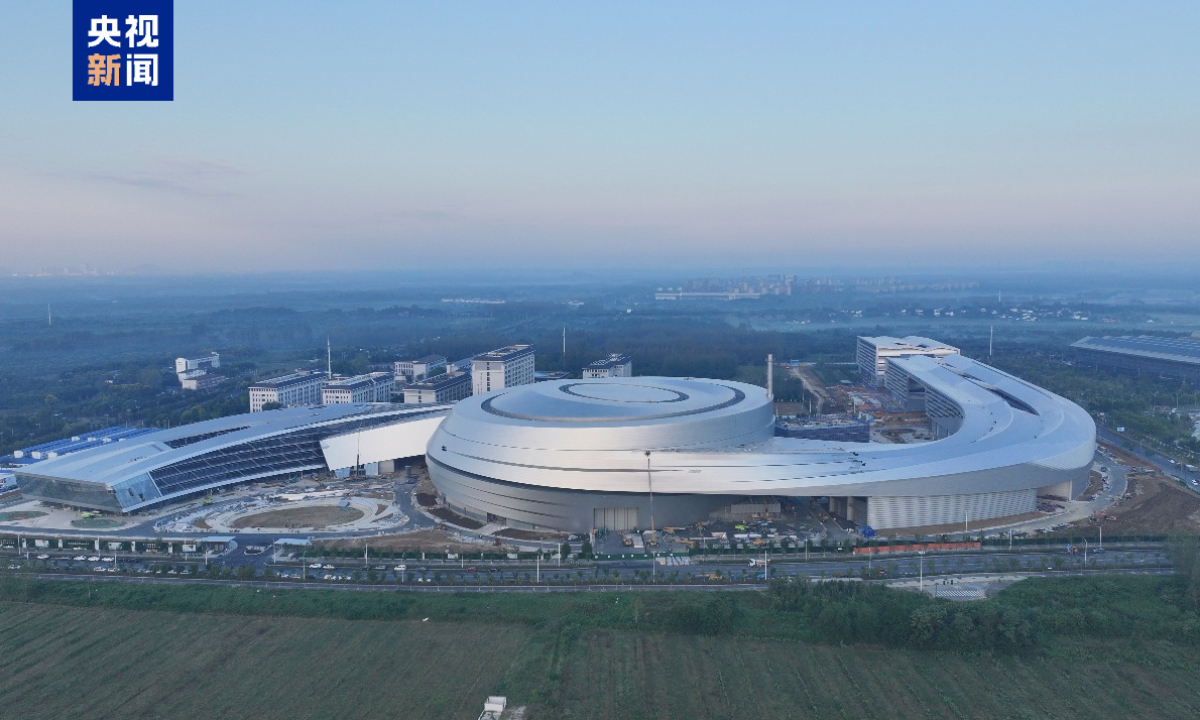
The project campus of the Burning Plasma Experimental Superconducting Tokamak (BEST) Photo: Screenshot from CCTV News
China’s efforts in accelerating the transition of its nuclear fusion program from fundamental research to large scale engineering have achieved a major milestone, as the project campus of the Burning Plasma Experimental Superconducting Tokamak (BEST), which is dubbed China's "artificial sun," was officially delivered and put into use in Hefei, East China’s Anhui Province, China Central Television (CCTV) reported on Thursday.
Currently, the construction of the BEST's main machine has entered a critical "four-layer nested assembly" phase. BEST is a new-generation fusion burning experimental device independently developed by China, aiming to simulate the nuclear fusion reactions inside the sun to obtain nearly inexhaustible clean energy.
Since July this year, multiple key core components of the BEST have been delivered to the site, and assembly has progressed steadily, with tasks now more than halfway complete.
Recently, the most critical task in the construction of BEST’s main machine started – the "four-layer nested assembly." Like a giant "thermos-like barrel" nested layer by layer, the device has, starting from the innermost layer, a vacuum vessel, then a thermal shield and toroidal field magnets are wrapped around it. The final step involves installing internal precision components, according to CCTV News.
The vacuum vessel is the "furnace chamber" where nuclear fusion reactions occur, and the thermal shield acts as a super insulation layer to block heat. The toroidal field magnets are responsible for generating an ultra-strong magnetic field, firmly confining the high-temperature plasma so it does not touch the vessel walls.
According to the plan, overall construction on BEST is estimated to complete by the end of 2027, after which deuterium-tritium fusion power generation demonstrations will be conducted around 2030. The experiment will replicate the sun's principle of "shining and generating heat" on Earth, and verifying the feasibility of commercial power generation through controlled nuclear fusion.
China has steadily accelerated progress toward commercial nuclear fusion in recent years. In January 2025, the "artificial sun" project sustained a plasma temperature of 100 million C for 1,066 seconds, setting a new world record, according to CCTV News.
Also, its Experimental Advanced Superconducting Tokamak (EAST) has repeatedly set world records. On June 28, the research team confirmed with the Global Times that development acceptance and full parameter testing on the two key superconducting magnets for EAST’s fusion reactors have been successfully completed.
Upon completion, the BEST facility is expected to demonstrate fusion electricity generation for the first time in history, according to the Xinhua News Agency.
Global Times
