Takaichi calls China 'important neighbor' but hypes 'regional' tensions; experts say rhetoric masks continued provocation
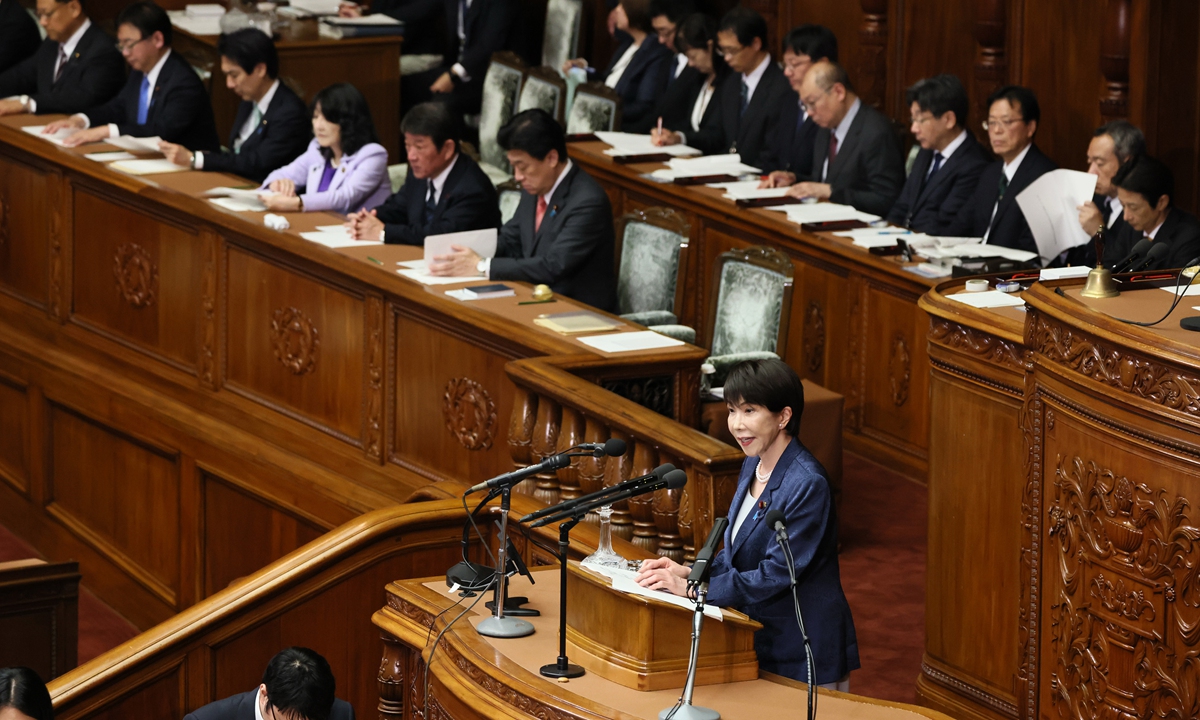
Japanese Prime Minister Sanae Takaichi delivers a policy speech at a plenary session of the House of Representatives on October 5, 2026. Photo: VCG
Japanese Prime Minister Sanae Takaichi on Monday called China an "important neighbor" and said Japan would advance its strategic relationship of mutual benefit, with China, while claiming that it would firmly "assert" its positions on issues including the East and South China Seas and what it called China's "regional military activities," and demanding that China take "responsible actions," Kyodo News reported.
Some Chinese experts said Takaichi's remarks were a perfunctory response to mounting pressure both at home and abroad, with the conciliatory rhetoric aimed at placating Japan's business community amid closely intertwined China-Japan supply chains and calls for the restoration of normal economic and trade ties. However, the Japanese government's fundamental stance toward China has not changed, and the remarks essentially amount to another provocation against China.
Takaichi made those remarks during a policy speech on Monday in both Diet chambers, according to Japanese media reports. Referring to China as an "important neighbor" despite increasingly strained bilateral ties, she said Japan would strengthen communication on "common challenges" and promote dialogue aimed at protecting Japan's national interests, the Sankei Shimbun reported.
Takaichi also seized on what she framed as heightened, assertive Chinese military posturing in the East China Sea and South China Sea, some Japanese media reports said. She claimed Japan would "vigorously press its own claims" and press China to behave in what Japan deems a responsible manner. Meanwhile, she noted that the two countries have longstanding ties despite of the existence of certain issues, and said Japan would continue to advance its strategic relationship of mutual benefit, according to Japanese media reports.
Lü Chao, an expert at the Liaoning Academy of Social Sciences, told the Global Times on Monday that Takaichi's remarks were aimed at responding to mounting pressure from Japan's business community. With China and Japan closely intertwined through their supply and industrial chains, political confrontation due to Takaichi's erroneous remarks about China's Taiwan island has seriously affected economic and trade cooperation.
As a Japanese economic delegation recently visited China and calls grow from various quarters to restore normal economic and trade exchanges, Takaichi is attempting to ease domestic pressure by making verbal gestures of easing tensions and providing an explanation to Japan's business community, Lü said.
Meanwhile, China has continued to strongly criticize Takaichi's erroneous positions in international forums, with 33rd Asia-Pacific Economic Cooperation (APEC) Economic Leaders' Meeting to be held in Shenzhen, South China's Guangdong Province, in November also approaching.
Takaichi's perfunctory remarks were a response to pressure both at home and abroad, aimed at using the occasion to project a certain stance, while her fundamental position remains unchanged, the expert said.
During the policy address, Takaichi also claimed Japan would strengthen its defense capabilities and intelligence functions, claiming that the security environment surrounding Japan was changing at an "astonishing speed" and becoming increasingly complex and severe. She said Japan would revise its three key security documents by the end of the year in order to "fundamentally strengthen defense capabilities," the Asahi Shimbun reported.
"The Japanese government was deliberately portraying the regional security situation as increasingly dangerous and creating a tense atmosphere to prepare public opinion for moves to break through the principle of 'exclusively defense-oriented policy' and three principles on transfer of defense equipment and technology," the expert noted.
Lü further criticized the Takaichi administration for displaying a more extreme right-wing tendency than previous Japanese administrations. Its main dangerous moves include continuously increasing defense spending and developing offensive weapons and weapons of mass destruction, easing restrictions on arms exports to promote Japanese military products overseas, and challenging international norms by advocating the removal of the "enemy state clauses" in the UN Charter, Lü said.
China's top diplomat Wang Yi met with Takeshi Iwaya, president of the Japanese Association for the Promotion of International Trade (JAPIT), in Beijing on September 28, the Xinhua News Agency reported.
Noting that this year marks the 80th anniversary of the opening of the Tokyo Trials, Wang, director of the Office of the Foreign Affairs Commission of the Communist Party of China Central Committee and a member of the Political Bureau of the Communist Party of China Central Committee, said that Japan is once again facing the test of history, Xinhua noted.
If Japan refuses to learn from historical lessons, challenges the post-war pacifist Constitution, denies its history of aggression or glorifies war criminals, it cannot face the world and there's no building a future to speak of, Wang said, per Xinhua.
Noting that next year marks the 55th anniversary of the normalization of diplomatic relations between China and Japan, Wang said what matters is to adopt a correct attitude on historical issues. Fundamentally, Japan needs to develop an objective and rational perception of China, he added, Xinhua said.
