Documentary exposes Wei family’s northern Myanmar telecom fraud crimes: ritual killings, victim with seven bullet holes in skull

Photo: Screenshot from CCTV
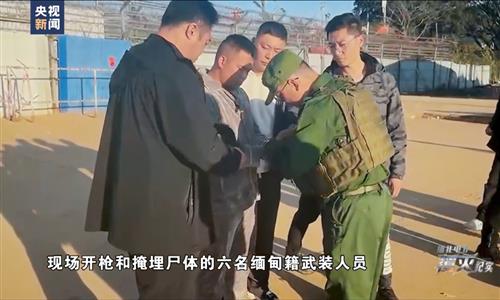
People were randomly killed as ritual sacrifices, including one victim whose skull was found to have seven bullet holes. The second episode of a new serial documentary reveals how the Wei family, one of the so-called “four major families” in northern Myanmar involved in telecom fraud, established and maintained its foothold in the region and imposed violent control over fraud compounds through armed forces.
The second episode of the serial documentary, titled “The Demise of Myanmar-Based Telecom Fraud,” focuses on China’s cross-border pursuit of criminal groups operating in northern Myanmar. It details how relevant Chinese authorities overcame jurisdictional and law-enforcement barriers to track down fugitives, highlighting Chinese public security authorities’ efforts and achievements in dismantling the “four major families” and other criminal groups in the region, China Central Television (CCTV) reported.
According to the documentary, the Wei family emerged as a key power in northern Myanmar about 15 years ago after rapidly expanding its political and military influence. Wei Chaoren of the Wei family served in Myanmar’s Union Parliament, while his younger brother, Wei Huairen, held military power.
The documentary also reveals that the Wei family received government salaries to ostensibly safeguard border security, while behind the scenes it used state institutions to protect the family’s interests. It pioneered the use of border forces and private armed groups to impose violent control over telecom-fraud compounds, CCTV reported.
To maintain the Wei family’s control over the armed forces in Kokang, Wei Huairen reportedly groomed his nephew, Chen Dawei, as a key second-generation family member, while Chen sought to strengthen ties with the financiers behind the compounds by becoming their sworn brother.
To lend greater solemnity to the sworn-brother ceremony and demonstrate his resolve to pledge allegiance, Chen ordered his subordinates to randomly find a stranger to serve as a sacrificial victim in a ritual killing.
The unfortunate “stranger” selected was at the time being held in solitary confinement in a small detention room for refusing to comply with the rules of the compound and was ultimately chosen at random to became a victim.
On another occasion, Chen, resentful over a previous dispute with a financier from another family-run compound, ordered one of his subordinates to seize the financier’s employee on the street in the second half of 2022 and detain the victim. A month later, Chen ordered his subordinates to take the victim, who had refused to submit or show weakness, to an execution site.
The victim had seven bullet holes in his skull. He was found kneeling and face down, with his hands bound behind his back. The condition of the body was indescribable, suggesting he had been shot to death in a hail of bullets, said Huang Yuanfeng, head of the criminal investigation brigade at the Nan’an city’s public security bureau in Quanzhou, East China’s Fujian Province, in the documentary.
The documentary, titled “The Demise of Myanmar-Based Telecom Fraud,” is jointly produced by China’s Ministry of Public Security and China Media Group. It is scheduled to air on China Central Television (CCTV) from Monday to Wednesday. The three-episode documentary series offers an unprecedented look into the horrific reality of Myanmar cyber fraud networks, as well as China’s determination and relentless crackdown on notorious cross-border cyber-scam operations.
Global Times
RELATED ARTICLES