Tokyo reportedly mulls nuclear subs amid security document revision; 'could spur arms race'
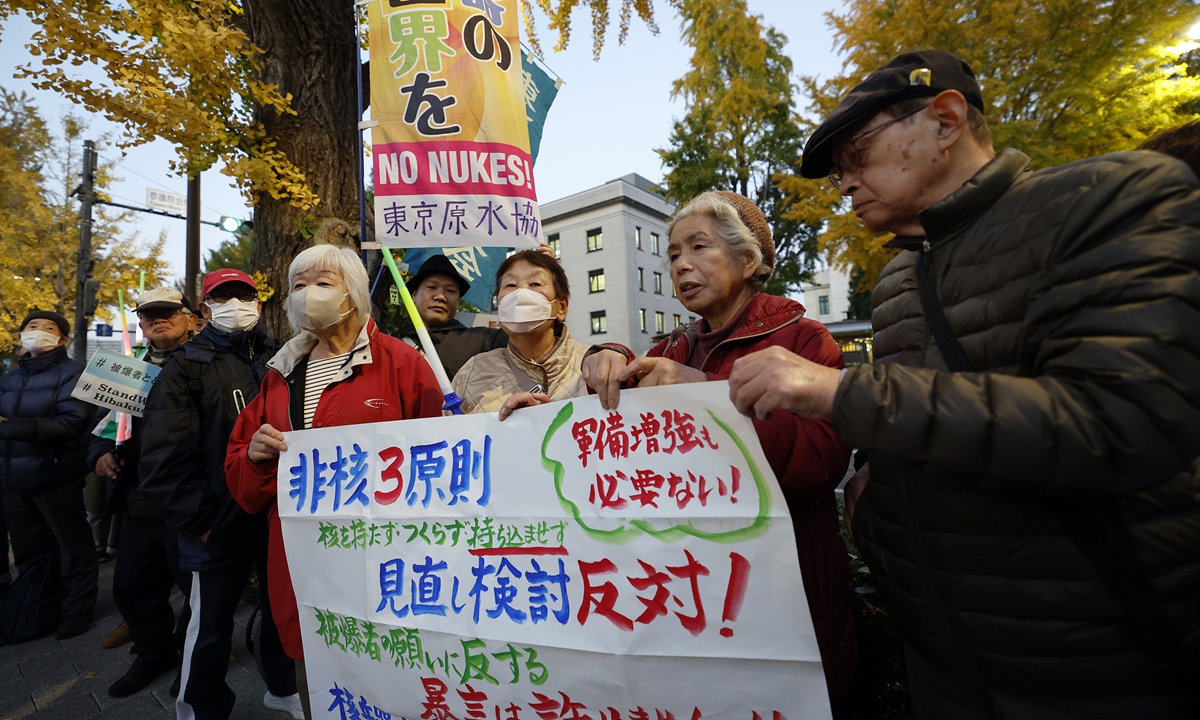
Demonstrators stage a rally before the Diet against the Japanese government's nuclear policies in Tokyo, Japan, on November 21, 2025. Protesters also call on the government to join the Treaty on the Prohibition of Nuclear Weapons. Photo: VCG
As Japan prepares to revise its three security documents by year-end, including the National Security Strategy, plans have emerged within the Japanese government to mention nuclear submarines as an option for strengthening deterrence, Kyodo News reported on Tuesday, citing several sources familiar with the matter.
The Japanese government may avoid directly mentioning Japan's "possession" of nuclear submarines, instead limiting the language to "further research and discussions" according to Kyodo News.
Yomiuri Shimbun reported on Wednesday that the plan is expected to take several years before a final decision is made on whether to formally acquire the equipment.
Zhang Junshe, a Chinese military affairs expert, said that if Japan were to introduce nuclear submarines, its military capabilities would undergo a significant shift toward a more offensive posture.
Since nuclear submarines offer extended submerged endurance, high-speed mobility and long-range operational capabilities, they could serve as highly concealed platforms for precision standoff strikes against land and maritime targets if they are equipped with vertical launch systems and long-range or hypersonic weapons, Zhang said.
The combination of these capabilities could shift Japan's self-claimed exclusively defense-oriented policy toward greater strategic deterrence and long-range strike capabilities, potentially altering the military balance in East Asia. Such a shift could spur neighboring countries to boost defense spending and expand anti-submarine and long-range strike capabilities, fueling an arms race and heightening regional security tensions, Zhang added.
Successive Japanese governments have limited the use of nuclear energy to peaceful purposes under the country's Atomic Energy Basic Act, prohibiting nuclear to be used for military purposes. Given the expected massive spending, strong caution remains within the Liberal Democratic Party (LDP), per Kyodo News.
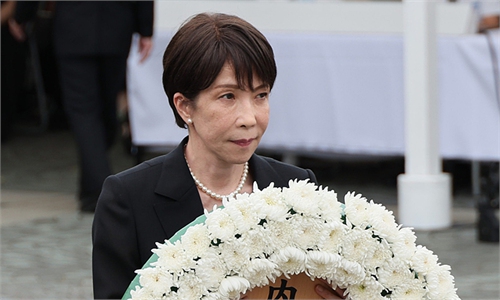
Da Zhigang, a research fellow at the Institute of Northeast Asian Studies of the Heilongjiang Academy of Social Sciences, pointed out that an explicit reference in its security documents to studying nuclear submarines could signal that the Takaichi administration is testing public opinion and laying the policy groundwork for eventually acquiring US-built or domestically developed nuclear subs.
Knowing that Japanese society, as well as its neighboring countries, remains wary of any attempt by Japan to revise its Three Non-Nuclear Principles or seek to acquire nuclear weapons, Takaichi administration is testing the waters step by step, Da told the Global Times on Wednesday.
Such tentative actions to strengthen its nuclear capabilities could raise tension and spur further military buildup in the region, Da added.
Japanese Defense Minister Shinjiro Koizumi said in September that Japan would "not rule out any options" in discussions and studies on whether to acquire nuclear-powered submarines as part of a revision of the country's key security documents, Xinhua reported, citing Kyodo News.
In response to that, Chinese Foreign Ministry spokesperson Guo Jiakun said during a press briefing on September 30 that the "no-nuclear-taboo" remark is a blatant provocation and serious stomp on the Non-Proliferation Treaty and the postwar international order. It is diametrically opposed to the three non-nuclear principles that Japan claims to uphold. His remark once again revealed the Japanese right-wing pursuit of a nuclear Japan.
The international community needs to call on Japan to strictly observe the three non-nuclear principles, fulfill its obligations under the NPT, abandon remilitarization and its nuclear ambitions, and earnestly respond to the concerns of the international community, Guo said.
RELATED ARTICLES