China’s COSCO acquisition of German firm a ‘normal business operation;’ analysts warn blockade could undercut Zippel’s global integration
By Published: Oct 08, 2026 01:18 PM

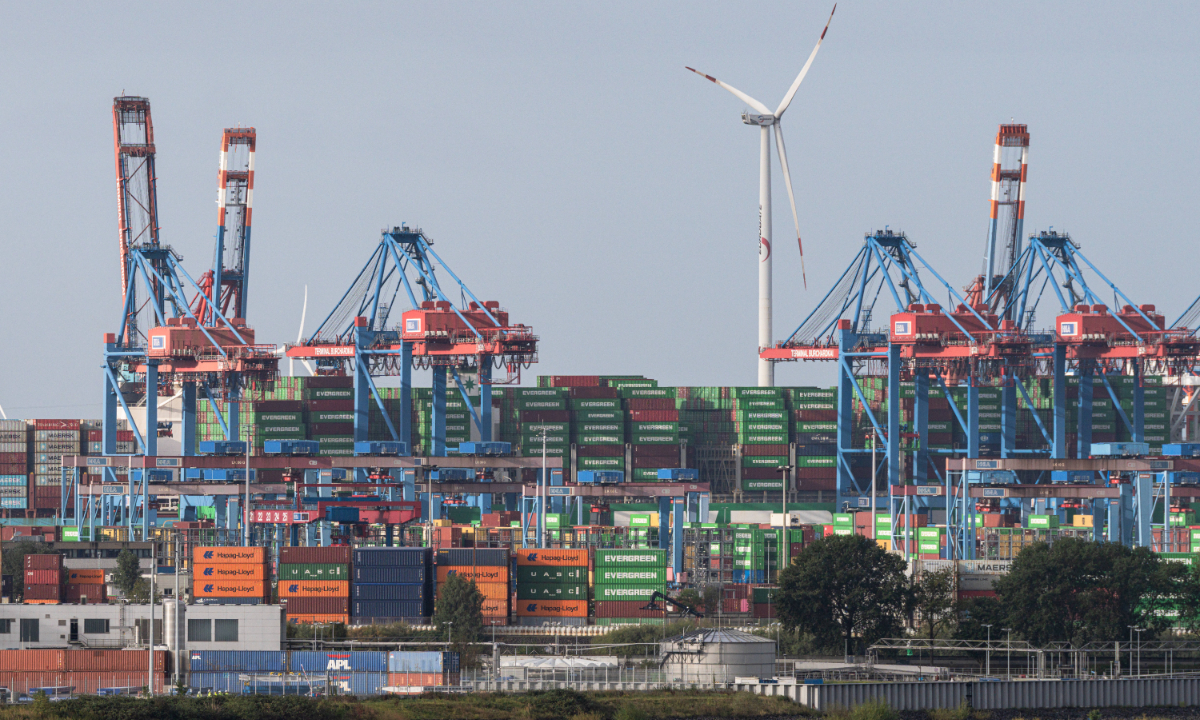
Container cranes, shipping containers and wind turbines at the HHLA Container Terminal Tollerort in Hamburg, Germany Photo: VCG
The German government has blocked the sale of logistics firm Zippel to Chinese state-owned shipping group COSCO over security concerns, according to media reports, a move that Chinese analysts slammed as another typical action of "politicizing normal economic cooperation between China and the EU" and "overstretching the concept of security." They also warned that such a unilateral measure could undercut the German firm's development prospects and its profit-making ability.
The blockade, adding to a slew of unilateral measures the EU has recently taken to target Chinese companies, has also laid bare Brussels' "inherently contradictory approach" ahead of a high-stakes meeting scheduled in recent days, analysts said. They pointed out that the EU, while pinning hopes to resolve bilateral economic and trade issues at the negotiating table, shows "limited sincerity" as it continues to create discords that could lead to new bilateral disputes between China and the EU, undermining not only the stability of bilateral economic relations but also the global economic order.
COSCO's potential acquisition of Zippel "would have deepened dependencies and jeopardized the resilience of Germany's and the EU's supply chains," the Economic Ministry said, according to a Reuters report.
Zippel is not a large-scale German logistics company. Figures previously disclosed by the firm show it has about 350 employees and a market share of roughly 1.5 percent, according to media reports.
As the German company mainly handles normal transport and transshipment in the supply chain, so it is very hard to infer that an acquisition of this size of company can pose any significant "security risk," a Chinese expert pointed out, warning that the blockade could potentially undercut Zippel's ability to integrate into COSCO's extensive global logistic network, and with it the firm's revenue prospects.
In response to the German government's decision, Zippel CEO Axel Plass said that "we would have preferred a different outcome and continue to consider our business decision the right one," per the Reuters report. COSCO has not responded to the interview request of the Global Times as of press time.
COSCO already has a minority stake in a Hamburg port-based container terminal. Analysts pointed out that it is a normal business operation for large carriers like COSCO to buy smaller firms along the logistics chain, so as to build an integrated service offering and rely less on third-party operators for hinterland transport.
"The decision of the German government in fact shows that the EU has been widening the range of targets as it politicizes economic and trade issues with China, from telecom, high-tech industries to the transportation and logistics sectors, which further puts strain on China-EU trade and economic relations," Jian Junbo, director of the Center for China-Europe Relations at Fudan University's Institute of International Studies, told the Global Times on Thursday.
The announcement came as preparations accelerated for a second meeting of the China-EU trade and investment consultation mechanism. Jian criticized that the EU has displayed a "very limited level of sincerity" that shakes the foundation of trust necessary for the upcoming trade talks.
According to a report by the Euro News, the European Commission had set October as a deadline to secure "tangible" results with Beijing to rebalance their trade relationship.
"It is clear that the EU wants to talk and hopes to reach a result, however what they have done is like shutting the door first. This contradiction shows that its understanding of the problem and its handling of it are not aligned, and that the bloc has yet to find the right way to manage and resolve the differences," Jian said, stressing that China does not accept such unilateral measures.
The expert also urged the EU to take a unified, pragmatic approach in dealing with the Chinese side, and resolve differences through bilateral consultation.
A spokesperson from China's Ministry of Commerce (MOFCOM) said on Tuesday that China has always believed that interdependence is not a risk, and intertwined interests are not a threat; openness and cooperation are the right path to development. Protectionism cannot enhance competitiveness, and decoupling will only harm others without benefiting oneself.
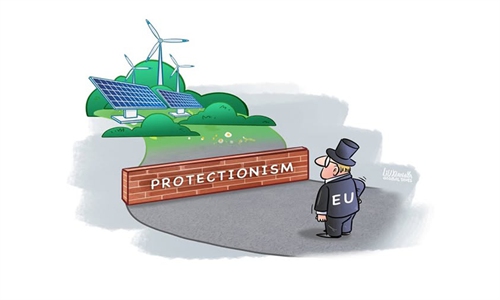
The spokesperson made the remarks as it is reported that France and Germany submitted an informal document to the European Commission on Monday, calling on the EU to strengthen its use of trade defense measures and roll out a series of new protectionist tools.
The Global Times reported earlier that if the EU presses ahead with protectionist measures targeting China, China will respond with a strong policy toolbox. Potential countermeasures could include anti-discrimination investigations, industrial and supply chain security investigations, investigations into the impact of foreign subsidies and so on, a Chinese observer said.
RELATED ARTICLES