US-led excess capacity narrative criticized for ignoring market demand and ‘justifying protectionism’
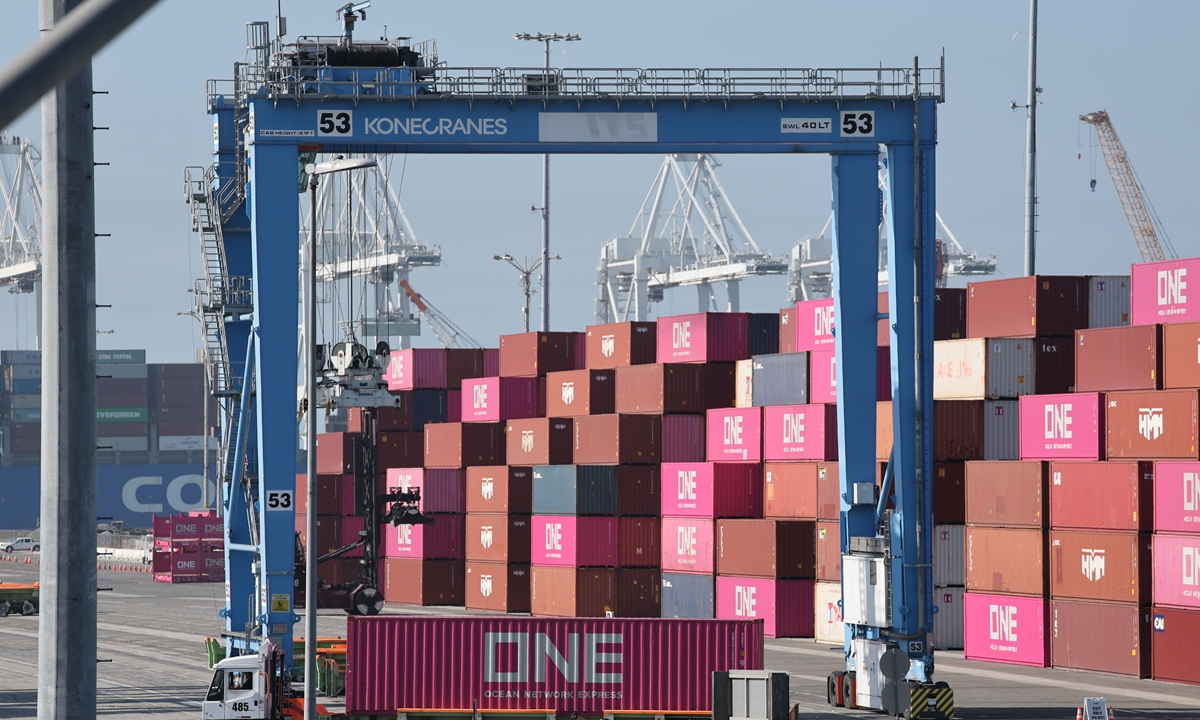
A truck moves goods in a shipping container next to large stacks of shipping containers and cranes at the Port of Long Beach in Long Beach, California, USA on August 26, 2026. Photo: VCG
Chinese experts on Thursday criticized US-led Western economies for long assessing trade issues with China without reference to actual market demand, while increasingly invoking the so-called excess capacity narrative to shape public opinion and justify trade restrictions on competitive foreign products.
The comments came after 15 economies signed a joint statement calling for actions against what they described as structural excess industrial capacity. While China has repeatedly called for an objective assessment of production capacity based on market demand and international industrial cooperation, warning that protectionism risks undermining global economic growth.
According to a statement released by the Office of the United States Trade Representative (USTR) on Wednesday, 14 economies joined the US in signing a Joint Ministerial Statement calling on countries to address "structural excess capacity and production" by ending "non-market policies and practices" that distort markets and perpetuate the problem.
The statement was signed on the margins of the Organisation for Economic Co-operation and Development Trade Committee meeting, following discussions at the G20 Trade Ministerial in Milwaukee, Wisconsin. The G20 meeting last week failed to reach consensus on the issue of excess industrial capacity, Reuters reported on Thursday.
The signatories agreed to establish sector-specific platforms, starting with autos and electric vehicles, batteries, chemicals, foundational semiconductors and solar panels. They also committed to meeting before December 2026 at the technical level to share non-confidential information and explore possible complementary actions, according to the statement.
Trade issues should be assessed against actual market demand and on an industry-by-industry basis, rather than simply judging China's manufacturing competitiveness by its export market share or trade surplus, or just so-called excess capacity, He Weiwen, a senior fellow at the Center for China and Globalization, told the Global Times on Thursday.
He questioned the rationale behind broadly labeling China's manufacturing competitiveness as excess capacity, arguing that some economies appear to base their assessments largely on China's export market shares and bilateral trade surpluses rather than a comprehensive examination of actual supply and demand, using the narrative to build public support for sweeping protectionist measures.
He stressed the need to closely monitor what specific trade measures these economies may take next, adding that China has corresponding countermeasures at its disposal should they impose unilateral restrictions that violate multilateral trade rules.
Against these one-sided and unfounded accusations, official international statistics offer a more comprehensive picture of China's manufacturing and export structure.
China accounted for 32 percent of global manufacturing value added in 2024, according to the United Nations Industrial Development Organization's International Yearbook of Industrial Statistics 2025. By contrast, China accounted for an average of 14.4 percent of global merchandise exports by value over the past three years, according to the World Trade Organization's Global Trade Outlook and Statistics released in March 2026.
These figures challenge the notion that China's manufacturing strength can be judged simply by the scale of its exports. He noted that the vast majority of China's manufactured products serve domestic demand, while exports are driven by demand in overseas markets.
The Chinese expert also pointed to China's trade in automatic data-processing equipment and integrated circuits as examples of why sector-specific analysis is necessary. According to He, exports of the two product categories have increased substantially, but their combined import growth has been even larger, illustrating China's continuing participation in international industrial supply chains on both the supply and demand sides.
The debate comes amid growing global demand for technologies needed to support energy transitions and expanding electricity infrastructure, even as Chinese products such as battery are repeatedly labeled by Western economies as a sector plagued by so-called excess capacity.
Global electric vehicle battery deployment surged nearly 30 percent year-on-year to 1.2 terawatt-hours in 2025, according to the International Energy Agency's Global EV Outlook 2026, highlighting growing global demand for battery technologies.
Demand is also growing in the US. Reuters reported in May that American battery storage companies were seeking to capitalize on rising electricity demand from AI data centers, while facing supply-chain constraints and continued dependence on Chinese battery materials.
The trend illustrates why assessments of industrial capacity need to take into account the evolving demand for manufactured products across global markets, the Chinese expert noted.
China has consistently rejected the broad characterization of its manufacturing competitiveness as a consequence of excess capacity, stressing that industrial production and cross-border trade should be assessed in the context of global supply and demand.
China's Ministry of Commerce said in its July position paper that all parties should strengthen communication on subsidies transparency under the WTO framework, and resolve differences through consultations on an equal footing.
The ministry warned that invoking protectionism will only serve to disrupt global economic and trade order and undermine the security and stability of global industrial and supply chains and the sound and orderly development of industrial cooperation, which spell long-term risks for world economic growth.
RELATED ARTICLES