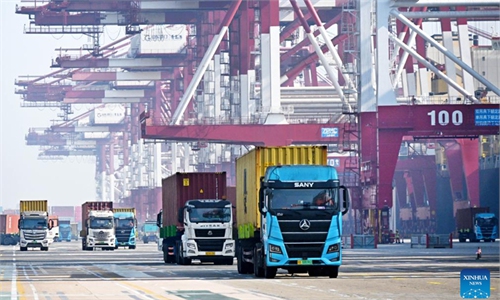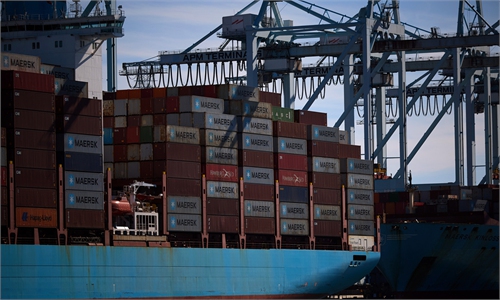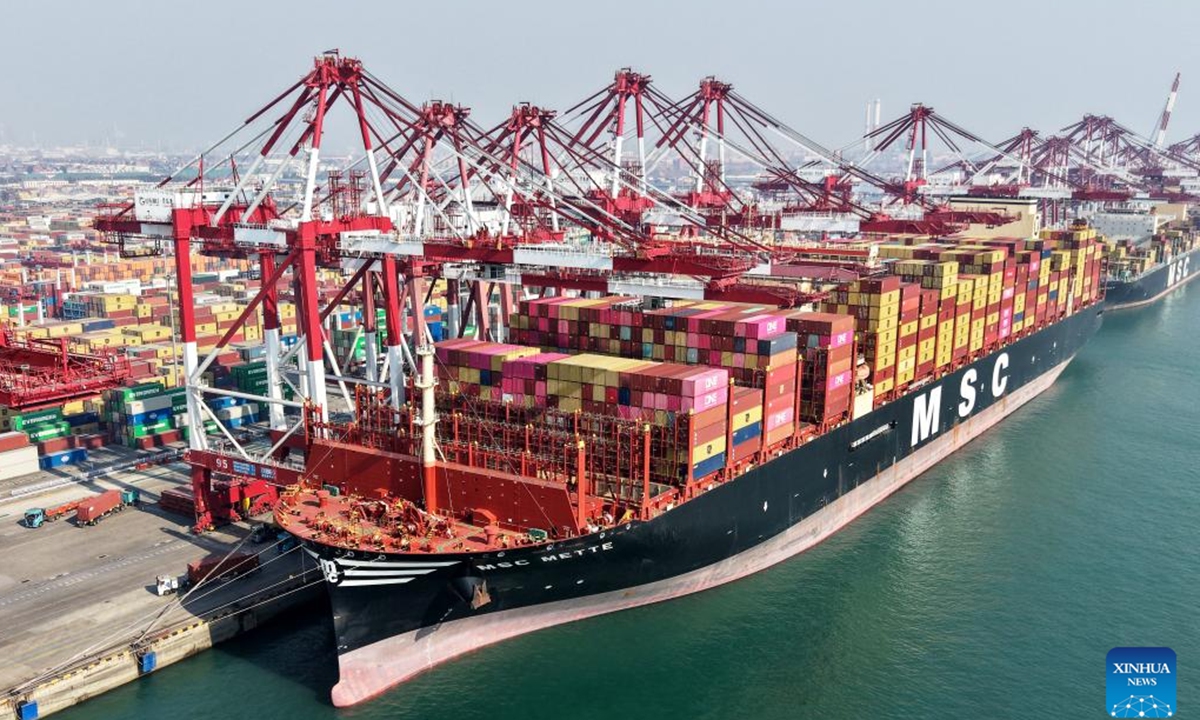
A drone photo taken on Feb. 18, 2026 shows a container vessel loading and unloading containers at Qianwan Container Terminal of Qingdao Port in Qingdao, east China's Shandong Province. During the Spring Festival holiday, Qianwan Container Terminal of Qingdao Port has witnessed a bustling scene. Qingdao Port coordinated in advance to ensure operations during the festival, improving cargo transportation efficiency and optimizing the foreign trade port's business environment while prioritizing the work safety. (Xinhua/Li Ziheng)
China's foreign trade has moved in lockstep with the country's broader economic development, demonstrating remarkable resilience. The resilience stems both from China's comprehensive industrial system and the cumulative benefits of the country's steadfast commitment to high-level opening-up.
Foreign trade remains a key driver of China's economic growth. Net exports of goods and services contributed more than 30 percent of GDP growth for the past two consecutive years.
The rapid expansion of China's foreign trade in recent years highlights the country's core strengths: a complete manufacturing ecosystem and a fully integrated industrial supply chain. The advantages are the result of decades of efforts to ramp up technological innovation and engagement with global markets, which also underpin the confidence and competitiveness of China's foreign trade sector.
And, the foreign trade growth has persisted despite facing external pressures, demonstrating a distinctive pattern - the greater the pressure, the stronger the resilience.
Promoting high-quality foreign trade growth requires efforts to strengthen product competitiveness and pursue broader structural improvements.
Concentrating on high-quality exports is the cornerstone of high-quality foreign trade development. In 2025, China accounted for roughly 30 percent of global manufacturing value added by holding more than 14 percent of the global export market share. This achievement is based on the competitiveness of Chinese products and the strength of the country's supply chains.
China's export structure is rapidly shifting toward high-tech and high-value-added products, and artificial intelligence-related electromechanical equipment, new-energy vehicles, premium consumer goods, and biopharmaceutical products are increasingly becoming key drivers of export growth. The competitive edge of these high-value-added exports reflects China's strength in technological innovation, advanced manufacturing, and integrated supply chains. The positive momentum is expected to be further consolidated.

Mao Zhenhua Photo: Courtesy of Mao Zhenhua
At its core, foreign trade is the cross-border circulation of products. As global industrial and supply chains undergo profound restructuring, expansion into international market has become an inevitable trend for Chinese enterprises. To achieve high-quality economic globalization, several priorities deserve attention.
First, it is important to recognize the inevitable trend of industrial globalization. China is poised to play a central role in the next phase of global supply chain restructuring. The current transformation is global in scale, long-term in nature, and unlikely to be reversed. China sits at the heart of this process. Chinese companies are expected to become active participants in the emerging global industrial and supply chain landscape.
Unlike previous waves of industrial relocation, in which traditional exporting countries rarely undertook large-scale overseas investment, Chinese firms are actively building production facilities abroad. If managed effectively, this transition could place China in a more advantageous position within the new global industrial order than any previous exporting nation.
Second, overseas green-tech investment presents major opportunities, but Chinese companies need to carefully balance opportunities with risks. Many recipient countries urgently seek foreign capital, technology and industrial capacity to support their economic development and industrial upgrading, and they welcome Chinese investment. Chinese enterprises need to remain alert to geopolitical uncertainties, policy shifts, legal barriers, and other external risks. Overseas investment expansion should proceed in a prudent, compliant, and risk-conscious way.
Third, fostering globally competitive Chinese multinational companies is essential for building a strong modern economy. The traditional development model - importing raw materials and energy, processing and assembling products domestically, and then exporting them worldwide - offers limited opportunities to add value.
Building multinational companies capable of using and optimizing resources on a global scale is certainly a more advanced and efficient path. By cultivating a group of internationally competitive multinational corporations, China can strengthen its economic foundation and enhance its trade resilience against external volatilities in an increasingly complex global environment.
The article was excerpted and compiled from a recent speech by Mao Zhenhua, co-director of the Institute of Economic Research at Renmin University of China, published by the China Macroeconomy Forum. bizopinion@globaltimes.com.cn
RELATED ARTICLES