Botswana's president to pay state visit to China; China-Botswana cooperation offer lessons for African nations to advance economic transition: expert
By Published: Oct 09, 2026 11:10 PM

File photo: VCG
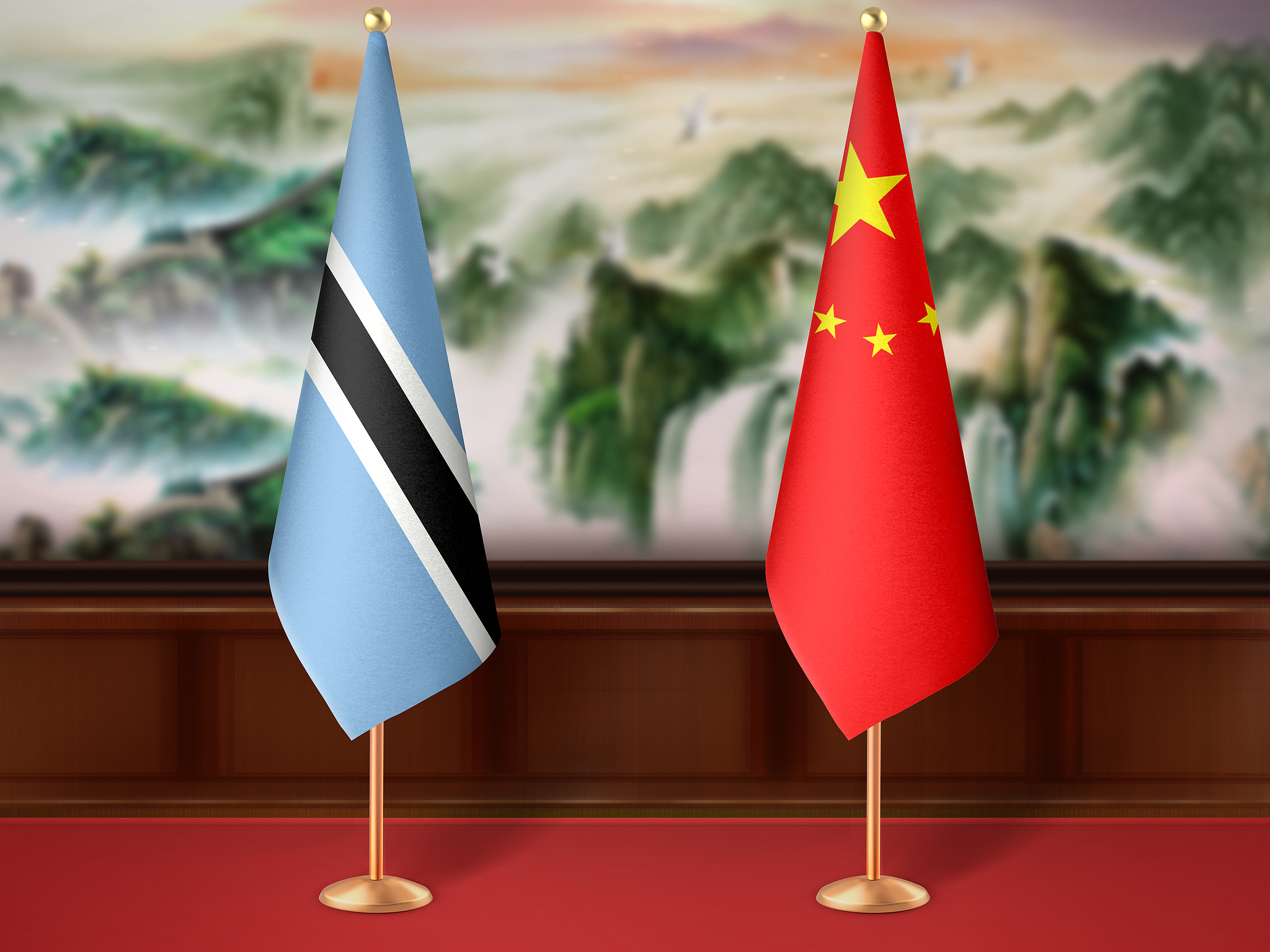
President of the Republic of Botswana Duma Gideon Boko will pay a state visit to China from October 12 to 17, the Chinese Foreign Ministry announced on Friday, and spokesperson Mao Ning said the upcoming visit will elevate China-Botswana relations to a new height and further contribute to building an all-weather China-Africa community with a shared future for the new era.When elaborating on details of the visit at the regular press conference, Mao said this will be President Boko's first visit to China since he assumed office. The two heads of state will hold talks. Besides, President Boko will pay a visit to East China's Fujian Province.
By noting that China and Botswana are strategic partners, the spokesperson said that over the 51 years since the establishment of diplomatic relations, the two countries have upheld sincere friendship and mutually beneficial cooperation.
The two countries support each other on major issues concerning respective core interests, assist each other in times of disaster and epidemic, join hands on the journey toward modernization, and firmly stand on the right side of history on international affairs, said Mao.
China and Botswana elevated their bilateral ties to a strategic partnership in September 2024. In January 2025, the two heads of state exchanged congratulatory messages marking the 50th anniversary of the establishment of China-Botswana diplomatic relations.
According to Song Wei, a professor at the School of International Relations and Diplomacy at Beijing Foreign Studies University, the upcoming visit marks an important strategic alignment between the two countries. It builds on more than half a century of friendly relations and provides a key opportunity to deepen the strategic partnership through practical implementation.
"The visit is expected to further consolidate bilateral strategic mutual trust and enable closer communication on issues concerning each side's core interests and major concerns," Song said. "It is also expected that the visit will advance practical cooperation by translating policy alignment into concrete projects and deeper cooperation."
According to data from the Chinese Foreign Ministry, bilateral trade between China and Botswana reached $1.222 billion in 2025, representing a year-on-year increase of 21.3 percent. China's exports amounted to $300 million, growing 24.9 percent year-on-year, while imports stood at $922 million, an increase of 20.2 percent year-on-year. China mainly exports machinery and equipment, transport vehicles, and light industrial and textile products, and primarily imports diamonds and copper concentrates.
According to experts, the strong complementarity in resource endowments and industrial capabilities between China and Botswana has laid a solid foundation for deeper cooperation.
"Botswana is a major diamond producer in Africa, with rich reserves of copper, nickel and other minerals, while China possesses a full industrial chain spanning mineral extraction, smelting, processing and equipment manufacturing," said Song. Botswana also has abundant solar resources, while China enjoys strong industrial advantages in photovoltaic power generation, energy storage equipment, water-saving agriculture and digital agriculture, said the expert.
She added that as a landlocked country, Botswana's development is constrained by transport, logistics and limited market size. China has rich experience in industrial park development, industrial chain cultivation, transportation, logistics and infrastructure construction.
2026 is designated as the China-Africa Year of People-to-People Exchanges and constitutes a pivotal year for delivering outcomes of the 2024 Forum on China-Africa Cooperation (FOCAC) Beijing Summit.
Since May 1, China has implemented zero-tariff treatment for all 53 African countries with which it has diplomatic relations. It continues negotiations with African nations on the Framework Agreement on Economic Partnership for Shared Development, to which Botswana is a signatory.
Deeper bilateral cooperation will not only help Botswana pursue an industrialization and modernization path suited to its national conditions, but also serve as a model for China-Africa cooperation, Song said.
According to the expert, many African countries rely heavily on resource exports and have underdeveloped industrial chains. Deepened China-Botswana cooperation can offer lessons for African nations to advance economic transition and independent development. It also serves as a model for reorienting China-Africa cooperation toward industrial upgrading.
"China-Botswana cooperation shows that despite differences in economic scale, industrial structure and development stage, countries can carry out practical cooperation on the basis of equal consultation and mutual respect," Song said. "It also demonstrates that the Global South cooperation championed by China is open and inclusive, with a global vision and strong development potential."
RELATED ARTICLES