Xi says ready to work with Trump to steer China-US ties on steady course
By Li Aixin in Washington, and Su Yaxuan in Beijing Published: Sep 25, 2026 03:07 AM

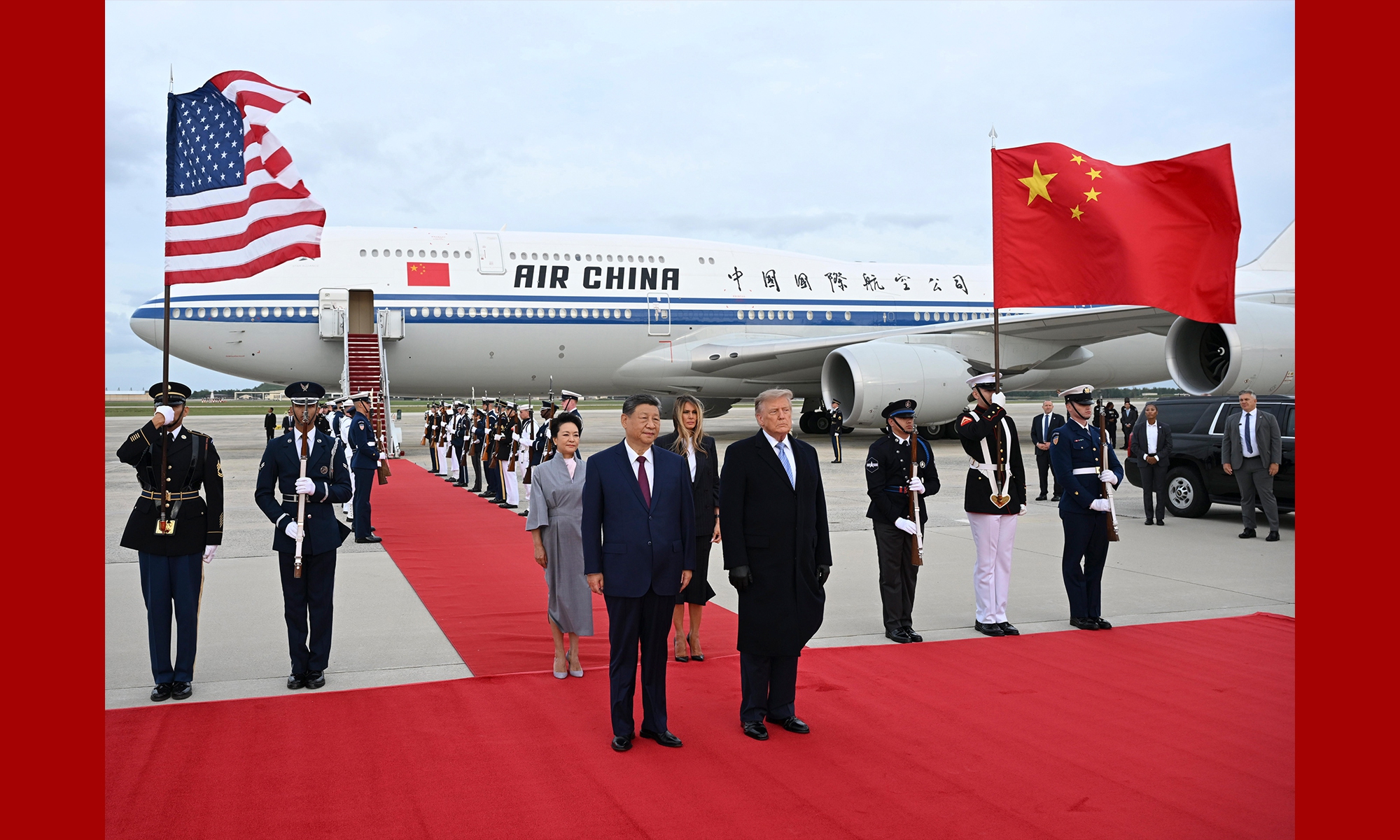
Chinese President Xi Jinping arrives at Joint Base Andrews on September 23, 2026, for a state visit to the US at the invitation of US President Donald Trump. Xi and his wife, Peng Liyuan, were warmly greeted by Trump and his wife, Melania Trump, at the airport in a rare planeside welcome. Photo: Xinhua
Chinese President Xi Jinping said on Thursday that he is ready to work with US President Donald Trump to steer the giant ship of China-US relationship on a steady course toward the future.
Addressing an arrival ceremony at the White House, Xi said that he is visiting the US at Trump's invitation to carry on their friendship, expand cooperation and promote the well-being of the two peoples, the Xinhua News Agency reported.
China and the US should strengthen communication, cooperate with sincerity and coexist in peace, he noted.
Xi said he and Trump encourage government departments, such as those in charge of foreign affairs, economic matters, financial cooperation, law enforcement and people-to-people exchanges, to catch up on strengthening contact.
China-US cooperation may not solve every problem in the world, but without it, it would be hard to solve many of the world's problems, Xi said.
China and the US must hold the line of no conflict and no confrontation, Xi said. "We can certainly find the right path for our two great countries to get along on this planet we both call home."
The Chinese leader also held small-group exchanges with Trump in the Oval Office at the White House on Thursday.
Xi's remarks at the arrival ceremony aim to reverse the US administration's previous positioning of China as a "strategic rival" and to put the current focus on achieving strategic stability, pursuing cooperation, and promoting peaceful coexistence. The visit highlighted the role of head-of-state diplomacy in providing top-level, strategic guidance for comprehensive bilateral engagements, including diplomatic, economic, and people-to-people exchanges, analysts said.
Rare planeside welcome
Chinese President Xi arrived at Joint Base Andrews on Wednesday afternoon for a state visit to the US at the invitation of US President Donald Trump, according to the Xinhua News Agency.
Xi and his wife, Peng Liyuan, received a rare planeside greeting by Trump and his wife, Melania Trump, upon their arrival. After Xi and Peng descended from their plane, the two presidential couples shook hands and exchanged greetings on the tarmac, Xinhua reported.
A red carpet was rolled out for the Chinese presidential couple, with honor guards lining up on both sides to pay their respects. Two American children presented bouquets of flowers to Xi and Peng.
The welcome ceremony also included a 21-gun salute, the playing of the national anthems of both countries and a military flyover. The 21-gun salute is among the highest military honors accorded to a visiting head of state, but is rarely rendered at an airport, according to Xinhua.
The gesture is notable even by broader diplomatic standards, as the arrangement has been described by US media as a "rare" and "unusual" departure from protocol, as US presidents typically receive visiting foreign leaders at the White House rather than greet them at the airport, Xinhua reported.
"This is significant," Anthony Moretti, an associate professor at Robert Morris University, told the Global Times. He said Joint Base Andrews carries a particular status in the US.
Joint Base Andrews has witnessed several milestones in China-US relations. President Richard Nixon departed from the base for his historic visit to China in 1972. In 1979, then Chinese Vice-Premier Deng Xiaoping arrived at Andrews Air Force Base, now Joint Base Andrews, for his landmark visit to the US, the first by a Chinese leader. President Xi also arrived at the base during his 2015 visit to the US.
In both substance and symbolism, President Trump wants this visit to succeed. Both sides need to affirm that they are working to find common ground and practical solutions to real problems, Moretti said.
President Xi's ongoing visit builds on earlier progress made in their Beijing summit in May while laying the groundwork for what comes next, Wu Xinbo, dean of the Institute of International Studies at Fudan University, told the Global Times on Thursday.
"Maintaining stable high-level exchanges and channels of communication is crucial to preventing major fluctuations in China-US relations," he said. On that basis, the two sides can leverage head-of-state diplomacy to make progress in specific areas, including trade, and advance the relationship while maintaining overall stability.
Sourabh Gupta, a senior fellow at the Washington-based Institute for China-America Studies, told the Global Times that head-of-state diplomacy remains indispensable in China-US relations - both as a stabilizing mechanism and as a means of strategic communication. The two leaders set the tone and the overall framework for the relationship. Given the fragile stability that still marks bilateral ties, this leader-led framework is all the more important.
Strengthening co-op, global governance
While addressing the arrival ceremony, Xi said both China and the US are leading nations in artificial intelligence (AI), noting that the two countries have both the capability and responsibility to develop and manage AI for good and ensure that the development of AI is always under human control and serves the well-being of the people.
On counternarcotics and law enforcement, the Chinese side is willing to strengthen cooperation with the US, Xi said. "Our two sides may also increase direct flights to facilitate two-way travel and trade."
Xi also announced an invitation for 100,000 young Americans to visit China for exchanges and study in the coming five years. He also declared that in a few days, a pair of pandas will come to their new home in Zoo Atlanta and meet with the American people.
Chinese experts said that stable and sustainable China-US relations are essential when it comes to global economic recovery, addressing regional flashpoints or governance in AI and other emerging fields. Mutual support and cooperation between the two countries would help spur global growth and improve global governance, they said.
China and the US are the two countries advancing most rapidly in AI and wielding the greatest influence in the field. Cooperation on this issue is therefore important not only for both countries, but also for the world, Wu told the Global Times. "Competition between China and the US in AI may continue, but a degree of dialogue - and even cooperation - on AI risks is both necessary and realistically possible," Wu said.
"Welcome to the US." That was the phrase a Global Times reporter heard most often along Pennsylvania Avenue NW in Washington, DC, on Wednesday afternoon, as people learned that the Chinese president had arrived for his visit.
Speaking of the Chinese leader's visit, local high school student Gus told the Global Times that he felt lucky to be in town for the occasion. "I'm just excited to see the motorcade. It's a once-in-a-lifetime opportunity."
Gus said that China and the US share an economic relationship of real value to both sides: the US relies on Chinese manufactured goods, and the US is likewise an important consumer market for China. "We need to have these conversations. Bringing different views together and finding a solution is literally what the US was founded on."
"I don't think two economic powers like China and the US should be at odds. If we can be business partners and learn from each other, I think humanity can move forward together."
Sarwar Kashmeri, founder and host of Polaris-Live.com program "US and China in the World," and senior fellow at the Foreign Policy Association, told the Global Times the signal from the visit is that the two most important and powerful leaders in the world know and understand that this is the most consequential relationship in the world.
He added that both sides also realize that their people's standard of living - not to mention that of the global population - now depends on a constructive relationship between China and the US.
During their last meeting in May, the two heads of state agreed to build a constructive China-US relationship of strategic stability. According to Gupta, it was the most important outcome of the Beijing summit, and it provided a certain anchoring of the bilateral relationship. The goal at the Washington summit is to broaden the relationship's horizons, deepen its substantive content, and seek to manage the relationship's competitive elements within a more cooperative framework.
RELATED ARTICLES