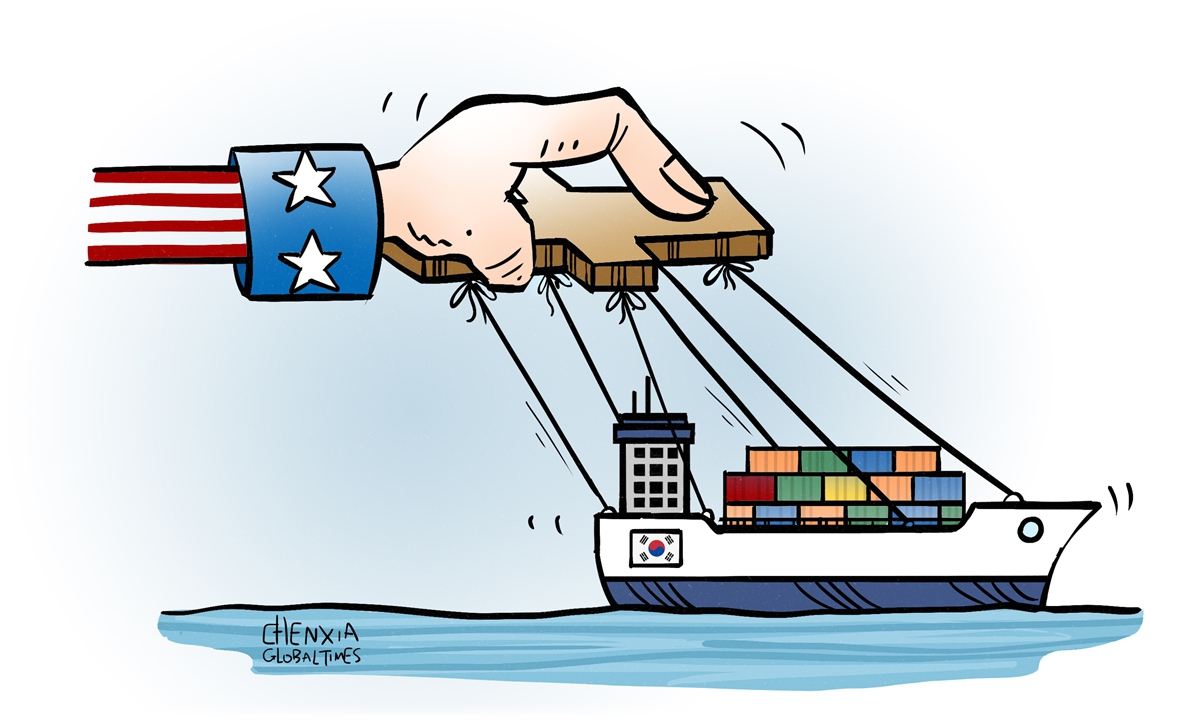
US South Korea Illustration: Chen Xia/Global Times
A dispute over the Alaska liquefied natural gas (LNG) project is stirring tensions in US-South Korea relations. Washington has been treating South Korea's participation in the Alaska LNG project as a done deal, nonetheless Seoul publicly clarified that the investment was still under review, and that any decision on participation would be based on commercial viability requirements and South Korean domestic legal procedures. Recently, the US issued a stern warning that if South Korea delayed signing the agreement, Washington would "charge more." What began as negotiations over an energy investment has evolved into an important test of the resilience of the US-South Korea alliance, offering a new perspective on the complex regional economic landscape.
Last year, the US and South Korea agreed on a package of investments during economic and trade negotiations, covering the Alaska LNG project, a gas-fired power plant in Texas and the construction of eight large nuclear power reactors. The Alaska project is the largest of these initiatives. It involves building a 1,298-kilometer pipeline to transport natural gas from Alaska's North Slope to the southern part of the state, where it would be liquefied and shipped to Asian markets. US Commerce Secretary Howard Lutnick said South Korea would invest more than $50 billion in the project.
The two countries, however, have significantly different interests in this undertaking. For the US, attracting South Korean capital to the Alaska project serves both economic and geopolitical objectives. Northern Alaska has abundant natural gas reserves, but its harsh climate and permafrost terrain make the construction of a pipeline stretching more than 1,000 kilometers technically challenging and extremely costly. A substantial funding shortfall has been a major obstacle to the project's progress for years. South Korean investment would help share the infrastructure costs, expand the market share of US LNG in the Asia-Pacific region and strengthen its competitive position against natural gas suppliers from the Middle East and Canada. At the same time, Washington seeks to use large-scale investment commitments to bind South Korea more closely to its strategic agenda, encouraging Seoul to align more closely with US positions on security arrangements and regional economic and trade issues. If South Korea refuses to provide funding, Washington would resort to threats of punitive measures. This reflects the transactional approach that characterizes US treatment of its allies.
South Korea's cautious approach is not simply a delaying tactic, but a rational choice. First, the project carries enormous commercial risks. Much of the proposed 1,298-kilometer pipeline would run through permafrost regions, where harsh construction conditions could easily lead to delays and cost overruns. South Korean energy industry experts worry that even if the project becomes operational, the delivered price of Alaskan LNG may not be competitive in the market.
Second, South Korea faces pressure to adjust its energy demand structure. Signing large, long-term LNG purchase agreements could expose the country to risks if demand declines in the future.
Third, the investment must go through domestic approval procedures. An overseas investment of this magnitude requires due diligence and statutory approvals. Seoul cannot rush into a decision simply because Washington has publicly announced its participation.
Washington's heavy-handed pressure exposes structural problems in the US-South Korea alliance. The US habitually links economic, trade and energy issues with security matters, frequently using threats of punitive measures to pressure South Korea and reducing the alliance to a transaction in which Washington can dictate the terms. The Alaska project dispute once again demonstrates that when major interests are at stake, solidarity between allies can easily give way to Washington's unilateral demands.
The disagreement between the two over what constitutes "cooperation" on a single project may just be the beginning. The implementation of subsequent investments could also encounter considerable obstacles. Although South Korea remains deeply dependent on the US for its security and is unlikely to confront Washington openly, Seoul is equally unwilling to sacrifice its core national interests or comply unconditionally with US demands. How the US and South Korea reconcile their competing interests and whether Seoul can withstand Washington's pressure will be key issues to watch as negotiations continue.
The author is a research fellow at the Institute of Northeast Asian Studies of the Heilongjiang Academy of Social Sciences. opinion@globaltimes.com.cn
RELATED ARTICLES