ARTS / CULTURE & LEISURE
China’s top court hands long jail terms for tomb looting inspired by fiction novels
By Published: Oct 11, 2026 10:37 PM

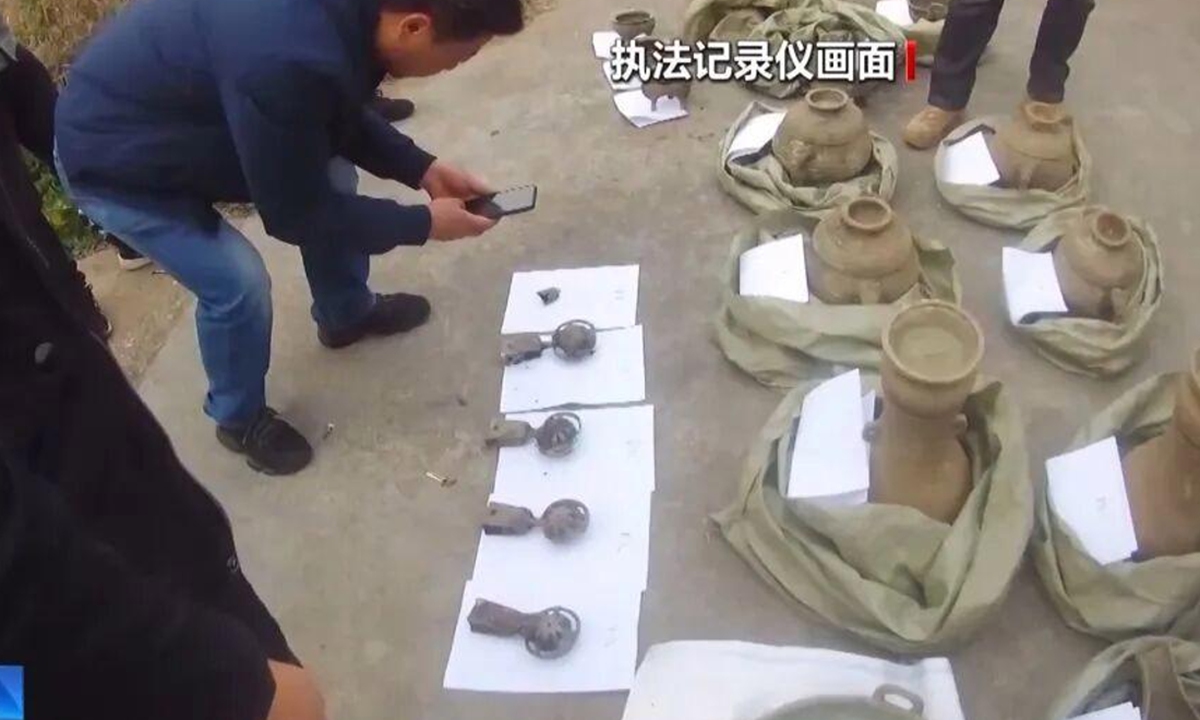
Photo: Snapshot of CCTV 13
China's Supreme People's Court and the National Cultural Heritage Administration on Saturday released information on six representative cases of cultural relic crimes, including a man who taught himself tomb-raiding techniques from fictional novels and another who dug up an ancient burial site beneath his own courtyard, as government authorities warned that heritage-related offenses are becoming increasingly professional and technology-driven.In the most prominent case, a man surnamed Yu was jailed 12 years in prison and fined for excavating ancient tombs after he became obsessed with tomb-raiding novels, taught himself excavation methods and purchased digging tools, according to a joint statement published by the two authorities.
Between September and November 2023, Yu conspired with others on two occasions to raid ancient burial sites in Zaoyang city, Central China's Hubei Province. He, either alone or with accomplices, located and excavated two tombs, stealing 23 artifacts, including an inscribed bronze dagger-axe, jade ornaments, bronze pots and a bronze ding vessel, the statement said.
The tombs are located within the provincial-level cultural relic protection site known as the Guojiamiao tomb cluster. All 23 stolen items were dated to the Spring and Autumn Period (770BC-476BC), with 22 classified as third-grade or above precious cultural relics, meaning they were of irreplaceable historical and cultural significance, authorities said.
The court in the Fancheng district of Xiangyang city, Hubei Province, ruled that Yu's actions constituted a crime. Though he confessed and pleaded guilty, the severity of the offense warranted a sentence of 12 years, the court said.
The Supreme People's Court revealed the details of the case to issue a public warning. Tomb-raiding fiction, it said, is a form of literary imagination with exaggerated and fantastical plots fundamentally different from lawful archaeological work. "The legal red line of cultural relic protection cannot be crossed," the court stated. "Tomb-raiding literary works must not be treated as a 'textbook' for committing crimes."
Beijing-based cultural scholar Yu Jinlong told the Global Times on Sunday that the case serves as a vital means to correct widespread misconceptions fueled by popular tomb-raiding fiction and screen productions.
"The official release of the representative cases delivers educational value by stripping away the fictional glamour of tomb raiding through real criminal penalties. The rulings help clarify the fundamental differences between archaeology and illegal excavation, reshape public perceptions of cultural relics' historical value and curb the prevalent trend of trivializing tomb-raiding behavior," Yu said.
In a separate case, a man surnamed Shi was sentenced to 15 years in prison for excavating an ancient tomb discovered while he was clearing persimmon tree roots in his courtyard in Xi'an, Northwest China's Shaanxi Province. Shi knew his residence fell within the protection zone of the Fenghao site, a national key cultural relic protection unit dating to the Western Zhou Dynasty (1046BC-771BC), but proceeded to dig and steal eight bronze artifacts with the intent to sell them.
The court ruled that although the tomb was located within Shi's homestead, this did not alter the tomb's legal status as state property.
Wu Xiaolin, a Beijing-based lawyer, told the Global Times on Sunday that the release of authoritative cases carries unique judicial and social significance beyond individual verdicts.
"Single-case rulings only discipline the involved parties, while publicly released representative cases unify judicial standards nationwide for relic-related trials, providing clear references for handling excavation, damage and relic-trafficking cases," Wu explained.
The authorities noted that China's cultural relic security situation remains complex, with heritage crimes becoming increasingly professional, intelligent and professionalized, while spreading online. Major cases continue to occur, they said.
Many ancient sites, tombs, grottoes and stone carvings are scattered across rural fields and mountain slopes, making them difficult to protect and vulnerable to illegal activity. Some offenders, lacking awareness of heritage protection, develop misconceptions about the nature of their actions and turn to crime, the statement said.
RELATED ARTICLES