IN-DEPTH / IN-DEPTH
Readers’ Reflections: China's urban development offers lessons and scope for co-op with developing countries: former Italian official
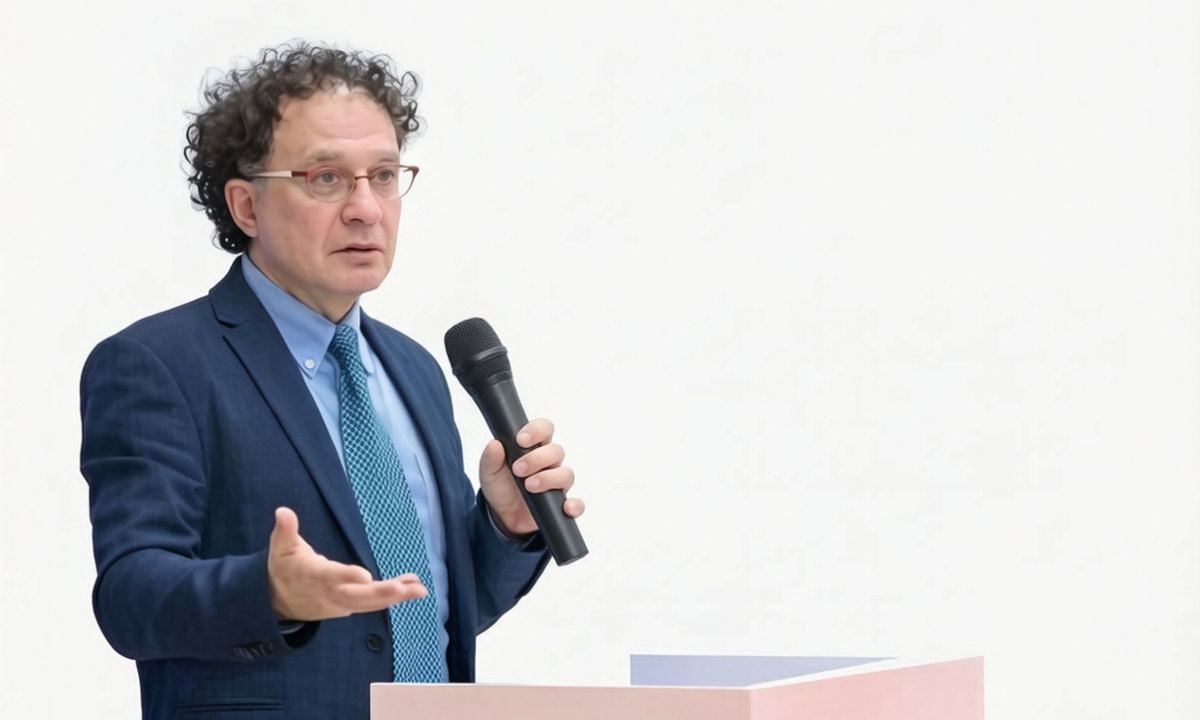
Michele Geraci Photo: Courtesy of Michele Geraci
Urban renewal initiatives should be carried out in a thorough, meticulous and effective manner to continuously enhance the people's sense of fulfillment, happiness and security, Xi said.
The concept that “cities should be built by the people and for the people,” is a concentrated expression of the development thinking of putting people first in urban governance. Volumes I through V of Xi Jinping: The Governance of China include a series of Xi’s important remarks on urban work.
In the article “Bring a sense of gain, happiness and security to the people” in Volume III of Xi Jinping: The Governance of China, Xi gave specific instructions on urban shantytown renovation and waste sorting. He said that “we cannot have cities with skyscrapers on the one side and slums on the other,” and that “garbage sorting concerns the public's living environment and resource conservation.” In Volume V, Xi said “we will carry out urban renewal projects and improve urban infrastructure to build livable, resilient and smart cities,” and emphasized, “guided by the principle that cities should be built by the people and for the people, the new era should witness the development of beautiful cities that are green, low-carbon, habitable, safe, healthy, smart and efficient.”
In the 29th installment of the special series “Decoding the Book of Xi Jinping: The Governance of China,” the Global Times, along with the People’s Daily Overseas Edition, continue to explore this theme – “Cities should be built by the people and for the people” – by inviting Chinese and foreign scholars, translators of the work, practitioners with firsthand experience, and overseas readers to engage in a deeper discussion of the practical value and broader significance of this concept.
GT: During his inspection tour in Shanghai on July 15, 2026, President Xi stressed the need to fully embrace the people-centered philosophy of urban development and adhere to the principle of understanding the people's needs, soliciting their suggestions, and assessing their evaluation of the effectiveness of urban renewal. How do you view the core of this philosophy? What lessons and practical experiences can it offer cities around the world as they confront common urban development challenges?
Geraci: I think the key point is very simple: a city is successful not because it has impressive buildings, but because it makes everyday life easier for the people who live there.
What I have observed in China is a very pragmatic approach. You look at what people actually need: transport, housing, schools, hospitals, green areas, safety and public services. Then you invest resources and assess, based on the results, whether people’s lives have actually improved. “Soliciting the people’s suggestions” means treating residents as participants in urban development, rather than passive recipients of policies and projects. I have witnessed this firsthand across many cities in China. For example, in Shanghai’s old neighborhood renovations, specific projects such as retrofitting elevators and upgrading community facilities are adjusted based on residents’ opinions and feedback. “Assessing the people’s evaluation of the effectiveness of urban renewal” serves as a very important evaluation mechanism: ultimately, it is ordinary citizens, rather than government officials or urban planners, who should judge the success of urban renewal.
One important lesson China can offer other countries is that urban development should be judged by its actual outcomes from the perspective of residents, rather than by ideology. In Europe, we sometimes spend more time discussing the process, while China tends to focus more on implementation and results. The ideal model, of course, is to combine both: sufficient communication and consultation, together with efficient execution and implementation.
GT: China’s urbanization is entering a phase of more stable development, with the focus of urban development shifting from large-scale expansion toward improving the quality and efficiency of existing cities. Having lived and worked in China for many years, what changes in Chinese cities have stood out to you most during this transition? And as urban renewal, public services and quality of life take on greater importance, how do you see this shift reshaping China’s approach to urban development?
Geraci: I have lived and worked in China for many years, particularly in Shanghai, so I have seen this transformation directly. The initial phase was characterized by urban construction on an unprecedented scale and at unprecedented speed – metros, airports, roads, housing and entirely new districts were built rapidly.
I have long believed that one of China’s most successful economic development models has been exactly this – using infrastructure and urbanization as a systematic development engine. Through infrastructure investment, you drive development and create prosperity, while making sure that economically viable projects can operate sustainably.
But today, the focus of China’s urban development is increasingly shifting from building new things to making what has already been built work better. That means renovating older neighborhoods, improving public spaces, upgrading public services and making cities greener and more livable. This shows that urban development is moving in the right direction – ensuring that the people who actually live in cities benefit from development.
Economically, this is also important. China is moving from a relatively extensive model of urban development toward a more intensive one, with productivity and the quality of development becoming increasingly important, rather than simply quantity and scale. This is what “high-quality development” looks like in practice.
GT: China’s urban development combines broader development goals with improvements in concrete aspects of people’s daily lives. In Shanghai, for example, the renovation of older residential communities has included the installation of private kitchens, bathrooms and elevators. China has systematically advanced urban renewal by starting with people’s most immediate and pressing needs. How do you view this approach?
Geraci: One of China’s notable strengths is its ability to turn broad national development goals into concrete, implementable projects. “Urban modernization” may sound abstract. But for an ordinary family, modernization can mean something very concrete in everyday life: having a private bathroom, an elevator in an old building, better heating, convenient access to healthcare close to home, or a metro station that shortens the daily commute.
This is important because China is a vast country with a large population. You cannot solve every problem in every place at the same time. So you start with specific problems and push improvements forward step by step. I think China’s experience shows that modernization is not only about GDP growth. Ultimately, people experience economic development through tangible, incremental improvements in their everyday lives.
GT: Volume V of Xi Jinping: The Governance of China includes Xi’s speech delivered at the National Conference on Ecological and Environmental Protection on July 17, 2023. He stated: “Guided by the principle that cities should be built by the people and for the people, the new era should witness the development of wonderful cities that are green, low-carbon, beautiful, habitable, safe, healthy, smart, and efficient.” Based on what you have seen in China, how are technological advances creating new possibilities for greener, lower-carbon cities?
Geraci: China has another important advantage: several transformations are advancing at the same time, including urbanization, electrification, renewable energy development and digitalization. This gives China a unique opportunity to bring these different trends together – an opportunity that many other countries do not have.
When it comes to the green and low-carbon transition, I think China has made remarkable progress. I have always spoken highly of China’s green development and have encouraged people to visit China and see its vast solar and wind power facilities for themselves. This is not just rhetoric – you can see it firsthand on the streets of any major Chinese city today.
Electric vehicles are a good example. China has developed a comprehensive ecosystem around new-energy vehicles, including batteries, charging infrastructure, public transport, renewable energy and increasingly smart energy management systems. By better integrating transport, power grids and digital systems, China can improve the overall efficiency of urban operations.
In this respect, China can also make an important contribution to the world in addressing global challenges such as climate change, because it has developed many of these technologies at enormous scale. That scale, in turn, has helped bring down costs, making green technologies increasingly accessible to developing countries.
GT: How do you view the key role of high-quality urban development in China's evolving economic development landscape? How can people-centered urban development help unlock domestic demand while improving factor allocation on the supply side?
Geraci: China today needs to further strengthen domestic demand, and urban renewal can play an important role in this. Renovating housing, improving transport, installing elevators in older buildings, developing green infrastructure and upgrading energy systems can all drive investment and create jobs. But beyond that, if residents have better access to public services and feel more secure about their future, this can help create more favorable conditions for expanding consumption.
The important issue for China today is therefore not simply increasing investment, but improving investment efficiency. After decades of very rapid infrastructure development, the question now is: where should additional investment go to generate the greatest economic and social returns? Increasingly, the answer may lie in improving the quality and operational efficiency of existing infrastructure and cities.
High-quality urban development is not a narrow economic growth target. It means a further shift in urban governance from being land-centric to people-centric. When cities serve residents better, they can more effectively unlock domestic demand, optimize resource allocation and generate sustained momentum for development.
GT: In a congratulatory letter to the Global Observance of World Cities Day 2022 and the Second Sustainable Development Goals Cities Global Conference on October 31, 2022, President Xi noted that the Global Observance of World Cities Day is committed to promoting the sustainable development of global cities, and is of great significance for jointly forging an inclusive, balanced and coordinated development pattern that features win-win cooperation and mutual prosperity. Many developing countries are at a critical stage of rapid urbanization. In your view, how practical experience from China’s people-centered approach to urban development could be useful for them?
Geraci: Every country has different institutional conditions, geography, income levels and social conditions. But there are certainly lessons to be drawn from China’s experience.
The first is long-term planning. The second is infrastructure: transport, electricity, water and telecommunications are foundations of development, not luxuries that should only be considered after economic development has taken place. The third is implementation capacity. Even the best plan can generate social and economic value only when it is actually implemented as a project.
There is also considerable scope for cooperation in this area. China has accumulated rich experience in infrastructure, renewable energy, electric mobility, telecommunications and urban development, while many developing countries also have enormous infrastructure needs.
Such cooperation therefore does not have to be ideological. It can be entirely practical: Chinese technology, investment and experience can be combined with each country’s own local knowledge and development priorities. Different countries can choose different development models, but as long as cooperation brings tangible benefits to local people, it is worth pursuing.
RELATED ARTICLES